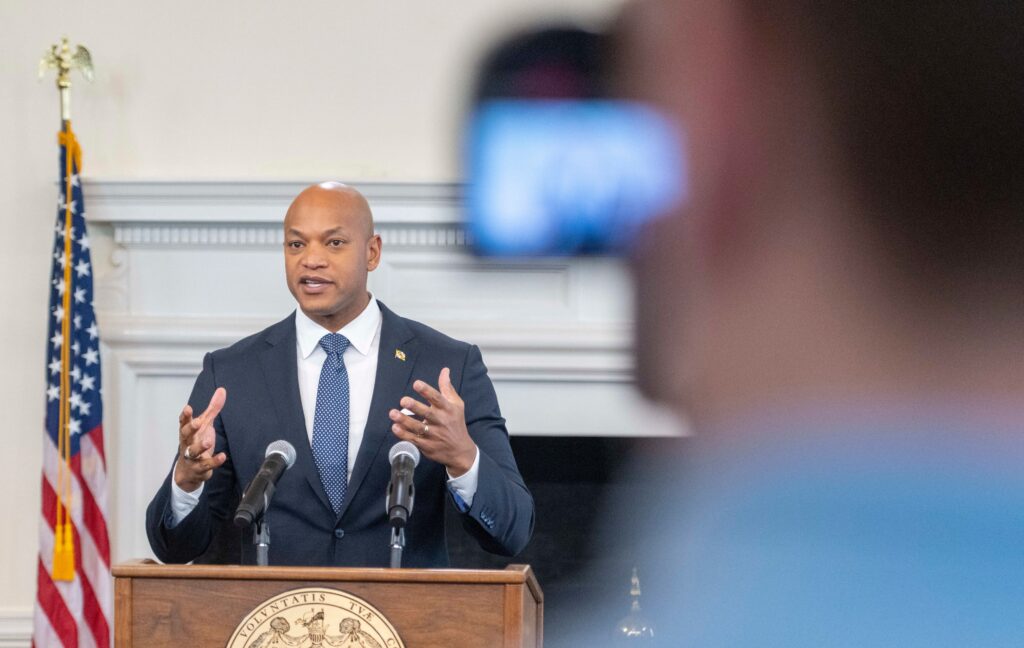
After more than a decade of lobbying by immigrant rights organizers, Maryland Gov. Wes Moore (D) signed into law Tuesday emergency legislation that bans local law enforcement agencies from formally facilitating federal immigration arrests.
The ban forces nine sheriff’s offices in the state to immediately sever agreements with U.S. Immigration and Customs Enforcement — including the Frederick County Sheriff’s Office, which had one of the nation’s longest-running 287(g) agreements with the federal agency. The agency uses the agreements to help ICE agents take into custody people they allege are in the country illegally.
Just before signing the bill, Moore called ICE an “unaccountable agency with seemingly unlimited resources.”
“We make a very clear statement to our community that we believe in your safety,” Moore said. “We believe in making sure that you are going to be safe from violent offenders, and also we believe in making sure that you are safe from unaccountable agents as well.”
Maryland’s ban comes two weeks after New Mexico Gov. Michelle Lujan Grisham (D) signed a similar measure in that state, part of a growing wave of Democratic-led states and cities that are attempting to use local legislation and regulations to curtail the Trump administration’s ramped-up immigration enforcement efforts nationwide.
At least eight other states — Washington, Illinois, California, Oregon, New Jersey, Maine, Delaware and Connecticut — have already either prohibited or set restrictions on 287(g) partnerships involving local police and sheriff’s offices. Virginia Gov. Abigail Spanberger (D) recently ordered state law enforcement agencies to dissolve any partnership agreements with federal immigration enforcement, and state lawmakers there and in New York are also weighing 287(g) bans.
Across the country, the Department of Homeland Security has rapidly expanded its use of the partnerships since President Donald Trump returned to the White House in January 2025. At the time of his inauguration, the agency had 135 agreements; it now has more than 1,300, according to ICE data.
The Trump administration has argued that such partnerships with local law enforcement foster collaboration and lessen the need for arrests in American streets — the kinds of targeted enforcement initiatives that have spurred mass protests in the nation’s capital, Los Angeles and Minneapolis.
Opponents of the agreements have argued in Maryland and elsewhere that the expansion of 287(g) partnerships has not become an alternative to street enforcement, but instead a force multiplier for ICE as its budget and recruitment efforts grow.
“It’s about ICE building an army of law enforcement all over the country who are answering to the president, not your local city council,” Naureen Shah, director of immigration policy at the American Civil Liberties Union, said in an interview after Maryland’s legislature passed the legislation earlier this month.
Maryland’s ban, which Moore signed Tuesday, applies to all four types of ICE partnerships: the Task Force Model, the Tribal Task Force Model, the Jail Enforcement Model and the Warrant Service Officer program.
Moore, the lone Black governor of a U.S. state and son of an immigrant mother, has been in the national spotlight on immigration policy since Kilmar Abrego García, a Maryland resident, was detained by ICE and mistakenly deported to his home country of El Salvador last year.
Immigrant rights advocates had amassed a groundswell of support for a 287(g) ban during last year’s legislative session in Maryland, which took place during the early months of Trump’s second term. But Moore did not flex his political power on the issue, and while the Maryland House of Delegates passed a 287(g) ban, the Senate chamber under the leadership of President Bill Ferguson (D-Baltimore City) declined to act.
This year, though, Maryland Democrats from both chambers signaled soon after the General Assembly convened for a new session that they would push through a ban early — rushing it through as a piece of emergency legislation in the weeks after federal personnel shot and killed two protesters in Minneapolis.
“This bill is so important because Maryland is speaking,” House Speaker Joseline A. Peña-Melnyk (D-Prince George’s), an immigrant from the Dominican Republic who co-sponsored last year’s 287(g) ban, said just before the bill signing Tuesday. “We are against racial profiling and we are going to be unapologetic about the values we stand for, and that is really important, regardless of what the federal government is doing.”
The post Maryland bans partnerships with ICE, citing ‘unaccountable agents’ appeared first on Washington Post.