To the Editor:
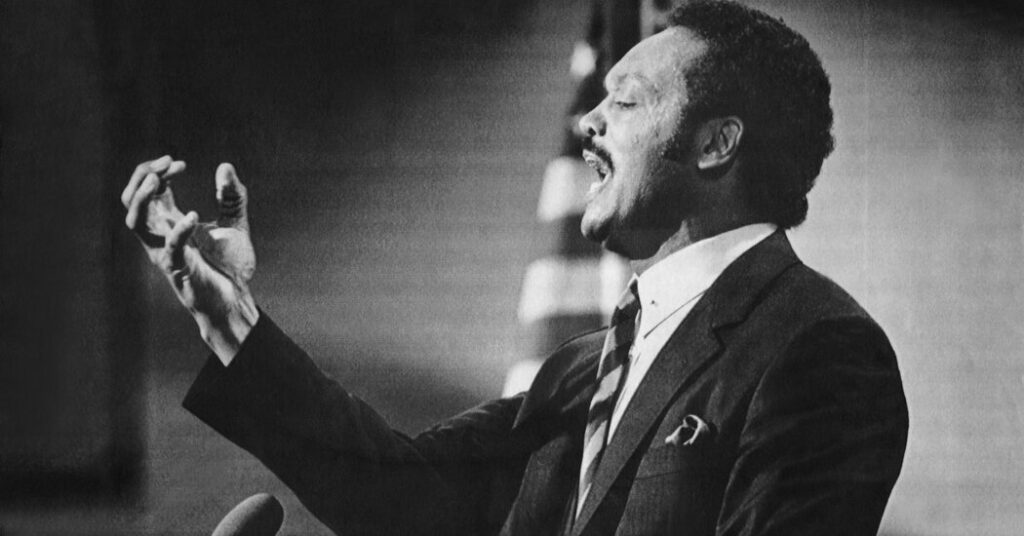
Re “Jesse Jackson, Charismatic Champion of Civil Rights, Dies at 84” (obituary, nytimes.com, Feb. 17):
In 1984, the Democratic Party ceded the playing field to the Republican far right when it shut out Jesse Jackson’s message of economic and social justice and peace with our neighbors in favor of its neoliberal agenda.
As the National Rainbow coordinator during Mr. Jackson’s presidential primary run, I saw how his message resonated with white working-class voters when he demonstrated that their interests for a better life were no different from those of their Black and brown neighbors.
When white farmers were losing their land to agribusiness, he delivered food from their farms to poor people in the inner cities of the country, cementing a relationship between rural and urban America. When he showed that our tax dollars were going to build weapons instead of feeding and housing people, those who had never voted or been involved in politics before began volunteering their time.
The political elites feared this kind of message and thus sought to portray him at first as a charlatan, then as a spoiler and finally as a candidate who spoke only for African Americans.
Walter Mondale, the candidate of the Democratic Party elites, lost the 1984 race to Ronald Reagan. We have been living with the consequences of this major failure of imagination ever since.
Sheila D. Collins New Rochelle, N.Y. The writer is the author of “The Rainbow Challenge: The Jackson Campaign and the Future of U.S. Politics.”
To the Editor:
Jesse Jackson’s life was a poignant reflection on the nature of the American experiment. The system that Mr. Jackson challenged was the same one that provided him with the platform to transform it.
Despite being the subject of government surveillance and systemic pushback, Mr. Jackson organized, televised his message and eventually ran for president. The fact that he was able to do so stands in stark contrast to authoritarian regimes.
In a dictatorial society, a leader who organizes the marginalized among them is often viewed as a threat to the state’s survival. The American framework — despite its flaws — contains the mechanisms for its own evolution.
N.G. Krishnan Bangalore, India
Power Should Serve the Public
To the Editor:
Thomas B. Edsall’s exploration of the addiction to power in “Trump Unmasked” (Opinion guest essay, nytimes.com, Jan. 13) touches a nerve because it explains what so many Americans feel but struggle to articulate: the sense that public office has drifted away from public service.
Power, once understood as a temporary trust, is now too often treated as a personal entitlement. That shift is not merely political; it is also a breach of the moral compact that holds a democracy together.
I spent my life in uniform and in public service believing that the American experiment endures only when those entrusted with authority remember that it does not belong to them. It belongs to the people, and ultimately to the generations who will inherit the consequences of our choices.
My great-grandson will grow up in a country shaped by decisions made today — whether we restore constitutional norms; whether we invest in the resilient, electrified infrastructure that will secure our future; whether we elevate leaders who understand that character is not ornamental but foundational.
Mr. Edsall is right to call out the danger. But the deeper truth is that this addiction to power survives only when citizens grow numb to it. Democracies do not collapse in a single dramatic moment; they erode when we stop insisting that leadership be anchored in humility, duty and the common good.
We owe the next generation something better than that. The founders expected courage from those who govern, but they expected no less from those who are governed. It is time we meet that standard again.
James Jordan Falls Church, Va.
Repeal Gravity, Too
To the Editor:
I request that President Trump, in addition to erasing the scientific finding that climate change endangers the environment, also erase the laws of gravity. They interfere with my freedom of movement. Thank you for your attention to this matter.
Ellen R. Goldman Brooklyn
The post Jesse Jackson’s Life and Legacy appeared first on New York Times.