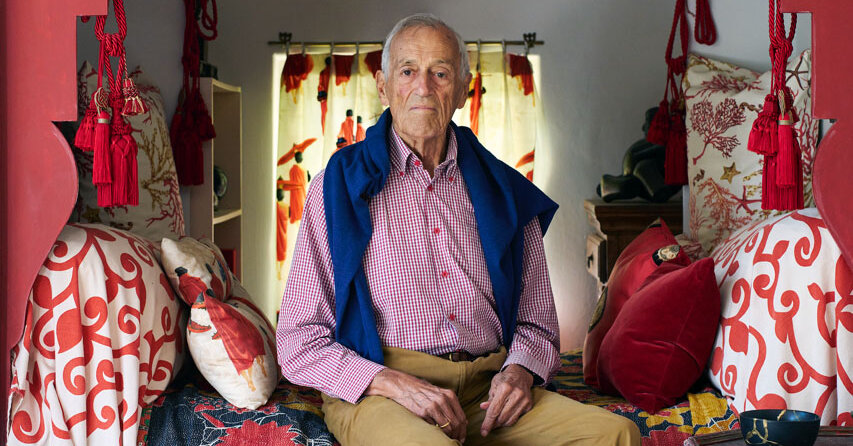
Frederick Vreeland, a debonair Cold War diplomat and spy who was a son of Diana Vreeland, the hortatory, theatrical and much-mythologized fashion editor, whose influence proved to be a valuable asset in his chosen profession, died on Jan. 26 at his home in Rome. He was 98.
His death was confirmed by his son Alexander.
Mr. Vreeland, known as Freck, grew up privileged but not exactly cosseted according to the rituals of the times and his particular demographic. He was educated at boarding school and Yale University after being raised mostly by nannies, including an Englishwoman who deflected his whining by saying, “If you’re happy as a child, you can’t be a happy as an adult.”
His mother, who became the fashion editor of Harper’s Bazaar when he was 10, urged him to be original. “Be at the top of your class,” she would say with a flourish of her cigarette holder, he recalled in his self-published memoir, “Mr. Ambassador” (2023). “Or at the bottom. Never in the middle.”
She did not, as she famously suggested in one of her “Why Don’t You …?” columns for Harper’s Bazaar, rinse his hair when he was a child “in dead champagne to keep it gold, as they do in France.” But he and his older brother each had a map of the world in his bedroom, following another of their mother’s dictums: “Why Don’t You … paint a map of the world on all four walls of your boys’ nursery so they won’t grow up with a provincial point of view?”
It seemed to work.
While still at Yale, Mr. Vreeland was recruited by the Central Intelligence Agency, which had been formed after World War II as a successor to the Office of Strategic Services, the wartime spy agency better known as the OSS.
Yale would become a go-to source for the State Department and the Foreign Service. “Male, pale and Yale” was the longtime descriptor for their members.
Mr. Vreeland’s double life began in 1952, when he was stationed in Geneva, followed by rougher, grimmer postings in Germany — in Berlin and then Bonn. It was all very John le Carré, although Mr. Vreeland in no way resembled Mr. le Carré’s rumpled hero, George Smiley. He was charming, handsome and a snappy dresser.
His cover roles were various positions connected to the U.S. Mission to the United Nations and the reconstruction of Europe after World War II. His covert activities included intelligence gathering and recruitment. (The first involved a lot of wining and dining; the second, cash payments.)
In his memoir, Mr. Vreeland noted that his tradecraft was often not quite up to par. He recalled the time he removed his license plate and screwed on one taken from another car to cover his tracks before meeting a potential recruit, only to discover after the meeting that he had put the license plate on upside down.
He must have been reasonably good at his work, however, because he went on to postings in Paris, Rome and Morocco. The 12,000-square-foot house he built in Marrakech, Morocco, was so labyrinthine, by his design, that guests often got lost. One U.S. Information Agency officer wasn’t missed by the group she was with until they were boarding a plane back to Rabat, the capital city.
Mr. Vreeland’s memoir is peppered with the names of Washington power brokers from the Kennedy era, including the Kennedys themselves and what used to be known as the international jet set.
He played polo with the only brother of King Hassan II of Morocco, on a pony paid for by the C.I.A. He irritated the Aga Khan by building a house on Sardinia that clashed with the architectural style of the development that the royal was building on the island. He let Mick Jagger ride his camel, Jameela.
“Our outreach to the glitterati” was how Gerald Wesley Scott, a career Foreign Service officer, described Mr. Vreeland in an oral history for the State Department.
“He really lived his cover as an aristocratic diplomat,” Tim Weiner, a former national security correspondent for The New York Times and the author of “The Mission: The C.I.A. in the 21st Century,” wrote in an email. “Moving in high society was his métier as a spy. His elegant provenance made him the C.I.A.’s reliable connection to the rich and famous: politicians, financiers, power brokers. Useful people. In Cold War Paris and Rome, a key C.I.A. mission was secret support for right-wing political parties, to help keep them in power, and the secret subversion of leftists, to keep them out. He was well suited for that role.”
Mr. Vreeland had various brushes with history, in his telling, including briefing President John F. Kennedy before his trip to West Berlin in June 1963 and making the suggestion that Mr. Kennedy include the now-famous line “Ich bin ein Berliner” (“I am a Berliner”) in his impassioned speech there. (The president ditched many of the stiffer remarks prepared for him by his speechwriter Ted Sorensen.)
Mr. Vreeland, however, was not alone in making that claim, as Stacey Chandler, an archivist at the John F. Kennedy Presidential Library, wrote in an email. The president’s national security adviser, McGeorge Bundy, said that he was the one who suggested the phrase to Mr. Kennedy on the flight to Berlin. And Robert H. Lochner, a journalist who was the president’s interpreter on the trip, said that Mr. Kennedy came up with it himself and asked how to pronounce it, writing the phrase phonetically on a notecard.
(Finally, for completists, the phrase as Mr. Kennedy spoke it does not have the alternative meaning “I am a jelly doughnut,” as The Times and other papers reported; it is proper vernacular German for what Mr. Kennedy wanted to convey, according to Jürgen Eichhoff, an academic who wrote about the famous phrase in Monatshefte, a journal of German studies, in 1993.)
“Everything about my father is a mystery,” Alexander Vreeland said. “There’s always two sides to each story. There’s the facade story, that he was a career American diplomat, and there’s the back story, which was that he was career C.I.A. In a similar manner, there was always the question of what the other story was in his life, what made him happy. He was hard to pin down.”
Frederick Dalziel Vreeland was born on June 24, 1927, in Danbury, Conn., the second of two sons of Mrs. Vreeland and T. Reed Vreeland, a banker. By the time he was 8, Freck had lived in New York, London, Germany and Switzerland. He graduated from Groton School, a boarding school in Groton, Mass. (it was boys-only at the time), and then from Yale, where he was the features editor of The Yale Daily News.
In addition to his son Alexander, who manages Mrs. Vreeland’s estate, he is survived by another son, Nicholas, a Tibetan Buddhist monk; his wife, Sandra Swollo; four grandchildren; four great-grandchildren; and his brother, Thomas Reed Vreeland Jr. Mr. Vreeland’s first marriage, to Elizabeth Breslauer, a poet, ended in divorce. His second wife, Vanessa (Somers) Vreeland, an artist, died in 2015.
Mr. Vreeland was appointed ambassador to Morocco in 1992, serving under President George H.W. Bush. It wasn’t his first choice. He had hoped for Myanmar, the former Burma, but his nomination was scuttled for several reasons, including what he and others described as a procedural mishap: The résumé presented to the Senate Committee on Foreign Relations listed only his diplomatic service, and when his C.I.A. experience was leaked to the press, it upset the Burmese, who thought the Americans were pulling a fast one by sending a spy.
In his confirmation hearings, Mr. Vreeland had also spoken out about Myanmar’s human rights record, though he was dutifully following American policy talking points on the issue. That also upset the Burmese.
In any case, Mr. Vreeland’s appointment to Morocco was a homecoming for him, and he did a lot more than play the dapper host there, colleagues in the State Department said. He tried to urge King Hassan II toward more democratic behavior, including promoting women’s rights, and was focused on the Middle East peace process. But when Bill Clinton, a Democrat, was elected president in 1992, Mr. Vreeland, a Republican appointee, had to resign, which he did soon after Mr. Clinton took office in 1993.
Soon after, among other endeavors, Mr. Vreeland started a small solar energy company, which supplied electricity to remote Moroccan villages.
Still, when his ambassadorship ended, “the news struck me hard,” he wrote. “I mourned for the work left undone and generally felt very sorry for myself.”
Mr. Vreeland’s son Nicholas, the monk, lifted him out of his funk.
“For the rest of your life, you will be Ambassador Vreeland,” he told his father. “You will always have the title. And you don’t have to go through the work involved in being an ambassador.”
Penelope Green is a Times reporter on the Obituaries desk.
The post Frederick Vreeland, Diplomat and Spy Who Served With Style, Dies at 98 appeared first on New York Times.