Heading into a new round of negotiations in Geneva on Tuesday, Russia ratcheted up the pressure on Ukraine to accept a peace deal on the Kremlin’s terms and launched another massive missile and drone strike targeting Ukraine’s energy and critical infrastructure overnight.
The Kremlin is intent on forcing Kyiv to bow to demands that would undermine Ukrainian President Volodymyr Zelensky’s hold on power, but as Russia’s full-scale invasion of Ukraine nears its four-year anniversary, time no longer appears to be on Moscow’s side.
The Russian economy is faltering, and its forces have sustained more losses than it has been able to replace over the past two months, Western officials say. The Kremlin also sees its window to reach an advantageous deal narrowing because the Trump administration could become distracted as midterm elections near — and possibly weakened by their result.
“It’s clear that if Congress comes under the Democrats’ control, then it will be harder for Trump to make some decisions,” said a Russian academic close to senior Russian diplomats who, like others, spoke on the condition of anonymity to discuss sensitive diplomacy.
But even as Moscow hopes to hand Trump a Ukraine peace deal as a political triumph ahead of the congressional midterms, the Kremlin is not ready to step back from any of its core demands of Ukraine, including that Kyiv surrender territory, analysts and people familiar with the talks said.
“It does seem like they want peace,” one person close to the talks said of the Russians. “But they want peace only on their terms.”
“Everyone is saying how productive the talks are, but in fact, everything has come to a halt,” the person close to the talks said last week. “We have agreed what we have managed to agree, and nothing progresses further.”
Trump administration officials continue to position themselves as mediators even as the Kremlin blames NATO for preventing a quick Russian victory. Kyiv and its European supporters are counting on the United States to help guarantee Ukraine’s postwar security in the event of a deal, but Russia has rejected any presence of Western peacekeepers, and it is unclear how far President Donald Trump is willing to involve the United States to clinch an agreement.
Meanwhile, Russia has dangled the prospect of economic deals and security partnerships in separate talks with the U.S. — hoping to keep Trump and his team on its side, the person close to the negotiations said. “They are just trying to avoid the new sanctions [Lindsay] Graham has been proposing,” one Russian official said.
The reappearance of Vladimir Medinsky, a hard-line aide to President Vladimir Putin who previously has questioned Ukraine’s sovereignty, as head of the Russian delegation for Tuesday’s talks in Geneva is a sign Moscow aims to double down on its toughest political demands for Ukraine, which aim to remove Zelensky from power and undermine the country’s statehood, analysts said.
Russia’s military attacks on Ukraine have been unrelenting, and drone and missile strikes pounded civilian and energy infrastructure overnight in the cities of Odesa, where three people were injured, and Dnipro — part of a campaign to paralyze Ukraine’s energy systems this winter, which has left hundreds of thousands of people living in the cold and dark, often with no water supply.
“Moscow only understands the language of pressure. It will not take diplomacy seriously if it is not backed by strength,” Ukrainian Foreign Minister Andrii Sybiha posted on X.
In January, Russia launched 91 ballistic missiles at Ukraine, the highest monthly number since the start of the full-scale invasion, Ukraine’s Defense Ministry said. Previously, Zelensky said that in the same month, Russia launched 6,000 attack drones, about 5,500 guided aerial bombs and 158 missiles of various types — most targeting energy facilities and other critical infrastructure.
Trump appeared to up the pressure further Monday night, telling reporters on Air Force One that “Ukraine better come to the table, fast.”
The American delegation at the two-day Geneva talks includes Steve Witkoff, the president’s envoy; Jared Kushner, Trump’s son-in-law; and Daniel Driscoll, the Army secretary, while Russia is also sending Igor Kostyukov, the military intelligence chief who led talks in Abu Dhabi last week. The Ukrainian delegation is led by Kyrylo Budanov, the former military intelligence leader who now serves as Zelensky’s chief of staff.
Given Moscow’s unmoving demands, analysts said, chances of a breakthrough in Geneva are low.
“It’s possible there could be progress on some questions,” said Tatiana Stanovaya, a senior fellow at the Carnegie Russia Eurasia Center. “But a bloc of principle subjects will remain, including political ones and the issue of security guarantees, on which there won’t be any compromises by Ukraine, and Russia won’t back down from its demands.”
European leaders increasingly fear that Russia is seeking to use the peace talks as a means to achieve gains it has been unable to make on the battlefield, while pressure is mounting on Russia’s economy.
“The greatest threat Russia presents right now is that it gains more at the negotiation table than it has achieved on the battlefield,” Kaja Kallas, the European Union’s foreign policy chief, told participants at the Munich Security Conference this weekend, noting that Russia had made minimal advances at a cost of 1.2 million killed and wounded troops.
Russia’s political demands include a ban on Ukrainian nationalism and a guarantee Ukraine won’t join NATO. “There is a very long list. And the focus on this explains why Putin is sending Medinsky,” Stanovaya said.
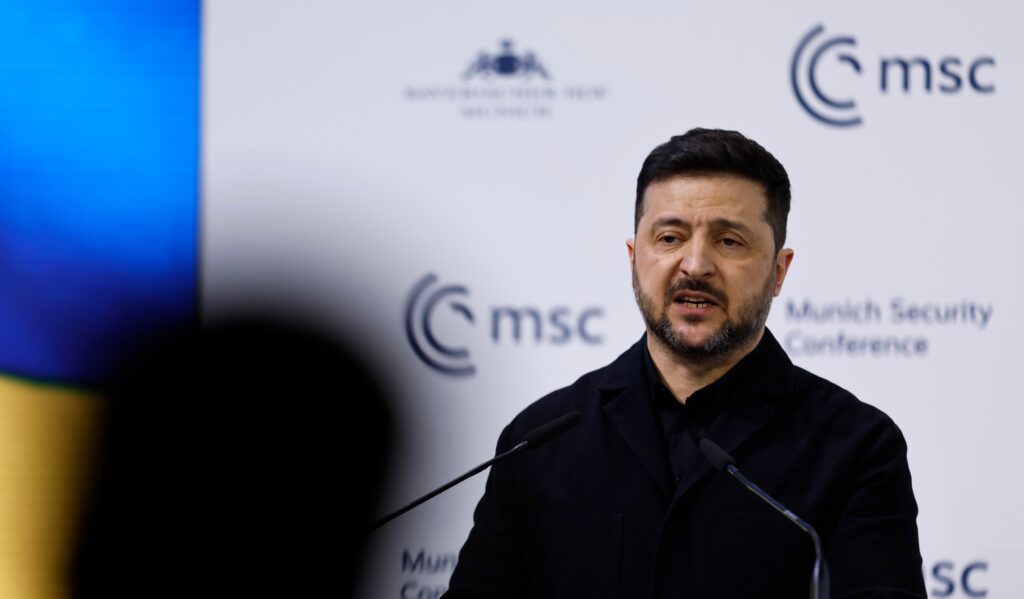
Ukraine has sought to demonstrate to the Trump administration that it is not the obstacle to a deal as pressure grows to reach an agreement. Zelensky indicated at the Munich Security Conference that he was ready to bow to Trump administration pressure that Ukraine hold presidential elections but said a two-month ceasefire is required first, to ensure a vote could be held securely.
Ukrainian law prohibits a vote during wartime, and most democracy and election experts say it would be extremely difficult to meet international standards while Russia occupies large swaths of Ukrainian territory, millions of war refugees are living abroad, millions more are displaced internally and hundreds of thousands of soldiers are deployed to the front.
Zelensky’s administration has even indicated it could agree to withdraw troops from the heavily fortified Donbas area in eastern Ukraine that Moscow wants Kyiv to surrender and Russia has failed to conquer in four years of conflict. But Kyiv has indicated it would agree to a pullback only if the United States first provides legally watertight security guarantees and only if the region becomes a demilitarized zone.
Analysts and some European officials have warned that Russia would seek to take advantage of potentially lax provisions for security guarantees under the Trump administration’s watch and march back in to grab more Ukrainian territory.
“Putin the tactician could see value in signing up to that arrangement,” said Eric Ciaramella, a Russia expert who worked on the National Security Council during Trump’s first term and is now a senior fellow at the Carnegie Endowment for International Peace. “It would be virtually impossible to prevent him from sending Russian forces into the zone once Ukraine vacated it — potentially without firing a shot.”
Zelensky warned against any such arrangements Monday, posting on X that it is “a big mistake to allow the aggressor to take something,” which would probably result in Putin rebuilding his army and then renewing his attack.
At a news conference in Munich, Zelensky told reporters that Ukraine needed a minimum 20-year agreement on security guarantees, specifying the assistance the United States would provide to any European forces.
Ukrainian officials have warned that ceding the fortified Donbas region, including its “fortress cities” of Kramatorsk and Sloviansk, would leave Ukraine open to further Russian attacks.
“If we give up Donbas, then maybe for half a year or a year, there could be some respite,” one Ukrainian security official said, speaking on the condition of anonymity to discuss a sensitive matter. “But in this time, Russia will rearm and then there will be a new escalation. And it will be very difficult for us to defend ourselves.”
Analysts said Russia and Ukraine remained far apart on the issue of security guarantees.
“The question of territory is far from the main one,” Stanovaya said. “Each side understands security guarantees their own way. Russia wants radical cuts to the Ukrainian armed forces, an annulment to all agreements on Ukraine’s military partnerships with NATO countries and no deployment of forces from NATO countries,” she said. “There should be no military infrastructure or long-range weapons. This is a principle issue for Russia, and as we know, it’s not likely Kyiv will agree.”
Analysts said Russia could pounce on proposed presidential elections as an opportunity to destabilize Ukraine internally.
Russia’s deputy foreign minister, Mikhail Galuzin, said Sunday that Russia could consider placing Ukraine under temporary external management under United Nations auspices if any peace deal was reached in order for “democratic elections” to be held.
Stanovaya said this proposal was a sign Russia did not support elections in Ukraine unless it could control them and orchestrate Zelensky’s removal. “The question is not about elections themselves, but regime change,” she said.
At the same time, Russia has been pressing constantly during the talks to divert the U.S. delegation to negotiations on other bilateral matters. As soon as talks between Russia, the U.S. and Ukraine ended last week in Abu Dhabi, the Russian delegation sought to engage the Americans on bilateral negotiations over a new nuclear arms pact, the person close to the talks said, after the New START accord expired on Feb. 5.
“Russia will try to expand the specter of questions it can discuss with the U.S. to the maximum,” the Russian academic said, including offers of Russian mediation over Iran “to show that even though Ukraine is very important, relations should not be limited to Ukraine.”
David L. Stern in Kyiv contributed to this report.
The post Russia presses demands, and faces pressure, as Ukraine talks move to Geneva appeared first on Washington Post.