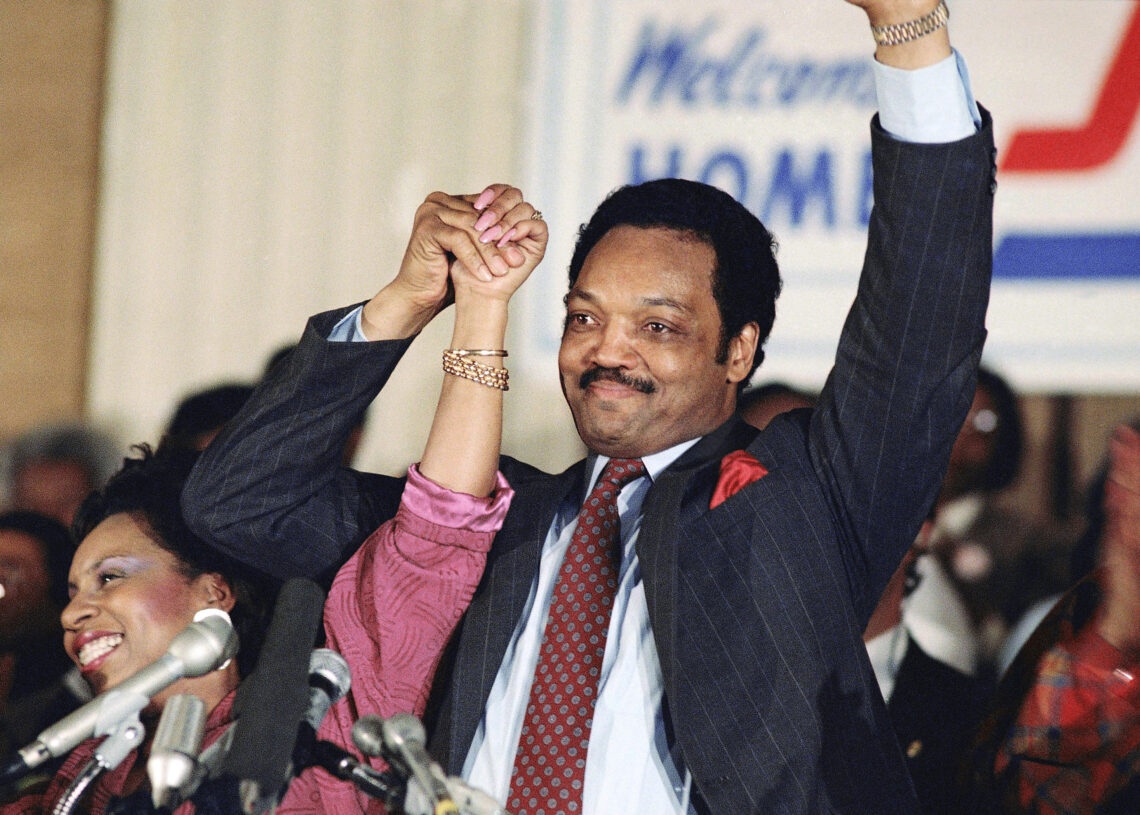
“Keep hope alive!” It was the signature line of Jesse Jackson’s second run for president. Euphoric crowds, numbering in the thousands, would chant it along with him.
I was a reporter for the Los Angeles Times, and that 1988 presidential campaign was the first I had ever covered. Those months revealed to me many things about America. Not all were as uplifting as the optimistic spirit that propelled the civil rights leader to a second-place finish against the ultimate Democratic nominee, Massachusetts Gov. Michael Dukakis.
One day in particular stands out in my memory for what I saw of undisguised racism, and for what I heard from Jackson himself about the less visible barriers he believed had been put in his way by some in his own party.
It was May 9. The campaign had begun before dawn, as many days did with Jackson’s operation. We were in poverty-stricken Arnett, West Virginia, and a few curious neighbors had gathered outside the home of an unemployed White coal miner, where Jackson had spent the night. When one of them was asked how he planned to cast his ballot in that week’s Democratic primary, he retorted: “I ain’t voting for no damn n—-r.”
The previous evening, the arrival of Jackson’s motorcade had been greeted with similar epithets, and someone in the crowd of about 200 appeared threatening enough that the Secret Service vetoed the candidate making his usual round of shaking hands.
Jackson, who died Tuesday at 84, was usually too much on the move to indulge in introspection and reflection. But later that day, in a conversation with a few bleary-eyed reporters aboard his campaign bus, he did.
In his view, Jackson told us, the most significant hurdles that a Black candidate had to overcome were not what we had seen in West Virginia. “Some people are very raw, very direct, [saying] ‘I would not vote for a n—-r.’ Other people are able to use sand to cover up their mess,” he said.
Jackson was a spellbinder on the stump, but well to the left of most of the country. And he had never shaken his reputation as a self-promoter — or, as then-Vice President George H.W. Bush once put it, a “hustler from Chicago.”
His candidacy had, from the outset, been “running against a headwind of culture and media and pundits,” Jackson said. “The party itself is using its strength to get the candidate it thinks can win.”
He faulted the news media and the polls for constantly raising the question of whether Americans would vote for a Black man: “If I’m asked, ‘Why run?,’ the people are asked, ‘Why vote?’”
Jackson was especially bitter about his treatment at the hands of the Democrats’ rising centrist faction, and particularly the Democratic Leadership Council, an organization which had backed Sen. Al Gore Jr. (Tennessee) in 1988’s Super Tuesday round of primaries. The new primary calendar had been designed and set up that year to give an advantage to a moderate candidate.
“The DLC crowd put all their eggs in Gore’s basket,” Jackson said. “Their basic line was a vote for anybody but Gore is a vote for Jackson, which was real subtle stuff.” And as things turned out, Jackson held his own in the Super Tuesday states against both Dukakis and Gore.
In June, Philadelphia Inquirer reporter Doreen Carvajal wrote a front-page story revealing that “Pontiac,” the code name that had been given Jackson by the Secret Service, was also the punch line to an old racist joke. The Secret Service said it was a coincidence, and that the code name had been picked from a random list. Those around Jackson did not buy the explanation.
In a Democratic field that had once numbered seven contenders, Jackson — whose 1988 campaign was better organized than his initial effort four years earlier — was the only one other than Dukakis to last until the final round of primaries. Though Jackson was a distant second in the delegate count, he received 7 million votes and won seven state primaries and four caucuses.
“The message has already won. It was so rich that others borrowed from it,” Jackson said in what was not quite a concession speech as the last ballots were being counted in California. “Now my opponents find it necessary to imitate Jackson action — to visit schools and crack houses. Their imitation only verifies my message and method.”
His speech at that summer’s Democratic National Convention in Atlanta electrified the delegates. Yet there would remain those, including some in his own party, who minimized what Jackson and his Rainbow Coalition had achieved.
Two decades later, when Sen. Barack Obama (Illinois) won the hotly contested South Carolina Democratic primary against his fellow senator, Hillary Clinton, her husband, Bill Clinton, shrugged off the significance of Obama’s double-digit victory. “Jesse Jackson won South Carolina twice, in ’84 and ’88,” the former president said.
It was “an appalling postmortem,” Obama strategist David Axelrod wrote in his memoir. “His point was abundantly clear. No big deal. The black guy won the black primary.”
When Obama went on to win the presidency, Jackson was in the crowd at the victory rally in Chicago’s Grant Park, American flag in hand and his face wet with tears.
“He had been there with Dr. King the night he was slain and had, himself, run two symbolic races for the White House,” Axelrod recalled. “Now the image of the new First Family — a splendid, black family — introducing themselves to the nation, had the reverend genuinely overcome.”
Jackson was onstage at the 2024 Democratic convention in Chicago, the city that had been his power base, to celebrate the first-ever nomination by a major party of a Black woman. He was in a wheelchair, and disease by then had taken away the greatest of his powers, the ability to speak. But, as my colleague David Maraniss wrote, “his legacy was everywhere, if underappreciated.”
The post I covered Jesse Jackson’s 1988 campaign. The racism he faced was undisguised. appeared first on Washington Post.