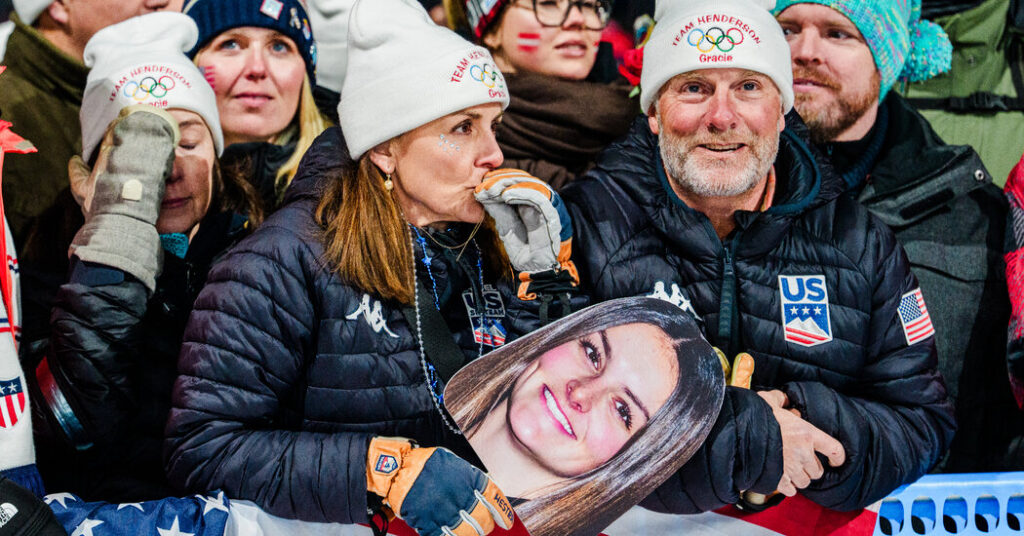
Peering up at the Italian Alps, their daughter seconds away from rocketing down a snowy hill and flipping in midair, Christine and Mark Henderson clutched their St. Christopher medals, talismans of safety for adventurers.
“I give it a little kiss and then send a prayer up to the mountaintop every time,” said Ms. Henderson, who traveled from New Hampshire to Livigno, Italy, to watch her daughter Grace, 24, compete in the freestyle skiing slopestyle and big air events at the Winter Games.
Her invocation was not for an Olympic medal, but for Grace not to get hurt. Over the past few years, her daughter has suffered two knee injuries, broken both heel bones, snapped her collarbone and fractured her back twice.
The prayer worked. Grace didn’t make the finals, but she finished the big air qualifier Saturday unscathed.
Most parents know the butterflies that come with watching a child perform in a piano recital or play a soccer game. But they don’t know the worry that hangs over parents of elite Olympic athletes who have chosen sports so extreme that devastating injury is an ever-present possibility.
There is immense pride, of course. And the confidence of knowing that their children are experts at what they do.
But in speaking with nearly two dozen parents who traveled to Italy to watch their children compete in the Milan-Cortina Games, almost all reported feeling serious nerves — if not downright terror.
“Sometimes my legs feel so weak, they can barely hold me up,” Jihyo Choi, the mother of the 17-year-old South Korean snowboarder Gaon Choi, said in an interview last week before her daughter took gold in the women’s halfpipe. “I pray continuously.”
Hanne Vestergaard of Denmark, has twice the reason to worry: Her daughter, Nanna Johansen, 19, and son, Rasmus Vestergaard Johansen, 23, are the first siblings to compete at the Olympics in skeleton, a sport in which athletes slide headfirst down an ice track at upward of 80 miles per hour.
Ms. Vestergaard said she struggles to eat before the races. Though she attends the competitions, she often doesn’t watch, closing her eyes behind dark sunglasses or turning her back as her kids whoosh past.
As Nanna competed in her first run on Friday on the mile-long track in Cortina d’Ampezzo, Ms. Vestergaard positioned herself in the stands so that a pillar blocked her view of the video screen showing the race.
For her daughter’s second race, she stood at a distance on a snow bank behind a crowd of taller people.
“I’ll be there, of course,” she said beforehand. “Then it seems like I watched it, but I didn’t.”
Despite her nerves, she credited the unusual sport with pulling her daughter out of severe anxiety, which was so acute years ago that ambulances had to be called several times to take her to the hospital. Those moments were scarier than any skeleton race, Ms. Vestergaard said.
Fear is a natural part of parenthood, said Dr. Paul McCarthy, a psychologist in Glasgow who works with Olympic-level athletes and their families. With low-risk activities, the worries tend to be performance-related. For higher-risk sports, it’s about injury.
“They are not in direct control, but they can see the potential injury,” he said. “Our brain is good at catastrophizing and going to the very nth degree of danger.”
He advises parents to watch their children’s training sessions and study the sport’s safety measures. During competition, emotion-regulating techniques, like breathing exercises, can help.
Debbie Curtis had a different idea for better understanding skeleton, the sport in which her daughter, Kelly Curtis, 37, of New Jersey, competes. She tried it herself. Well, an easier stretch of a track in Lake Placid, N.Y., that is open to newbies.
It did not work out so well.
“When I went into a curve, all I could see was ice, and I thought I was going to die,” recalled the elder Ms. Curtis, a Miami resident. “I was hanging on for dear life.” Her husband, John Curtis, remembered her screaming.
When she finished, she decided she was never doing that again.
Mimi Wacholder of New York has so much adrenaline before her son, the 20-year-old ski jumper Tate Frantz, competes that she can’t stand still. She dances to music if it’s playing at the venue, walks laps or steps away from the crowd.
One thing she doesn’t do? Approach her son.
“It’s kind of like showing up at their office,” she said.
Rituals and good-luck charms help many parents. Chantal and Stephan Gremaud, a Swiss couple whose daughter Mathilde Gremaud, 26, competes in skiing, may have one the most elaborate pre-race routines.
Ms. Gremaud avoids coffee for two days before her daughter competes, trying to calm her nerves. She carries to the course three small clay angels that represent relatives who have died and who she hopes are watching over her daughter. Mr. Gremaud lights a candle at church and wears the same outfit for each race.
“Everything is the same except my underwear,” he said.
Last week, their daughter captured the gold in slopestyle. But on Monday, during a practice run before the big air finals, she came up short on a landing and crashed. She bruised her hip and neck and spent the night in the hospital for observation, said her agent, Daniela Bauer.
Gaon Choi’s father wears the same underwear each day of competition, her mother disclosed. Peter Gasser, the father of Anna Gasser, a 34-year-old snowboarder from Austria, carries a blue backpack from the 2018 Winter Games, where she won her first gold medal. Sean Florian, the father of the American skeleton racer Austin Florian, 31, of Connecticut, wears his son’s ratty blue T-shirt to every event he’s in.
When injuries happen, it’s hard to remain composed. Mr. Florian recalls watching a race on his laptop while he was in a meeting at work. As his son slid into the last curve, he flew off the track and hit the roof. Mr. Florian jumped up with a gasp and told his co-workers that he had to leave. A destroyed helmet and seven stitches later, his son was fine.
Athletes who chose riskier sports sometimes anticipate that their parents won’t be happy. The American skeleton racer Daniel Barefoot, 35, of Pennsylvania, kept his passion for hurtling down ice chutes from his parents for years, swearing his brother, David, to secrecy.
One day, he confessed.
“I thought, ‘That crazy S.O.B.,’” his father, Barry Barefoot, recalled at the track in Cortina, his family clad head to toe in red, white and blue for a race last week.
His wife, Becky, prays all day for their son’s safety. Their daughter, Erin, closes her eyes during every race.
Scott Colby, of Steamboat Springs, Colo., may have been one of calmer parents at the Olympics. Yes, his son Jason, 19, jumped off the equivalent of a 40-story building on skis. But Mr. Colby, a former competitive ski jumper himself, had faith that his son would do it safely.
He tells parents who are new to such a jaw-dropping sport to do something seemingly counterintuitive: Climb to the top of the giant hill, look down and marvel at what their children have proven they can do.
“Scare yourself, but realize your kid’s not too worried about it. Your kid is fine,” he said. “Go be proud.”
Heather Knight is a reporter in San Francisco, leading The Times’s coverage of the Bay Area and Northern California.
The post Look, Ma! Or Maybe Don’t. Parents of Some Olympians Face Extreme Fear. appeared first on New York Times.