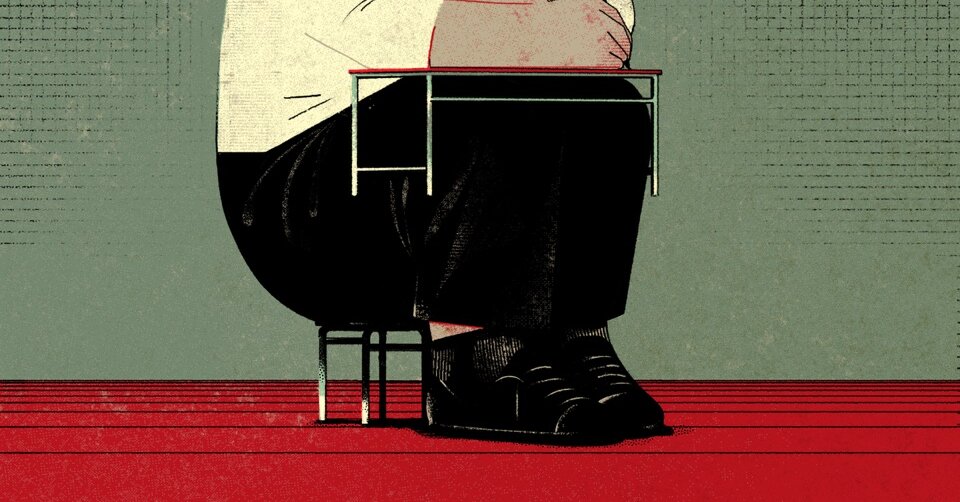
America is in a decade-long education depression. Barely a third of students are proficient in reading or math across most grades in recent testing, achievement gaps are widening fast, and too many college freshmen are arriving on campus unable to read a full book or do middle-school-level math. Chronic absenteeism has surged after the pandemic; students are disengaged. Educators are burning out, and teachers are increasingly hard to recruit and retain. Costs are rising. Trust in public schools is at a record low, and families with the means to leave increasingly do, leaving districts with half-empty buildings.
This is what an institutional breaking point looks like. In these periods of deep political and social change, or interregnums, reforms that were once considered unthinkable become not only possible but also necessary. This moment of crisis in K-12 education is an opportunity to reimagine it from the ground up. We need nothing less than a new educational operating system — one that channels public funding through students and families directly, rather than through centralized district bureaucracies.
For decades, reformers have tried to fix the education system from within, pushing for higher standards, better data, stronger accountability and more equitable funding. Some gains have been made, but efforts to improve the system have repeatedly ground to a halt, blocked by bureaucratic inertia and political gridlock.
At the heart of this resistance is a fundamental misalignment of incentives. Schools are largely funded according to their ZIP code, not their success or failure. They often don’t need to deliver strong outcomes to maintain enrollment or secure their budgets. Without structural incentives to improve, even well-meaning systems stagnate, as bureaucracies optimize for self-preservation rather than delivering results. To transform our education system, we need to change the architecture of the system itself, not just patch the policies and programs that sit on top of it.
We’ve seen in other sectors what’s possible when consumers, not top-down managers, are put in the driver’s seat. When Apple introduced the iPhone, it wasn’t the phone’s sleek design that changed everything. The true revolution came from its open operating system that invited third parties to create apps to meet nearly every imaginable need. The result was an explosion of bottom-up innovation: innumerable independent creators responding directly to users in ways Apple alone never could.
Education needs a similar shift. Instead of a top-down model that delivers a one-size-fits-all experience, we need an open, dynamic system where educators have the freedom to design new schools — and parents have the power to choose among them. When families have more agency, schools are compelled to adapt and improve to earn their trust, and a more responsive system follows.
This is the core of a new educational operating system: public funding flowing to numerous types of schools. In this model, government still plays a critical role. It sets guardrails to ensure access and standards and provides the funding. Critically, it no longer controls how schooling is delivered. Instead, the money follows the children themselves to different learning environments, whether public or private, that families believe best meet their needs. This vision is not theoretical. Most of our international peers fund students and diverse types of school, not large public systems. States across the country have begun to follow suit.
Since the pandemic, education savings accounts and tax credit programs have expanded, allowing education dollars to follow children to the schools families choose. Families now have access to learning experiences that are hard to find under the traditional system: blended artificial intelligence and Montessori methods in Arizona microschools, a focus on Black culture in Atlanta and personalized tutoring in New Hampshire. Public schools, charter schools, private schools and hybrid models should all be on the table.
This is the same logic we apply to Pell Grants, housing vouchers, Affordable Care Act plans and many child care subsidies that allow individuals to choose between a variety of public and private providers. K-12 education should be no different.
Private schools — and school choice — are not a panacea. When oversight is lacking, quality suffers. But research by the scholar Ashley Rogers Berner shows that when countries fund many types of schools while holding them to common academic standards, students thrive both academically and civically. A growing body of evidence and research, across the United States and abroad, shows that a well-designed school choice program can produce academic and civic results that match or surpass those of traditional schools.
When traditional public schools have to demonstrate value alongside other options, they get better too. Rigorous studies from New York City and beyond show that the presence of charter schools and private scholarship programs provides healthy competitive pressure and sometimes even boosts achievement in nearby district schools.
Pursuing this vision does not mean abandoning public education; rather, we must reimagine it for a new era. Public education is a goal, not a fixed set of institutions. If the aim is an educated public, we should care less about who runs a school and more about whether it helps students thrive. Families should be able to choose any learning environment that meets their needs, so long as it is accessible and accountable.
Both conservatives and progressives would find much to like in this new system. Conservatives would find its promise of freedom from government control appealing, while progressives could focus on how it empowers families and communities. Both can unite around a system designed to meet the needs of every child.
The next generation is stepping into a world of constant, accelerating change. If we want children to thrive, we need an education system as dynamic and future-ready as the world ahead, one that is student-centered, innovation-driven and flexible enough to evolve with the times.
Jorge Elorza is the chief executive of Democrats for Education Reform and the former mayor of Providence, R.I.
The Times is committed to publishing a diversity of letters to the editor. We’d like to hear what you think about this or any of our articles. Here are some tips. And here’s our email: [email protected].
Follow the New York Times Opinion section on Facebook, Instagram, TikTok, Bluesky, WhatsApp and Threads.
The post Democrats, It’s Time to Embrace School Choice appeared first on New York Times.