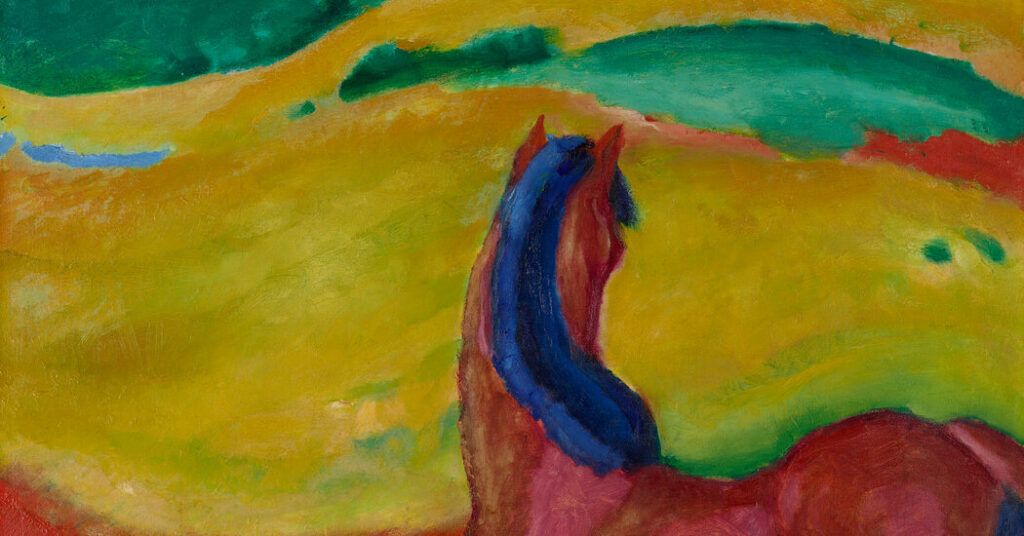
No one disputes that Hugo Simon, a Jewish banker who fled Berlin weeks after the Nazis seized power in 1933, was at that time the rightful owner of a valuable painting by Franz Marc known as “Horse in Landscape.”
Two years later, he shipped the painting to his son-in-law in the south of France. Simon was still identified as the owner in 1938 when the painting showed up on lists of potential works to be shown at upcoming exhibitions.
But what happened to the painting after that remains a mystery and is at the heart of a restitution claim that Simon’s heirs have been pursuing against a German museum for almost two decades.
The Folkwang Museum in Essen has had the painting in its possession since buying it from a German art dealer, Werner Rusche, and a business partner in 1953. The dealer told the museum he had acquired it from a private collector in the south of France that year “with great difficulty and trouble,” but he never identified the seller or provided any particulars about how the collector might have acquired the work.
The Simon heirs argue that, in the absence of a more detailed provenance, the museum should recognize that the painting, with a value estimated at $36 million, was most likely abandoned by their fleeing relatives and stolen. But the Folkwang Museum, concerned by the lack of concrete evidence, is not ready to give it up. It has commissioned three different external research studies, which have proven to be inconclusive.
“The provenance of ‘Horse in Landscape’ by Franz Marc is one of the most intensively researched in the Folkwang Museum’s collection,” said Silke Lenz, a spokeswoman for the City of Essen, which co-owns the collection with the Folkwang Museum Association. “Despite committing major personnel and financial resources, the provenance gap between the years 1937/1938 and 1953 could not be closed.”
The spokeswoman said that the city and museum association are open to “a fair and just solution” if additional research uncovers “enough evidence that the work was lost due to Nazi persecution.”
Museums around the world struggle with how to properly respond in the many cases where art they hold has significant gaps in provenance and was in Europe when the Nazis were persecuting Jews and plundering their possessions. In the case of the Marc, Simon’s heirs argue that the probabilities lean heavily in their favor that the work was looted, and they are upset about the amount of time the museum has deliberated over their claim.
Lawyers for Simon’s granddaughter, Nadya Cardoso Denis, first inquired about the painting in a 2007 letter to the museum. Since her death in 2022, her son, Rafael Cardoso, has pursued the claim and said in an interview that he was disappointed the discussion has dragged on for so long.
“At this rate, the next generation will pass away before they sit down to negotiate,” Cardoso said. “Our approach has been non-confrontational. But if people hide from you, you can’t discuss. They have been stalling us for 18 years. And they continue to put up obstacles, practical and procedural, at every juncture. Enough is enough.”
Friederike von Brühl, the lawyer representing the museum, disagreed.
“On the basis of the facts unearthed so far in the research, I cannot recommend restitution,” she said. “Even assuming a very low burden of proof for victims of Nazi persecution, the provenance of this artwork leaves too many questions unresolved.”
Hugo Simon, who founded his own bank in Berlin in 1911, was a pacifist and socialist who built an art collection that included works by George Grosz, Paul Klee and Edvard Munch. The Marc painting he owned, created in 1910, is one of only about 250 oil paintings the artist is known to have produced. Like some of his best-known works, it shows Marc’s desire to explore how animals perceive the world around them.
Simon’s Berlin villa was a gathering place for artists and intellectuals and he counted Albert Einstein, Thomas Mann and Stefan Zweig among his friends. But his political beliefs and Jewish roots made him an early target for the Nazis after Hitler seized power. Threatened with arrest, he escaped to Paris in 1933; his assets in Germany were confiscated.
When the German army occupied Paris in 1940, Simon and his wife, Gertrud, fled to the south of France. They eventually fled to Portugal, crossing the Pyrenees on foot and using false Czech passports. From there, they boarded a ship to Brazil but Simon was later ordered to leave as an “undesirable” foreigner. Without papers, the couple had no prospects of finding refuge elsewhere, so they went into hiding. In Barbacena, a town north of Rio de Janeiro, Simon made a living as a silkworm farmer. He died in 1950.
Before he fled Germany, Simon had managed to have “Horse in Landscape” and other paintings and sculptures sent to Amsterdam. In 1934, they were sent from there to the Kunsthaus in Zurich, according to research commissioned by the Folkwang. Simon offered them for sale to that museum and another in Basel, his correspondence shows.
When “Horse in Landscape” failed to sell, he asked the Kunsthaus to send it to his son-in-law, the sculptor Wolf Demeter, who was then living in Nice with Simon’s daughter, Ursula. Simon was still identified as its owner in 1938 when the organizers of exhibitions of German 20th -century art listed the painting as one they would possibly include in two shows that took place in London and Paris. But it was not shown in either exhibition and after that all trace of the painting disappeared until it was offered to the Folkwang Museum in 1953 by the German dealer, Rusche. His partner in the painting, Hermann Abels, was a dealer who bought art in occupied France for Hitler’s planned “Führermuseum” in Linz, according to research undertaken for the museum.
Simon’s son-in-law and his daughter also fled Nazi-occupied France, using fake French passports to arrange passage to Brazil to join her parents. Cardoso, an art historian and novelist, said that he assumes the Marc work remained in France and was later looted during the war. In his view, the burden of proof should be on the Folkwang Museum to prove that it has good title for the painting. Rusche, the dealer who could help explain the circumstances of how it resurfaced after the war, died in 1976.
“Until we see documentary proof that the ownership of the painting was transferred from Hugo Simon, we can’t assume that it was,” he said. “Everything else is speculation.”
Peter Gorschlüter, the museum’s director since 2018, said it has conducted internal research on the provenance in addition to the three external studies it has commissioned.
The latest study, by an independent researcher, Isabel von Klitzing, is still underway. She said she hopes to complete it by the end of this year. “We still have plenty of promising leads to follow,” she said.
The heirs’ lawyer, Agnes Peresztegi, filed a formal claim with the Folkwang Museum a year ago. The City of Essen has recently said it is willing to take the case to a new arbitration tribunal for Nazi-looted art claims set up by the German government. The tribunal, which began operating on Dec. 1, has yet to rule on a case.
Peresztegi said she instead plans to pursue justice by filing suit in France. “Hugo Simon lived in France before escaping penniless to South America,” she said. “He was a victim of the Vichy regime and their Nazi allies.”
The post Was This Painting Looted by Nazis? After 19 Years, the Debate Goes On. appeared first on New York Times.