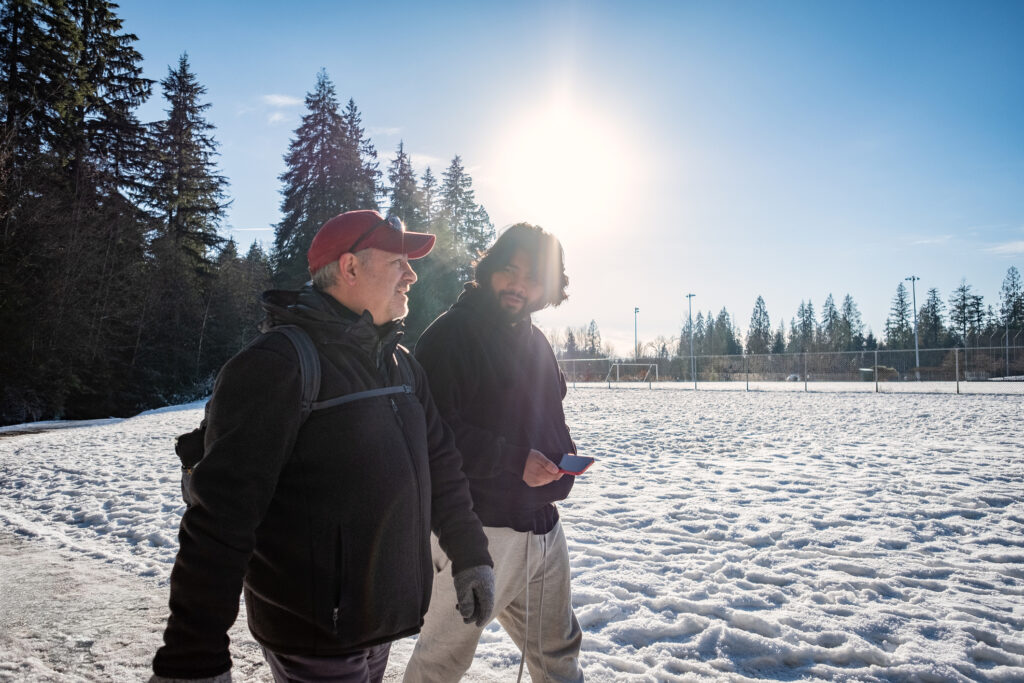
Jennifer Udler has been a practicing therapist for 25 years. A little over a decade ago, she started training for a marathon, running with a group near her home in Montgomery County, Maryland.
“I noticed that people were more comfortable, less inhibited, opening up and talking during our group training runs,” Udler said. “And I started to wonder if there was a way to do a practice where people are moving.”
Udler sees children and adolescents as well as adults, and she suspected that her younger clients especially might feel more comfortable talking while walking on a nature trailrather than sitting in a therapist’s office. She decided to try it with one of her young clients with his mom’s permission.
“We met at a park, and we walked around, and he was a different kid,” Udler said. “He was running around, and he was showing me stuff in nature. And he talked.” She said they made more progress in one session outside than they had in two years meeting in her office.
“That was in the snow in February,” she added. “So I was like, it’s only going to get better.”
Udler started reading more about outdoor therapy, which is also known as walk-and-talkor nature-informed therapy. At that time she couldn’t find any formal training or certification programs, but she did learn that other therapists had tried it and found many of the same benefits she had.
“You’ve got the movement, you’ve got nature, which is extremely grounding and stabilizing for people, and you have the co-regulation, walking side-by-side,” Udler said. For her younger clients or anyone uncomfortable with therapy, it also helped to be walking while talking about difficult topics because they didn’t always have to make eye contact with her.
She wrote her own informed consent for her clients, establishing the additional risks of outdoor therapy and how confidentiality would work in a public park. She started a practice called Positive Strides, specializing in walk-and-talk therapy sessions outdoors in nature.
“As I did the work and saw different types of people with different kinds of mental health issues, I realized how amazing it is,” Udler said.
Trading the couch for the great outdoors
In March of 2020, when many therapists moved their practices online, a smaller number brought their practices outside. The benefits were not felt only by the clients. Nature acts as a sort of “buffer against burnout,” said Heidi Schreiber-Pan, the executive director and founder of the Center for Nature Informed Therapy, where she trains clinicians in how to bring their practices outdoors.
“What we’re hearing from people is that they can see more clients when they have outdoor sessions or nature-informed sessions,” Schreiber-Pan said.
The American Psychological Association put out new guidelines this past fall for how clinicians can implement walk-and-talk therapy into their practice.
The number of therapists working outside is still small. Shreiber-Pan believes that’s in part because therapists don’t realize that nature is all around us. One of the first questions she asks in her trainings is: When you think of nature, what comes to mind?
“They talk about, like, these beautiful national parks or the mountains or the ocean,” Shreiber-Pan said. “And where is your therapy office? Not there.” She said that part of the training is helping practitioners recognize that nature is all around us — even in a city park.
Miki Moskowitz is a clinical psychologist who practices in a primary care setting, which means she sometimes sees a patient only a couple of times.
“We’re trying to make a difference, even in one single session,” she said.
For Moskowitz, practicing outside has improved her own mental health and increased her capacity, but she also sees the immediate impact for her patients.
“What I’ve seen that’s so encouraging is that sometimes just that first session we go for the walk, and patients are, like: ‘Wow, I didn’t know this trail was here. This is so beautiful. This feels so great. This is totally something I can do on my own,’” Moskowitz said. “That is so much more powerful than if we’re sitting in my office, which has no windows, just talking about the idea of going outside.”
The brain benefits of getting outside — even when it’s freezing
When Marc Berman was doing research at the University of Michigan, he helped devise a study to look at the brain benefits of time in nature. Participants did a challenging task testing their memory and attention, and then they were sent on a walk either through downtown Ann Arbor or in the area arboretum. Those who walked in nature showed a 20 percent improvement in their short-term memory, while those who walked in an urban environment did not.
Berman and his colleagues did this experiment in June and January. In the winter, the nature walk was less enjoyable — but just as beneficial.
“That was pretty cool because it suggested that you didn’t have to enjoy the nature walk to get these cognitive benefits. There was something deeper going on,” Berman said.
One explanation for why nature is so good for our brains is called the attention restoration theory. The idea is that our ability to pay attention is finite, and spending time in nature can replenish our capacity. Nature is also “softly fascinating” — it captures our attention without overwhelming our senses.
“I can kind of mind-wander and think about other things when I’m looking at a waterfall,” Berman said. “I can’t really mind-wander or think about other things when I’m in Times Square.”
Berman is now a psychology professor at the University of Chicago and author of the new book “Nature and the Mind: The Science of How Nature Improves Cognitive, Physical, and Social Well-Being.”
How to make the most of time outdoors
Whether or not you are in therapy, your brain can benefit from a dose of nature, especially during the colder months when many of us are inclined to stay indoors. Here are some science-backed tips for how to get the benefits.
- Nature can be found anywhere. You just have to look for it. Research has shown that noticing nature and paying attention to it can have positive effects even in an urban environment. Psychologists recommend noting the bird song you hear on the walk to your car, looking at the leaves on the trees and the clouds in the sky, and just taking a moment to appreciate nature’s beauty — even if it’s just a small plant poking through the sidewalk.
- You don’t have to like it. Nature can be an acquired taste, especially when it’s cold. But you don’t have to be a backpacker or love camping to benefit from time outside. Berman and others have found in their research that we get the brain benefits whether or not we enjoy a walk in the woods.
- Try a mindfulness exercise. Many people struggle to sit still and meditate, despite its benefits — but Moskowitz said that mindfulness practices can come more easily outside. “Just look up at the treetops and notice what you see, notice what you hear,” Moskowitz said. “Look for something that’s moving, and watch the branches sway in the breeze. Look at something close up, or look at something far away. You’re doing a mindfulness practice, and you’re tuning into your senses, and you are focusing your attention, but it’s not hard work.”
- Bring nature inside. If you aren’t able to get outside as often as you would like, you can still get some of the benefits. Put a plant in your office — even a fake one — or look at pictures of beautiful landscapes. Listen to bird songs at your desk. “It’s not as strong as the real thing, but you can get benefits from the simulated nature,” Berman said.
- Embrace the winter. When it’s cold and snowy outside, our impulse is to stay inside. But less time outside can contribute to seasonal depression. Schreiber-Pan recommends following the Scandinavian practices of “friluftsliv” — or “open-air living,” getting outside no matter the weather — and hygge, or embracing the cozy indoors when you come back in. “The happiest people on this planet are the Scandinavians,” Schreiber-Pan said. “They also have the longest winters.”
The post Should your therapy session be outdoors? More therapists are trying it. appeared first on Washington Post.