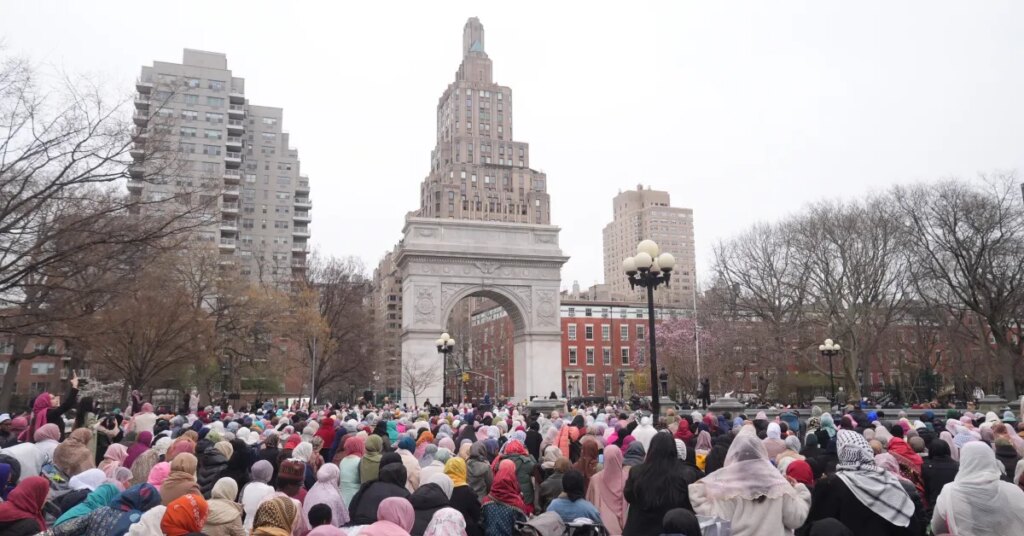
Lubna Turaani has been strategizing for weeks. The 26-year-old nurse and student in Virginia knows that when Daylight Saving Time hits halfway through Ramadan, her carefully constructed routine will need to shift on a dime. So she’s planned ahead, temporarily canceling her gym membership and mapping out exactly what kind of food she’ll eat to break her fast for the first half of the month. It’s the kind of meticulous preparation that millions of American Muslims are undertaking this year.
[time-brightcove not-tgx=”true”]
Ramadan begins around Feb. 17 and runs through mid-March this year. That means when clocks in the U.S. spring forward on March 8, the daily rhythm of fasting will suddenly shift by an hour, disrupting routines and presenting an unusual scenario for families, workers, and students observing the month.
Understanding the Islamic calendar
The Islamic calendar is lunar, meaning it’s based on the cycles of the moon rather than the sun. This differs from the Gregorian calendar—the solar calendar most of the world uses for civil purposes. Imam Farhan Siddiqi, Resident Imam at Dar Al-Hijrah Islamic Center in Virginia, breaks down the math: “The [lunar calendar] translates to about 10 days less than the solar calendar. Because it’s 10 days shorter, the months are going to shift 10 days every single year.”
This means Ramadan moves through every season over a cycle of roughly 33 years—sometimes falling in summer with long, hot days and late sunsets, and other years in winter with shorter, more manageable fasts. In 2026, it lands in late winter and early spring for the Northern Hemisphere, which would normally be a moderate fasting period. But Daylight Saving Time complicates that.
The change is straightforward but significant. In the first half of Ramadan this year, a Muslim in New York City might break their fast with the evening meal—known as iftar—around 5:45 p.m. Each day, sunset time gradually shifts a minute or two later, to 5:54 on March 7. But after Daylight Saving Time takes effect on March 8, that same sunset suddenly happens at 6:55 p.m. on the clock. The fast itself isn’t longer, but everything now happens an hour later: dinner, the pre-dawn meal, evening prayers, family time, and sleep.
During Ramadan, practicing Muslims abstain from all food and water from dawn until sunset— typically 12 to 15 hours depending on location. Days naturally lengthen as spring approaches, so fasts gradually get longer throughout the month. What makes the time change uniquely challenging is the sudden disruption to routines that are also linked to clock time.
Where it’s happening
This disruption affects Muslims across most of the United States and Canada. The impact is most pronounced in:
• The continental U.S. (excluding Arizona and Hawaii, which don’t observe Daylight Saving Time)
• Most of Canada (excluding parts of Saskatchewan, Yukon, and some regions of British Columbia and Quebec)
Parts of Europe that observe summer time won’t endure the shift this year as their clocks change on March 29—after Ramadan ends. Muslims in regions without Daylight Saving Time (including Arizona, Hawaii, most of the Middle East, and large parts of Asia and Africa) won’t experience this mid-Ramadan shift either.
The disruption affects people differently
Imam Abdul-Malik Merchant, program director at Hearts Together Foundation, a Muslim-run nonprofit that promotes scholarship and research, emphasizes that the shift will affect different people in different ways. “For the vast majority of people, I don’t think it’s going to [mean] anything,” he says, noting that by the time the change happens, “you’ve already gone through 20 days, your body’s well accustomed to fasting by then.”
Aseel Hasan, a 29-year-old mother in Cincinnati who is six months pregnant, is approaching the time change with a mixture of pragmatism and determination. Though pregnant and breastfeeding women are exempt from fasting in Islam (along with the sick, disabled, mentally ill, and those who choose not to while traveling), Hasan is attempting to fast during Ramadan this year. “I don’t feel spiritually fully connected if I’m not fasting,” she says.
The shifting schedule is on her mind: “I’m going to have to make sure I’m very hydrated. I’m going to have to make sure I have enough energy to be able to follow my toddler around and have a full-day schedule ahead of me and not feel like I need to break my fast at any given point.”
Turaani juggles an irregular part-time work schedule with full-time school. She plans on handling cooking and cleaning on her off-days, meal prepping, and relying on her husband’s crucial help. “I haven’t had to plan for cooking and cleaning as much as I’ve had to plan for my work and study schedule,” she says. Turaani expects to accustom her body to the extra hour she’ll have to wait after her shifts end at 7 p.m. once Daylight Saving Time takes effect. “ I did account for the time change, and I decided for this Ramadan that I would take a date and soup with me to work.” Her small iftar at work will be followed by a larger meal when she gets back home around 8 p.m.
How to support Muslims this Ramadan
Merchant, of Hearts Together, draws on a running metaphor to explain how he sees the situation: “Maybe you’ve been training all year for a marathon and now there’s hills. Well, that’s a new variable and tests a new type of stamina that you didn’t know you needed. The time change is a new variable that’s going to be a new opportunity to deepen our resolve and our devotion.”
For non-Muslims with family members, coworkers, classmates, or neighbors who observe Ramadan, understanding this shift can help if they seek to be more supportive during the second half of the month. That colleague who seemed fine in early March might suddenly seem more fatigued in the weeks after the time change—not because the fasts are necessarily longer, but because the schedule disruption affects sleep and evening routines. A Muslim friend who was happy to meet for dinner at 6:30 p.m. last week might need to push plans to 7:30 p.m. or later after the time change.
But that push, Turaani suggests, might benefit both sides, if it inspires more thoughtfulness. “ It’s nice to experience every time I break my fast because it’s a good reminder about anything in life,” she says, comparing it to perseverance in times of hardship. “ I recommend for [non-Muslims] to try it as much as they’re able to, just to experience the beauty of it.”
Looking ahead
American Muslims are preparing for this year’s unique circumstances with a mixture of practical planning and spiritual resolve. Some, like Imam Siddiqi, are approaching it matter-of-factly. Others, like Hasan and Turaani, are carefully strategizing around work, childcare, and homemaking while maintaining their spiritual commitments.
What they share is the understanding that Ramadan—like faith itself—is about more than comfort. Many Muslims, in describing why they fast, emphasize focus on growth, discipline, and connection to something larger than themselves. A disrupted schedule, an interrupted sleep pattern, or a shifted evening routine are all part of that journey.
For the Muslims navigating this unusual Ramadan, that journey is exactly what they’ve prepared for.
“We treat Ramadan as a springboard,” says Siddiqi. “It’s actually a catalyst that gives us that spiritual energy to continue the rest of the year. It’s very much like a devotional retreat, and it’s an opportunity for us to renew our relationship with God.”
The post Why Are Ramadan Fasting Times Changing This Year? appeared first on TIME.