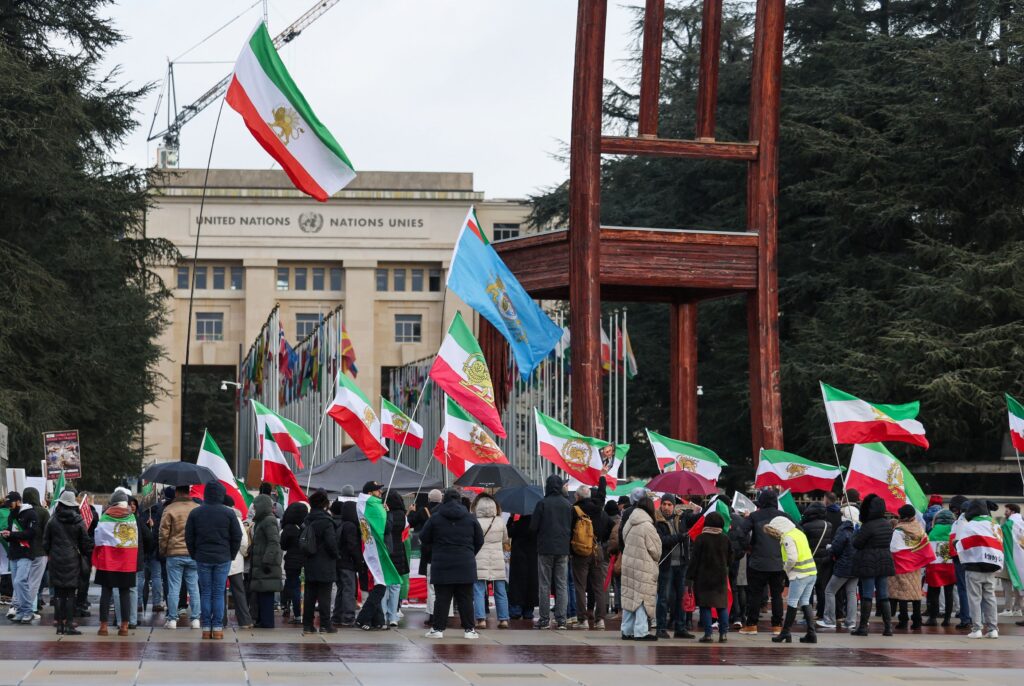
U.S. and Iranian officials opened a new round of nuclear talks in Geneva on Tuesday, against the backdrop of an expanded U.S. military presencein the Persian Gulf and the wider Middle East and following weeks of deadly domestic turmoil in Iran.
U.S. officials want Iran to curb its nuclear program. Tehran is seeking reprieve from crippling U.S. sanctions.
President Donald Trump, speaking to reporters aboard Air Force One late Monday, said that the Iranian negotiators have been “tough” but that he hoped they would be “more reasonable.” Trump said the Iranians “want to make a deal. I don’t think they want the consequences of not making a deal.”
Tensions have been mounting for weeks, raising fears of a military confrontation if talks fail.
An Iranian official, speaking on the condition of anonymity to discuss sensitive negotiations, confirmed via text message on Tuesday morning that indirect talks had began at Oman’s Consulate in Geneva.
The Swiss city was the scene of a striking confluence of high-stakes diplomacy on Tuesday as Russian, Ukrainian and American negotiators also planned to open the latest round of talks aimed at ending Moscow’s war in Ukraine.
The Russia talks were scheduled to take place at the InterContinental Hotel, according to the Tass state news agency, about a seven-minute drive from Oman’s Consulate.
Iranian and U.S. officials have described their latest diplomatic effort as positive, but significant differences appear to remain on key issues such as nuclear enrichment.
Iranian Foreign Minister Abbas Araghchi said Monday in a social media post that he was in Geneva “to achieve a fair and equitable deal.” But he added: “What is not on the table: submission before threats.”
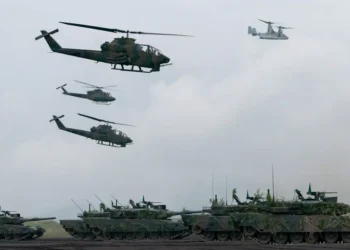
Since a first round of talks in Oman this month, Trump has ordered a military buildup in the region and repeatedly threatened the use of force if negotiations fail. Late last week, the Pentagon deployed a second aircraft carrier strike group to the region, joining at least a dozen other U.S. warships in the area.
Iran has threatened retaliation if attacked, and U.S. allies in the Persian Gulf have said Tehran’s missile program poses a deadly threat to U.S. interests in the region, including more than a dozen military bases and tens of thousands of troops.
Iran also appeared to signal its ability to close the Strait of Hormuz on Monday, when it held military exercises in the strategically important waterway.
Oman’s foreign minister, Badr Albusaidi, will mediate the talks in Geneva on Tuesday as he did this month in Muscat. U.S. envoy Steve Witkoff and Trump’s son-in-law Jared Kushner are leading the U.S. negotiating team, and are also responsible for the Russian talks — raising the prospect that they may need to shuttle quickly between venues.
The Iranian team is led by Araghchi, the foreign minister.
It is unclear what compromises the two sides might be willing to make or accept, but details of various proposals have emerged, with the central issue continuing to be enrichment.
Trump said as recently as Friday that “we don’t want any enrichment” — a position strongly supported by Israeli Prime Minister Benjamin Netanyahu, who said in a speech Sunday that Iran must be required to relinquish all its enriched uranium and be barred from enriching more in any deal negotiated with the United States.
But in an interview with the BBC on Sunday, Iranian Deputy Foreign Minister Majid Takht Ravanchi suggested the U.S. was no longer insisting on zero enrichment. The “issue of zero enrichment is not an issue anymore, and as far as Iran is concerned,” Ravanchi said. “it is not on the table anymore.”
Ravanchi did not rule out an agreement to ship Iran’s stockpile of uranium out of the country. He also said that an Iranian offer to dilute its highly enriched uranium was proof of its willingness to compromise and that the sides had also discussed shared interests in critical minerals, oil and gas.
Tehran is demanding significant relief from U.S. sanctions in exchange for limits on its nuclear program. Iran’s economic situation is dire, and without sanctions relief, the country’s leadership seems unable to improve living conditions for the population. Economic grievances sparked mass protests last month that morphed into anti-regime demonstrations and drew a vicious and deadly government response.
The post U.S. and Iran resume nuclear talks amid heavy military buildup appeared first on Washington Post.