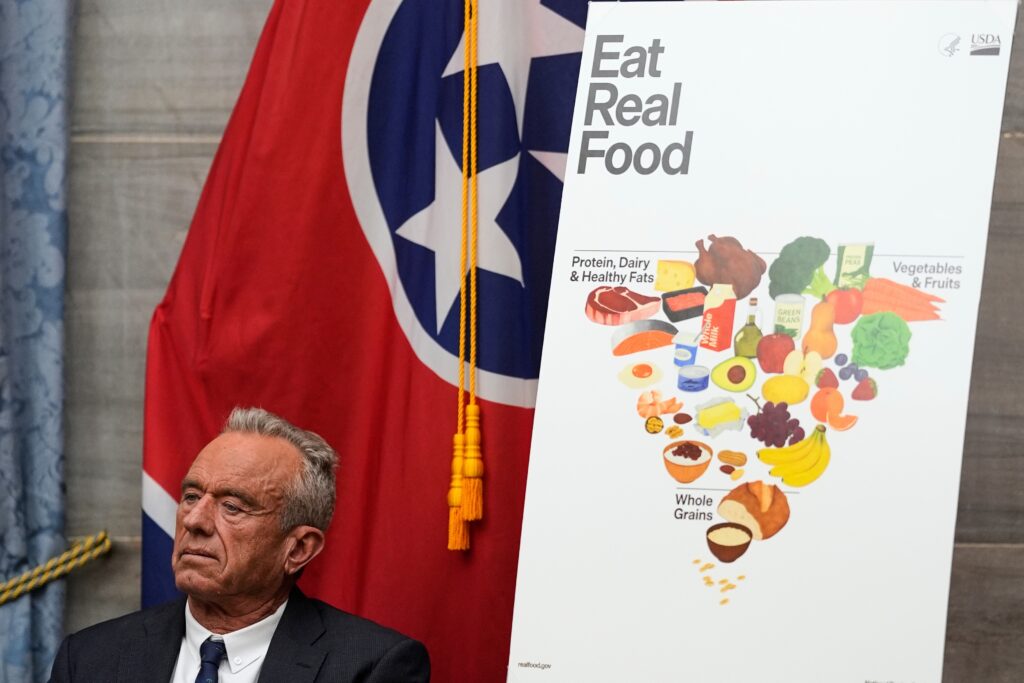
Health Secretary Robert F. Kennedy Jr. has been inaccurately claiming that patients with schizophrenia were cured through ketogenic diets, the latest instance in which medical experts say he has overstated nutritional science.
But his comments spotlight an emerging body of evidence that food can improve the lives of people with severe mental illness when medication alone isn’t working.
“There’s a germ of truth here,” said Ken Duckworth, medical director of the National Alliance on Mental Illness, which raises awareness about mental health and advocates for improved patient care. “But the science is not sophisticated yet.”
Psychiatrists say chronic mental illnesses like schizophrenia are managed and not cured. The doctor whose work Kennedy cited for the claim disputed how the nation’s top health official described his work. Preliminary research has shown potential in using the high-fat, low-carbohydrate diet to treat severe mental illness — but with crucial caveats that Kennedy did not offer.
While keto has been embraced as a fad diet for weight loss, research has long shown medical use for the diet under careful supervision. The diet, which alters a person’s metabolic state, has been used for decades to manage seizures for children with difficult-to-treat epilepsy. Patients with schizophrenia featured in case studies and followed in small trials have shown similar improvement.
However, large randomized, controlled trials — the gold standard for evidence-based medicine that compares people who receive a particular treatment with those who do not — have not demonstrated that patients with schizophrenia are better off with a keto diet than medication alone. Kennedy and his allies in the anti-vaccine movement often demand similar trials for vaccines, which scientists have described as unethical for immunization because they withhold proven protection from disease from children and unnecessary because the vaccines have been extensively studied for safety and efficacy. As health secretary, Kennedy says his decisions are guided by “gold-standard science.”
Kevin Klatt, an assistant professor in the department of nutritional sciences at the University of Toronto, said Kennedy’s comments about the keto diet illustrate the contradiction between the extremely high bar the health secretary sets for evidence of vaccine efficacy and the low bar for nutritional advice.
“Gold-standard science for them is the science they like,” said Klatt, who is also a registered dietician. “You can take a single study or anecdote, and that gets to be called gold-standard science.”
Kennedy’s claims on the keto diet reflect how he misstates, exaggerates or strips context from legitimate research, according to medical experts and science fact-checkers who monitor him.
He joined President Donald Trump in connecting Tylenol use in pregnancy to autism based on research that shows an association but not causation. He has criticized the fluoridation of drinking water as lowering the IQs of children, citing studies in areas with levels far above the acceptable threshold in the United States. He also touted Vitamin A as a measles treatment, which has not been proven in the U.S., based on the experiences of malnourished children abroad.
A spokesman for the Department of Health and Human Services did not respond to requests for comment.
In a January interviewwith USA Today, Kennedy drew a distinction between his demand for vigorous testing of vaccines compared with standards related to personal health habits.
“For most supplements, you take Vitamin D and it’s out of your system and it doesn’t have any long-term effects,” Kennedy said — although health officials warn prolonged excessive Vitamin D can damage bones and organs. “I wouldn’t do an intervention that I knew from day one, the first time I took it, that it was going to permanently alter my immune system unless I had good studies of it.”
Unpacking the claim
Kennedy has long pointed to the American dietheavy in processed foods, refined carbohydrates and added sugars as a primary driver of chronic illness.
In Feb. 4 remarks at the Tennessee Capitol during a national “Take Back Your Health” tour, Kennedy claimed that the food Americans eat drives mental illness. He invoked the case of a Harvard University psychiatrist who he said “cured schizophrenia using keto diets.” He repeated the claim in an interview on Theo Von’s podcast that published Thursday.
Christopher Palmer, the associate professor of psychiatry at Harvard Medical School whom Kennedy referenced, said in an interview that those patients are better described as being in remission rather than being cured.
Scientists are studying the fat-heavy keto diet in psychiatric care because it triggers a “nutritional ketosis” state in which the body burns fat in addition to glucose for energy. That sets off changes that affect the brain and body, including reducing inflammation and improving mitochondrial dysfunction. Researchers theorize that the changes during a ketosis state ease mood swings and hallucinations in people with severe mental illness. Those benefits must be weighed against risks such as short-term electrolyte loss and long-term nutrient deficiencies, and the challenges of sticking to such a restrictive diet.
Keto diets are part of the broader burgeoning field of metabolic health that scrutinizes how the body’s production and use of energy influence illness.
In a 2019 paper, Palmer spotlighted the cases of two women who had schizophrenia for decades and stopped using antipsychotic medication and remain symptom-free years after starting ketogenic diets. He said their stories offer “a little glimmer of hope” that schizophrenia may not be a permanent lifelong disorder that patients must tolerate.
Palmer noted, however, that the patients needed to remain on their diets to manage their conditions although they were able to be less strict with the diet over time. Other patients who tried the diet did not have similar outcomes. He cautioned that his work was preliminary and that far more research is needed to routinely recommend dietary changes for patients with severe mental illness.
“The value of case reports is it’s really nothing other than a possible signal; it creates a hypothesis,” said Palmer, who joined a 2024 health roundtable on Capitol Hill with Kennedy and prominent figures in the Make America Healthy Again movement. “I do think with case reports, sometimes it can suggest something that’s quite shocking and audacious, but it still needs to be tested.”
Emerging research
Studies to do that have proliferated in recent years.
In 2024, researchers at Stanford Medicine published the results of the first clinical trial of a ketogenic diet for 21 patients with schizophrenia or bipolar disorder. All but one of the dozen patients with symptoms who were adherent to the diet showed “clinically meaningful improvement.” But the study did not compare those patients with a control group of people who made no changes to what they ate.
Still, promising results from small trials give researchers reason to believe they’re onto a breakthrough that merits spending money on larger studies.
Two randomized trials — one in California, the other in Australia — that include patients with schizophrenia recently concluded, and their findings are expected to be published soon. Nearly two dozen trials examining keto diets for a range of conditions are underway globally. “This field is about to explode,” Palmer said.
While that research continues, researchers said medical professionals should avoid overselling the treatment.
“When we use studies that are very small or case studies or underpowered studies, we run the risk of misleading our patients and our clients,” said Alison Steiber, who oversees research affairs at the Academy of Nutrition and Dietetics. “It could create harm from a physical or mental perspective. It’s unethical to give your patient information that is not grounded in science.”
Kevin Hall, who resigned last year as a prominent nutrition researcher for the National Institutes of Health in protest of Kennedy’s leadership, said it was “far too premature” for the secretary to claim keto diets could cure schizophrenia.
“If this is a topic of interest, you should fund a lot more rigorous nutrition research that would be able to accurately assess whether or not so much a claim is founded,” Hall said.
Dietary studies are notoriously difficult to conduct because of the challenges in getting patients to adhere to them, especially if they have a mental illness. Ketogenic diets are rich in fat, including from meat and fish, whole dairy and nuts. To minimize carbohydrates, a person must sharply limit or avoid consumption of grains such as bread and pasta, certain fruits such as bananas and grapes, legumes such as beans and lentils, many desserts, as well as alcohol and juice.
Scientists can measure the pressure of ketones in a person’s blood to ensure they are adhering to the diet and guide patients on adjusting their food intake to maintain ketosis. Palmer said these challenges underscore the importance of medical supervision and the danger of self-treatment.
“Please don’t go out and just try the internet keto diet that you read about because that’s not what this diet is,” Palmer said. “It’s medically prescribed. It’s very precise.”
Although the patients spotlighted by Palmer stopped taking their medication, he and other researchers cautioned that the studies are designed to examine ketogenic diets as a supplement to drugs rather than a replacement.
“Some people can get off medication or decrease medication, but that’s not been formally studied,” said Shebani Sethi, a psychiatrist and the lead author of the Stanford study who is also involved in the randomized trials. She also co-founded a start-up to offer metabolic psychiatric care. “There’s no evidence to suggest people can be off medication completely and be on a ketogenic diet.”
The post RFK Jr. claimed that keto diets cured schizophrenia. Here’s what science says. appeared first on Washington Post.