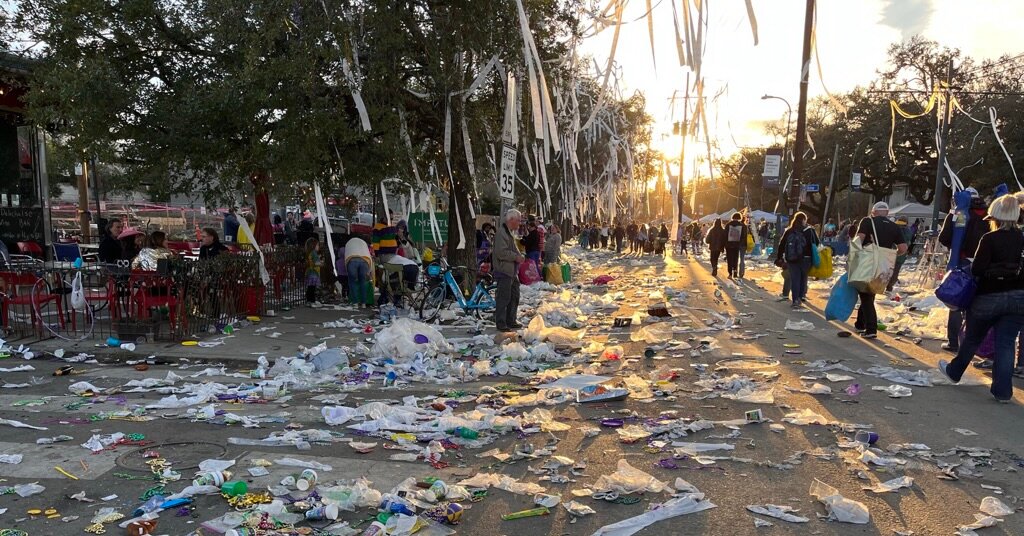
New Orleans is having Mardi Gras regrets, and not just the kind that come from too many daiquiris. In recent years, the city’s huge, weekslong party has been producing more waste than ever: an average of 1,123 tons per year for the last decade, according to the city’s Sanitation Department.
“It’s an environmental catastrophe,” said Brett Davis, who runs a nonprofit group, Grounds Krewe, that’s trying to make Carnival greener.
The New Orleans area is especially vulnerable to climate change because of hurricanes and coastal erosion. Yet, for weeks of ebullient parading, which culminate on Tuesday, those problems are forgotten as float riders fling plastic beads, cups, doubloons and foam footballs at teeming crowds. In the moment, these baubles can seem like treasures. Within days, though, what was caught, as well as the excess left on the streets or dangling from oak trees like Spanish moss, ends up in the trash.
Now, a coalition of nonprofit organizations, city officials and scientists is trying to clean up the party, pushing for everything from reusing beads to reorienting the culture of Carnival with the environment in mind.
It’s not just that all this party detritus is swelling landfills. A 2013 study found that more than 60 percent of Mardi Gras beads contained unsafe levels of lead. And in 2018, the city discovered 46 tons of beads clogging catch basins that are essential for clearing floodwaters.
“The city used to measure the success of Mardi Gras based on the trash collected,” said Kevin Ferguson, chief of staff for the New Orleans mayor. “But there are a lot of reasons we have to make a change.”
Mardi Gras wasn’t always so wasteful. Starting in the 1920s, the social clubs that organize balls and parades were throwing glass beads from floats, and “not nearly in the tonnage we have gotten to know,” said Lydia Blackmore, a curator at the Historic New Orleans Collection, a museum and research center.
But as global trade changed in the 1970s, more inexpensive goods manufactured in China became available in the United States. Soon, those social clubs, known as Carnival krewes, began selling these novelties in larger and larger “throw packages” to their members.
Because city laws prohibit sponsors or items with logos at Carnival, those sales became an essential way to finance the spectacle of modern Mardi Gras: fog machines, out-of-town bands and increasingly big and elaborate floats. Now, trinkets rain from the sky across the city. So much so that a kind of bead fatigue has set in.
“When I was a kid, we caught everything that came off the floats,” Mr. Davis said. “There was a big hoopla about who was going to get it. Now it’s a carpet, a river of waste.”
Mr. Davis’s own efforts to clean up Mardi Gras began in 2018. That year, he started collecting, sorting and repackaging beads in partnership with a local organization that works with people with developmental disabilities. For the 2023 season, his group, Grounds Krewe, became part of a coalition called Recycle Dat, organized by the city’s tourism association and the mayor’s Office of Resilience and Sustainability.
For the 2025 Carnival season, the coalition had collected 74,500 pounds of bottles, cans, plastic and parade throws, up from 8,130 pounds two years earlier.
“It’s very ethical recycling,” said Don Bates, the owner of Osprey Initiative, a company in the coalition. “Everything we sort has a final destination already identified.”
Despite this success, Mr. Davis came to believe that, by reusing beads, he was just “recirculating toxic, plastic junk no one wants,” he said. Now, he has pivoted to waste prevention, building a catalog of sustainable throws.
To date, he has sold more than $1 million of these festive but practical items, including jambalaya mix, native flower starter kits and plant-based glitter. He has also recruited a cadre of volunteers, from fifth graders to retirees, to help package the goods.
While Mr. Davis knows he can’t realistically “compete with the cheapest things on the planet,” he hopes that scarcity will raise awareness. After all, the most coveted throws are the rarest: hand-decorated coconuts from the Zulu parade and bedazzled, high-heeled shoes from Muses.
For Carnival to become truly sustainable, though, the standard, ubiquitous Mardi Gras beads will have to get greener. Two Louisiana State University scientists are working to solve that problem.
When Naohiro Kato, a plant molecular biologist at the university, learned about the proliferation of plastic necklaces, he began experimenting with creating beads from algae. But he struggled to produce them affordably until he learned that he could use 3-D printers to make them out of plastics derived from plants rather than fossil fuels. Now, his PlantMe beads are embedded with okra seeds that, when placed in soil, can help them to break down in an estimated two to three years. (And, okra is a common ingredient in gumbo.) While his first iterations cost $50 per necklace, he can produce them now for less than 50 cents apiece.
Grounds Krewe has also contracted Qinglin Wu, an engineer at the L.S.U. School of Renewable Natural Resources, to develop a bead made out of bagasse, the fibrous material left over in sugar cane production. The research is partly funded by Rex, the old-line krewe that was among the first to throw trinkets. Another group, the Krewe of Freret, has committed to stop throwing conventional beads and tossed out Dr. Kato’s PlantMe beads for the first time this year.
These efforts to make Mardi Gras sustainable are having an impact beyond Carnival. Anna Nguyen, of the mayor’s sustainability office, said that more local festivals had started recycling and composting.
As for those plantable beads, Dr. Kato hopes they will shift the dynamic between paradegoers and throws. “To have beautiful flowers,” he said, people will have to nurture their beads’ seedlings. “You have to take care of what you receive.”
The post It’s Mardi Gras in New Orleans. This Year, the Party Might Be a Bit Greener. appeared first on New York Times.