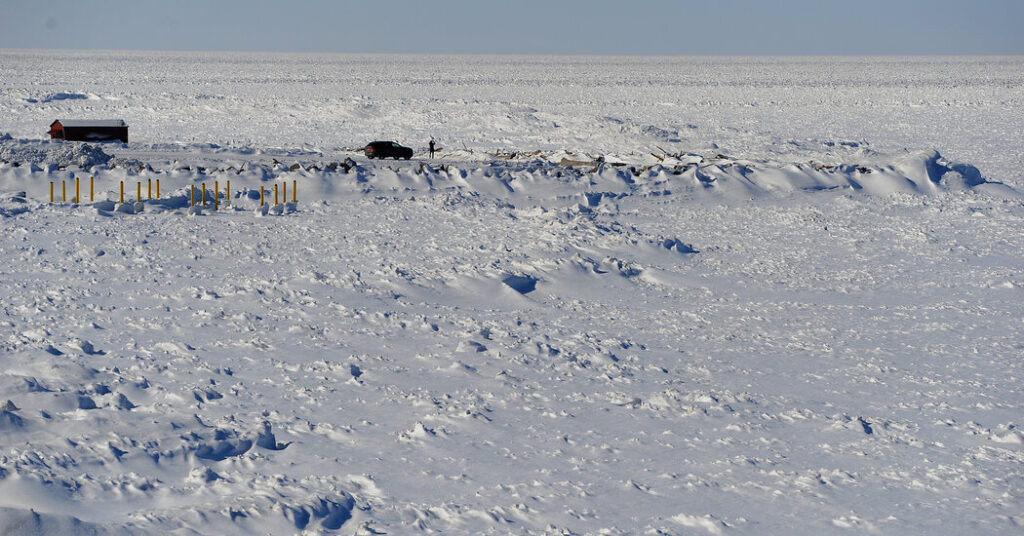
This winter’s bitter cold spell has turned Lake Erie into a glacial landscape, with the entire body of water almost completely frozen and mountains of blue-tinted ice up to 25 feet tall lining the shore.
High winds have played a major role in the ice drama. A satellite image by NOAA this month revealed a stunning 80-mile crack in the hardened tundra-like surface of the lake, caused in part by winds. Other images show tsunami-like waves of ice, driven by high winds, pushing mounds of what’s known as brash ice onto the near shore.
“Ice cover is well above average this year, but not unprecedented,” said James Kessler, an ice researcher with the National Oceanic and Atmospheric Administration at the Great Lakes Environmental Research Lab in Ann Arbor, Mich. “And it happened very quickly.”
It is a rarity, and an anomaly that is part of the so-called Big Freeze over major parts of the United States in recent weeks. Though upstate New York is always hammered by blizzards and lake-effect snowstorms, this winter’s frozen terrain defies a long trend of warming temperatures that have led to a 5 percent decline in ice cover on the Great Lakes every decade for the last 50 years.
In the last half-century, Lake Erie has had an increasing number of low- or no-ice conditions well into the winter. That intensifies the risk that the storms will spawn surges that significantly raise water levels and push water inland, and at the same time, force a recession of the lake level along the western shoreline in Ohio.
The warming of the lakes has captured the attention of planners and officials in the Buffalo region, who have been working on a $120 million project to build a new shoreline aimed at mitigating the effects of an increase in the number of storms and their ferocity. The project and others around the country are trying to advance beyond the centuries-old sea walls of rocks and bricks and build more naturalness into the shore.
The storm surges can be brutal. Before the recent frigid ice-over, at least two extreme events with high winds hit the lake’s beaches in December and January.
And one of the most punishing surges occurred during the lake-effect Christmas blizzard in 2022 in Buffalo and the region, when a bomb cyclone roared across the unfrozen lake, picked up moisture and dropped more than four feet of snow.
Winds as high as 80 miles per hour created a giant storm surge that pushed water ashore on the eastern end of the lake, including near downtown Buffalo, flooding roads and houses and coating the shoreline and everything on it with a thick layer of ice.
In a matter of hours, water levels rose eight feet in Buffalo, while in Ohio, they dropped eight feet, a likely record. Levels near Toledo, Ohio, were so low that officials became concerned that the Davis-Besse nuclear power station would no longer be able to draw water from the lake.
What was most striking about the event — known as a seiche to some and a surge to others — was that it was not all that unusual.
“We experienced three 100-year-type storms in consecutive years between 2020 and 2022 that included various combinations of extreme wind, waves, lake seiche and record snowfall levels,” said Jill Jedlicka, executive director of Buffalo Niagara Waterkeeper, an environmental nonprofit that works to protect freshwater ecosystems in western New York.
These extreme weather events are heightening interest in finding ways to adapt the shoreline. The storms are occurring more frequently because of how climate change has affected the Great Lakes; longer periods of ice-free winters allow the storms to take up moisture longer, creating lengthier storm seasons. Open water also means greater wave energy in the storms, which increases erosion and flooding.
Lake Erie is home to “the most dramatic, damaging and deadly surges” in the region, said Jay Austin, a physicist at the Large Lakes Observatory in Duluth, Minn. The Buffalo area, at the lake’s eastern end, is the bull’s-eye.
Storm surges are inversely proportional to the depth of the lake — the shallower the lake, the bigger the surge. Erie has an average depth of 62 feet; by contrast, Lake Superior averages 483 feet.
Because of wave physics, major storms produce greater waves in Lake Erie’s shallow waters, contributing to more shipwrecks — roughly 2,000 in U.S. waters since the early 19th century — than in any of the other Great Lakes.
The strategy to buffer the impact of these powerful storm events is changing from the armor of rock and concrete walls, which were built largely in the 19th century near Buffalo to protect the transshipment of grain and other goods onto freighters and ships small enough to ply the Erie Canal.
The historic rock breakwaters help block some of the storms’ fury, but they also exacerbate it.
“It hits the shoreline and starts to ricochet and builds more energy,” said Kerrie Gallo, deputy director for strategic initiatives at Buffalo Niagara Waterkeeper, which is collaborating with local governments to change shoreline design. “It’s like putting a toddler in a room and closing the door.”
Along Lake Erie, the new Ralph Wilson Centennial Park, named after the former owner of the Buffalo Bills, is being built to help counter the powerful surges and seiches. Wilson’s foundation financed much of the park’s cost of about $120 million so far, along with other public and private funding.
The 100-acre park reflects a new type of design that uses the natural elements of lakeshore to protect the site from quickly rising waters and improves the habitat for fish and wildlife.
“You can put more rocks in the breakwater, or think beyond the next storm,” Ms. Gallo said. “That’s nature-based design. It’s managing the energy better.”
Living shorelines and soft engineering are increasingly part of the adaptation to more severe weather around the country and the world. Tosin Gaskin, a researcher with the U.S. Army Corps of Engineers, estimated that there were at least 150 soft shoreline projects that had been completed or were still underway in the United States.
The crumbling sea wall of rock and concrete in the old park in Buffalo has been replaced with an undulating shoreline, new 30-foot-tall hills to block rising water and a sheltered lagoon to dissipate wave energy, stabilize sediments and promote growth of submerged aquatic vegetation. It also creates transitional habitats to encourage biodiversity. A calm water nursery supports young aquatic animals. Several acres of new wetlands have been constructed by precise grading, restoring water flow and planting wetland species such as cattails.
While the new park is expected to cushion the impact of storm surges and seiches, there is no way to mitigate the lake-effect snowstorms that pummel Buffalo and other lake regions every year, and are projected to increase in the coming decades.
Prevailing winds blow across Lake Erie’s 240-mile length, allowing cold air to pick up heat and moisture from the relatively warm lake waters. This makes the air unstable, causing it to rise, cool and form clouds that produce heavy bands of snow.
More than 50 inches of snow accumulated during the 2022 storm, which lasted for a record 37 hours. More than 40 people died, including 17 who became disoriented and fell into snowbanks.
Lake-effect storms are most common in the late fall and winter before the lake freezes over. “In November, you can stand here in the sun and watch a wall of clouds from a lake-effect storm over there,” Ms. Gallo said, pointing farther west.
Surges and seiches have a deadly track record on the Great Lakes. In 1844, a seiche, reportedly 22 feet high, suddenly swept through parts of downtown Buffalo, along the lake, and killed 78 people. In 2013, a rapid-onset seiche killed six people at a family reunion in northwest Ohio when Lake Erie waves swept over a pier.
Much better forecasting has helped reduce the threat from these rogue storms.
The terms surge and seiche are often used interchangeably, but Dr. Austin called the Buffalo storm in 2022 a surge, while others referred to it as a seiche. He said the terms were often confused.
A seiche is a standing wave in a fully or partly enclosed basin, such as Lake Erie, that can oscillate, or slosh back and forth rhythmically. They are often caused by a wind-driven surge.
“The storm surge is like your finger displacing a guitar string from equilibrium,” Dr. Austin said. “Once you release the string, it vibrates on its own. This is similar to the seiche — a regular oscillation that follows a disturbance.”
How long a seiche lasts depends not on the original force, but on the geometry of the lake. Because Lake Erie is shallow, a seiche is more likely, but there is more drag from the bottom, and seiches don’t last as long as they do in Lake Superior or in other deeper lakes.
A rapid change in weather can also cause seiches, as atmospheric pressure pushes down with more force on one end of the lake than the other, something known as a meteotsunami.
The longest known seiche was the result of a landslide in a Greenland fjord, forming a tsunami in September 2023. The resulting huge wave in the fjord oscillated for nine days.
Ecologically, seiches and surges are called disturbance events and play important roles in the lakes. They flush sediment out of marshes, changing water temperatures and water quality rapidly, and they alter the distribution of fish populations. They mix stratified layers, preventing anoxia, or low oxygen levels, in the water.
On the other hand, they can cause algae blooms and fish kills by raising anoxic water, and they destroy bird and fish nests, while also benefiting fish by cleaning spawning areas.
Seiches and surges have caused water levels to drop so low that shipwrecks and other archaeological artifacts have been exposed, though they are quickly submerged again when levels return to normal. During a seiche in November, what was assumed to be a 19th-century schooner was spotted briefly near Kingsville, Ontario. And in January 2024, what was believed to be a shipwreck was spotted near Toledo with mussel-encrusted cannons still intact.
The extreme events also provide unique opportunities for research. Todd Crail, a professor of ecology at the University of Toledo, has scoured exposed lake beds to study native mussels that would otherwise be hard to find.
Buffalo often deals with flooding caused by storms, while Ohio experiences an unusual seiche-driven drying.
“Most of the western basin was dewatered,” Dr. Crail said of the 2022 event. “It was absolutely crazy. It was convenient to have the water out of the way, and we just walked around on the mud.”
It enabled some biological detective work. “It was thought the native Unionidae mussels here had been completely wiped out by invasive zebra and quagga mussels,” he said. “And we found that wasn’t the case.”
The native mussels had instead burrowed into the lake bed and were still there, but they were not observable or collectible. Living in the mud was a way to smother and kill the invader mussels that were attaching to the shells of the larger native ones. “It’s a remarkable evolutionary adaptation,” Dr. Crail said.
The post Lake Erie’s Storm Surges Become More Extreme appeared first on New York Times.