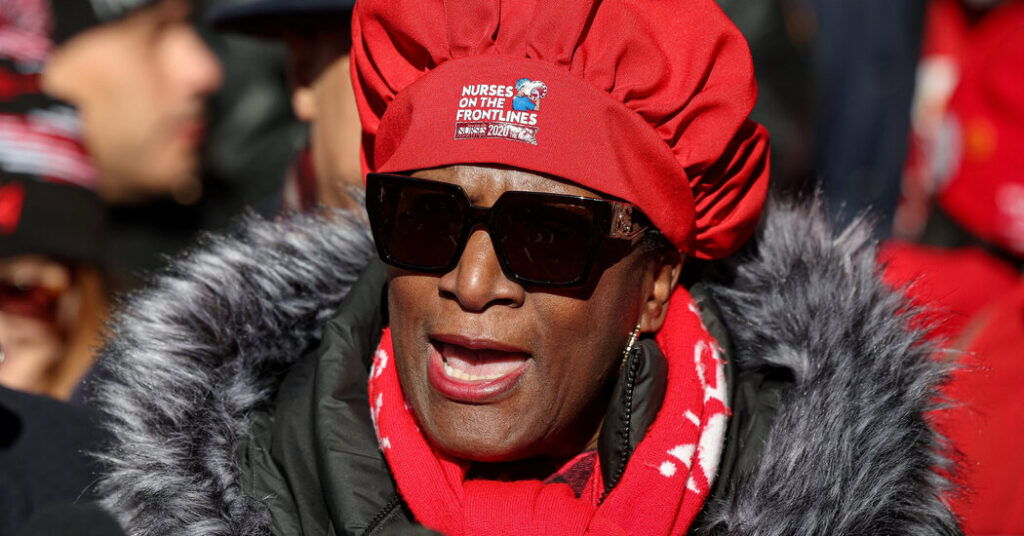
It should have been a triumphant moment for Nancy Hagans. A nurse at a Brooklyn hospital, she is the president of the state’s largest nursing union. Three years ago, she had led 7,000 health care workers on a strike that resulted in major gains, and now she had done it again — this time with nearly 15,000 nurses.
But this winter’s walkout had been a far bigger gamble, with far less upside and considerably more peril. There were fewer protections for striking workers, and hospitals were better prepared than in 2023. Still, after a monthlong strike, the hospitals offered the nurses better pay and working conditions than they had been likely to get without striking.
And last week, after having gone on strike for the second time in three years, most of the nurses took the deal — an accomplishment that sealed the nurses’ position as a potent political force. But, for Ms. Hagans and other leaders of the statewide union, it came at a cost.
The most recent strike has revealed a bitter rift inside the union, which has come to the surface in the past week. While most nurses are returning to work, thousands of others have decided to persist with the strike while accusing the union’s leadership of undermining their efforts.
Nurses from one of the city’s largest hospitals, NewYork-Presbyterian/Columbia, hand-delivered a letter to the union’s office last week, demanding Ms. Hagans’s removal as president of the New York State Nurses Association, according to one of the leaders of the union’s chapter at the hospital, Cagatay Celik. The letter was first reported by The City, an online news outlet.
The dispute stems from the statewide union taking the pact directly to nurses and bypassing the nurse leaders at NewYork-Presbyterian/Columbia, who had opposed the deal a mediator had offered to end the strike.
“That was a very unfortunate decision,” Judy Sheridan-Gonzalez, who was the statewide union’s president until 2021, said. “I don’t want to denigrate my union leadership, so I want to be very careful how I phrase this.”
She said that the union leadership had erred in its efforts to get nurses at NewYork-Presbyterian to vote on a deal that local union leaders had rejected.
“I just think that they perhaps have lost touch with some of the rank and file,” she said.
It was only after four weeks that a deal began to take shape, after the mediators put forward a proposal. The nurse bargaining units at Mount Sinai Health System and Montefiore Medical Center voted to approve the deal and put it to the rank-and-file nurses at those hospitals, who ratified the deal.
But at NewYork-Presbyterian/Columbia, Beth Loudin, the head of the bargaining unit, said that the proposed deal did not include sufficient protections against layoffs, nor did it add enough nurses in understaffed units.
To her surprise, the union’s leadership decided to put the proposal to a vote of the more than 4,000 striking nurses at the hospital, a move that struck many nurses as a betrayal of those on the picket line. The nurses there voted against the proposal, and to stay on strike.
It was that decision that led Ms. Loudin and others, including Mr. Celik, to demand the ouster of Ms. Hagans, who has been the union president since 2021, and other union leaders. On “The Brian Lehrer Show” on WNYC radio, Ms. Hagans, who did not respond to interview requests from The New York Times, defended her decision to have the NewYork-Presbyterian nurses vote on the deal.
“The decision was to put it out there for all the members to see and make that decision,” Ms. Hagans said. “It’s about democracy.”
When she was asked on WNYC how she would restore her credibility with the rank and file, she said that she understood that many nurses were frustrated.
“This is a very difficult time,” she said. “This is a long strike. The nurses are frustrated and I understand that.”
About 10,000 nurses began returning to work this past weekend at Montefiore in the Bronx and across three hospitals in the Mount Sinai Health System. But more than 4,000 nurses remained on strike in Upper Manhattan, outside NewYork-Presbyterian/Columbia.
NewYork-Presbyterian has begun encouraging nurses to cross the picket line, sending emails that invite them to return to work.
“We know that for many, missing another paycheck and going without health care coverage is not an option you and your families can afford,” the hospital wrote in an email Friday.
What happens next is far from clear. The NewYork-Presbyterian nurses could land the deal they are seeking. Or perhaps the picket line caves, under fear that the hospital will replace those on strike, a worry that some nurses have expressed.
Jason Ortiz, a political operative who was once the political director of a labor union, the New York Hotel Trades Council, said that he couldn’t recall any other union in New York that had led its members on two major strikes in such a short period.
“That was a very, very risky and very, very courageous move,” he said.
Striking workers, he said, couldn’t depend on protections from the National Labor Relations Board, a federal agency that has been largely sidelined.
“It’s not a decision to be taken lightly, and one where the consequences of doing it and staying out for a long time could be catastrophic,” he said, noting the results of a five-year strike by Spectrum cable and internet workers in New York City that resulted in decertification of the union.
But many wondered if this was the start of a pattern. Would there be a nurses strike at the end of every three-year contract?
“That is not our desire,” said Ms. Sheridan-Gonzalez, the former president of the statewide union, who remains on the union’s bargaining committee at Montefiore.
The New York State Nurses Association is New York’s oldest nursing union and professional association for nurses. Two decades ago, it was nobody’s idea of a pugnacious union. But a group of nurse leaders, including Ms. Sheridan-Gonzalez, transformed the organization.
During the past decade or so, it has fought with considerable success for minimum staffing levels. For years, the union complained that hospitals hired too few nurses, leaving them with far too many patients to care for properly. With the union’s support, state lawmakers passed a law that established safe staffing standards.
The issue resonated with anyone who had ever waited in a crowded emergency room. It linked working conditions for nurses to the care that patients received. “More nurses, better care for patients,” Ms. Hagans said on WNYC.
But the state law proved less effective than the nurses hoped. Three years ago, during contract negotiations, the nurses’ union won not just a guarantee of minimum staffing levels but, in some cases, a mechanism for extracting payouts from hospitals that didn’t comply.
At Mount Sinai, nurses have been awarded more than $6 million from arbitrators because of insufficient staffing levels.
The nurses say they won those provisions by going on strike in January 2023. It was the first significant nurses’ strike in New York City in a quarter century. Hospital executives doubted the nurses would walk. When they did, they had broad public support: New Yorkers remembered opening their windows and banging pots and pans to celebrate health care workers each night early in the coronavirus pandemic. That strike lasted just three days.
The hospitals were better prepared this time. To replace the striking workers, the hospitals quickly deployed thousands of short-term contract nurses, paying them about $9,000 a week, substantially more than nurses typically earn.
By early January, both sides were accusing the other of failing to negotiate in good faith. The hospitals focused on the nurses’ initial pay demands — 10 percent raises a year that they lowered to 8 percent — as unrealistic.
The union accused the hospitals of trying to compel them to strike, by offering too little and trying to roll back the wins of the last contract.
As the strike persisted, the negotiations unfolding at the Javits Convention Center made little headway through January. At times, the bargaining units of nurses at each hospital staked out separate positions, with one unit rejecting a deal that another had accepted.
“Every bargaining unit went and did their own thing,” Marc Z. Kramer, the lead negotiator for Mount Sinai, said.
Some of the demands, in the view of hospital negotiators, went beyond the scope of typical union-management issues, such as the union’s demand that hospitals bar officials from the federal Immigration and Customs Enforcement agency from hospitals, without a warrant.
The strike wasn’t a last resort for the union, Mr. Kramer said. “It was their first resort.”
“Their tactics were strike first and bargain second.”
Joseph Goldstein covers health care in New York for The Times, following years of criminal justice and police reporting.
The post 2 Strikes in 3 Years: N.Y.C. Nurses Awaken as a Major Labor Voice appeared first on New York Times.