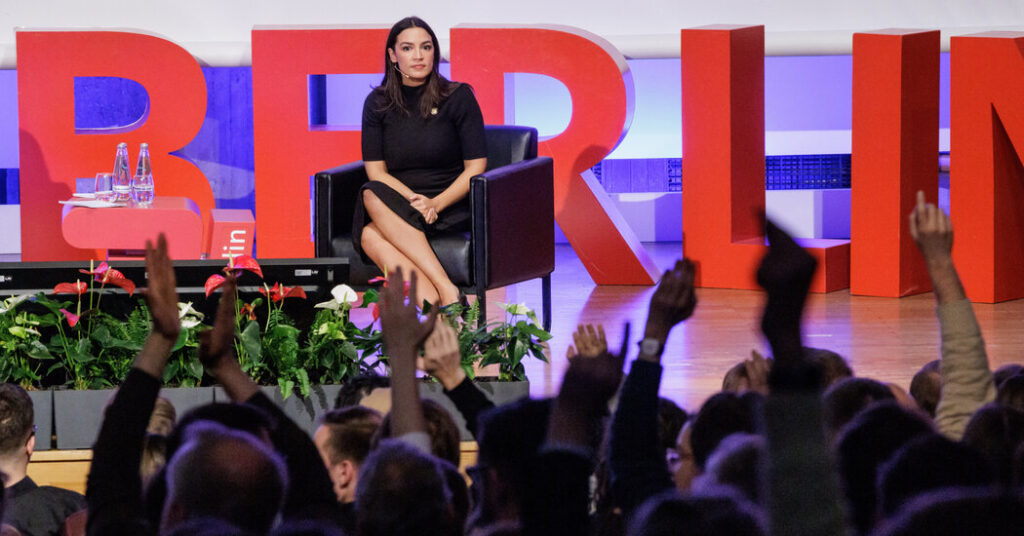
Representative Alexandria Ocasio-Cortez had anticipated a potentially frosty reception to her anti-establishment arguments at the Munich Security Conference, a venue she called “an elite place of decision makers that, frankly, are not responsive to a class-based message.”
And the visit to Germany felt high-stakes: It was the most prominent foreign trip to date by the progressive New York congresswoman, who had mostly focused on domestic priorities until now. Her remarks last week about addressing working-class concerns around the globe, and the reception from world leaders, were both eagerly awaited and highly scrutinized.
But rather than the substance of her arguments, it was her on-camera stumbles when answering questions about specific world affairs that rocketed around conservative social media and drove plenty of the discussion about her visit, as political observers speculated whether they would make a dent in a potential presidential run in 2028.
The most notable instance was when she was asked whether the United States should send troops to aid Taiwan if China invaded the island. She stalled for roughly 20 seconds before offering a response that reflected the United States’ longtime policy of strategic ambiguity.
The way her performance was microscopically dissected through the lens of what it meant for a hypothetical White House campaign frustrated Ms. Ocasio-Cortez, 36. She said she worried that her message — warning that wealthy world leaders must better provide for their working classes or risk their countries sliding toward authoritarianism — was being lost in all the commotion.
So on Monday night, while still in Berlin, Ms. Ocasio-Cortez spoke to The New York Times by phone and tried to underscore that message.
“This reporter came up to me and was like, ‘Is Munich the new New Hampshire?’ And I cannot say enough how out of touch and missing the point, genuinely, that is,” Ms. Ocasio-Cortez said in an interview, referring to the state’s tradition of hosting early presidential primary contests. “Global democracies are on fire the world over, and established parties are falling to right-wing populist movements.”
To Ms. Ocasio-Cortez, the discourse about her visit had missed the more important point about the risks of authoritarianism — an argument that she said had been well-received by the Europeans during two foreign policy panels, private meetings with German leaders and an address in a packed university auditorium in Berlin.
She added that she had gone to Munich “not because I’m running for president, not because I’ve made some kind of decision about a horse race or a candidacy, but because we need to sound the alarm bells that a lot of those folks in nicely pressed suits in that room will not be there much longer if we do not do something about the runaway inequality that is fueling far-right populist movements.”
Ms. Ocasio-Cortez argued that efforts to make clips of “any five-to-10-second thing” from her remarks go viral online, especially in the conservative ecosystem, had been done to “distract from the substance of what I am saying.”
On the ground in Germany, the reaction to Ms. Ocasio-Cortez’s visit seemed mostly positive, at a time when many of the United States’ traditional Western allies are alarmed by President Trump’s hostility and are eager for an alternate approach.
Rafał Trzaskowski, the mayor of Warsaw, said he had been heartened by Ms. Ocasio-Cortez’s visit and her eagerness to diagnose the causes of the recent surge of right-wing populism, which was the subject of one of the congresswoman’s panels in Munich.
“It’s of course refreshing to see some American politicians who talk openly about all of those challenges that we face,” Mr. Trzaskowski said. “It’s good to hear progressive voices which are courageous enough to call a spade a spade.”
Mary Robinson, a former president of Ireland and the former head of a group of world leaders known as the Elders, said that Ms. Ocasio-Cortez offered a generational freshness and that her left-wing ideals appealed to Europeans.
“I’m not sure America’s ready for that yet,” she said. “But maybe it is.”
Still, Ms. Ocasio-Cortez’s missteps were striking for a politician who is usually quick on her feet and is considered one of the best communicators in politics. In addition to the answer on Taiwan, critics highlighted comments referring to the “Trans-Pacific Partnership” (she clarified online that she meant Atlantic) and suggesting that Venezuela was below the Equator (the country lies just to the north).
The Munich performances of other prominent Democrats considered possible presidential candidates, such as Govs. Gavin Newsom of California and Gretchen Whitmer of Michigan, were also watched closely by European attendees and news outlets — and, in Ms. Whitmer’s case, criticized — but none of them seemed to generate as much buzz or scrutiny as Ms. Ocasio-Cortez.
In Munich, Ms. Ocasio-Cortez met privately with Lars Klingbeil, the German finance minister; Carsten Schneider, the environment minister; and Siemtje Möller and Sonja Eichwede, members of Parliament, according to a person familiar with the conversations. Representatives for Mr. Klingbeil and Mr. Schneider declined to share their perspectives on the meetings, saying they were private talks.
But Ms. Ocasio-Cortez said that her meetings had gone well and that she had been “pleasantly surprised” by her reception in Munich, attributing some of it to European governments’ worries about far-right movements on the rise.
At a news conference in Munich, she said that “we have tried everything that the conventional wisdom has said is best, and where we are today is record inequality.” She added that “we have no other choice — the only alternative is a world that is dominated by a handful of elites.”
In the interview, she said her meetings had dealt with questions like how to structure a global wealth or corporate tax. And she said she and the European leaders had also discussed how to rebut conservative arguments against renewable energy, for instance by highlighting the role of artificial intelligence data centers in driving up energy costs and framing renewable energy as a backstop to volatile fossil fuel prices.
Citing Secretary of State Marco Rubio’s speech, which was generally received positively by European leaders, she said that movements she saw as hostile to working-class interests were still powerful. And she warned that such groups were coordinating around the world, fueled by figures like Prime Minister Viktor Orban of Hungary, President Javier Milei of Argentina and former President Jair Bolsonaro of Brazil.
“Everyone’s got this story wrong, that this is about me running for president,” Ms. Ocasio-Cortez said. “I could give — whatever, about that, to be honest.” She added: “The story is less about the opponents being some hypothetical primary. To me, my opponents are the network that links Orban, Trump, Milei, Bolsonaro, all of these folks.”
Ms. Ocasio-Cortez’s frustration, she said, was that she felt there had been an effort “to shadow and obscure this all through the idea of a horse race. Like, ‘Her performance about this, or her performance about that. What does that mean about her as a candidate?’ That’s not what I went to Munich for.”
She added: “If I were running — if I had made a decision or anything about being president, or Senate, or anything like that — frankly, I say this all the time: Am I acting like someone who is trying to run? No! Because I’m there for a very different, specific purpose.”
In Berlin, she encountered a friendlier audience, touring the Bundestag, the federal Parliament, with a group of younger, progressive members of Germany’s Social Democratic Party, and dispensing advice to them about campaigning and organizing. On Monday, she met with members of Die Linke, Germany’s primary democratic socialist party and discussed the implementation of a wealth tax.
In both cities, her argument was that the best way to counteract far-right movements was to address people’s economic struggles — including by pursuing antitrust efforts against corporations — so they did not seek “scapegoats” for their challenges.
And she critiqued the Western world’s approach, arguing that global trade agreements were often used “as a back door for major corporations and global industries” to circumvent governments and enact rules that favored the wealthy.
At the university event in Berlin, Ms. Ocasio-Cortez encountered another tricky situation: pro-Palestinian college students demanding that the university and the Social Democratic Party she was meeting with vocally condemn Israel — an especially fraught topic in Germany because of the Holocaust.
Ms. Ocasio-Cortez told the students that it was important to remain critical but also to keep left-wing movements united, a sign of her evolution over the years from a progressive agitator within the Democratic Party to someone trying to build coalitions.
“We need to be able to be very angry at each other, and also know what the real enemy is,” she said. “We have to grow our ranks, and we have to persuade. If we go separately, we will lose it all.”
In the interview, she said that idea was underscored when she was at the Bundestag. She said she gazed down on the floor of the Parliament and saw the seats of the various liberal parties arrayed next to one another, even as they have conflicts over whether to work together — rifts that work to the benefit of the country’s far-right Alternative for Germany party.
“I think a lot about all of the heartburn that the Democratic Party has sometimes had in these internal conversations,” Ms. Ocasio-Cortez said. In both countries, she added, if the center-left and those further on the left are unable to put their differences aside, “then the whole thing goes out the window.”
Jim Tankersley contributed reporting.
Kellen Browning is a Times political reporter based in San Francisco.
The post After First Big Overseas Trip, Ocasio-Cortez Expresses Frustrations appeared first on New York Times.