To the Editor:
Re “The Harry Potter Generation Needs to Grow Up,” by Louise Perry (Opinion guest essay, Feb. 1):
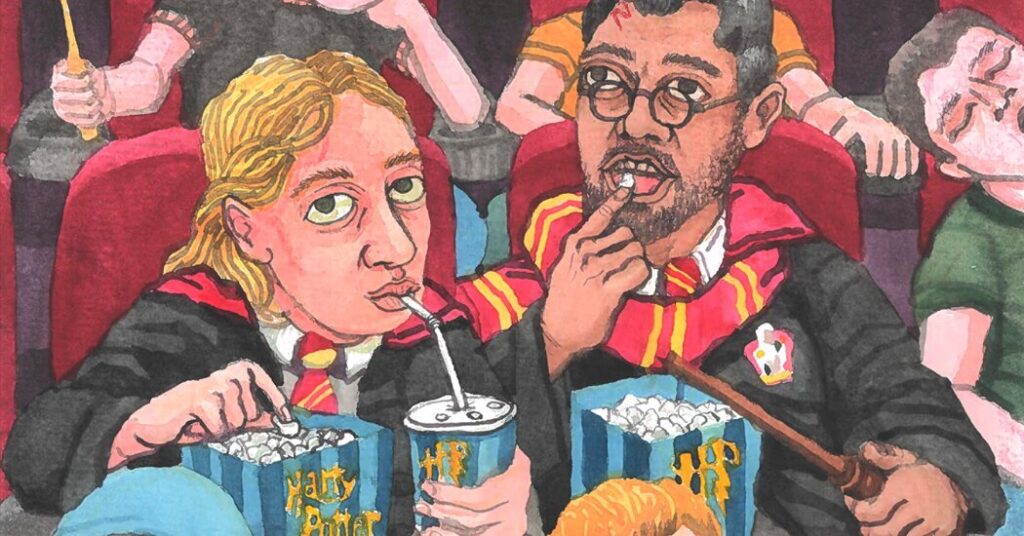
I have a slightly different take on the Harry Potter message, finding it inspirational and timeless rather than out of touch and out of date.
I am a Gen X-er and share my love of all things Harry Potter with my Gen Z children. We have frequently cited the determination, values and challenges of the Hogwarts children as inspiring ideals, particularly in today’s increasingly fraught era.
While the author suggests that Harry Potter fans should give up their naïveté and realize that J.K. Rowling’s ideals are a relic of the past, I would counter that fans (and new generations) should embrace the values and tenacity of Dumbledore’s Army. They are the values of Western liberalism since the 17th century, not just the 1990s.
Ms. Rowling’s stories are not Pollyannaish. The children and mentors of the Harry Potter world faced malign, treacherous and divisive forces, and the outcomes of their journeys were never assured. Some died or were grievously wounded, yet they held firm to their principles and loved ones.
As we encounter similar times in our lives, the story of Harry and his cadre can shine as examples for children and adults alike.
Amethyst Kurbegov Nashville
To the Editor:
Louise Perry’s argument that the Harry Potter generation needs to “grow up” fails to appreciate the enduring power of the books and why they mattered in the first place.
I am an unapologetic Harry Potter fan. I am also the founder of Urban Prep, the country’s first all-boys charter high school. Urban Prep students are predominantly Black and low-income and from tough Chicago neighborhoods. Since Urban Prep’s founding, 100 percent of its graduates have been admitted to four-year colleges. When the schools were launched, Harry Potter was required reading not because the books were best sellers but because they taught much-needed lessons.
Urban Prep borrowed Hogwarts trappings: red and gold colors, a lion mascot and students placed in “houses” called Prides. The school was jokingly described as “Hogwarts in the ’Hood.” But beneath the humor was intention. The Harry Potter series tells the story of a boy with hidden power, dismissed by the world, surviving hostile environments and choosing belief over bitterness. That story resonated deeply with Black boys who already knew what it felt like to be unseen or underestimated.
Ms. Perry suggests that Harry Potter has lost relevance for Gen Z. I would argue the opposite. The idea that ordinary people can confront evil is not naïve. Stories that insist choice still matters are not relics. In the hostile world young people face today, belief and hope are necessary armor.
Harry Potter still has something to teach us, no matter the generation or the house we might have been placed in by the Sorting Hat.
Tim King Chicago
To the Editor:
Louise Perry ends her essay: “It was beautiful in its moral simplicity. It was also too good to be true.”
Yes, children defeating evil wizards is the stuff of fantasy, but the struggle between those who want to oppress and those who resist oppression is timeless and universal. I came of age during the struggles over civil rights, the Vietnam War and the women’s movement. Before those movements, the idea that students could influence change in the Jim Crow South, Defense Department policy and established patriarchy would have been dismissed.
America now is suffering the resurgence of those who seek to be oppressors. The ideals of democracy are being challenged, and the economy has been manipulated to serve the few and keep others settling for crumbs. Some young people seem to feel at a loss, but the young people of every past generation faced such challenges and more.
This isn’t the time to give in to the despair that ideals are “too good to be true.” It is the time when standing up and living up to our ideals is most essential.
Carol Graham Denville, N.J. The writer is a former English teacher.
The Healing Hand
To the Editor:
Re “The Threat of Dr. A.I.” (Science Times, Feb. 10):
Many years ago, I bled into my brain from a malformed blood vessel, an often fatal or disabling event. As I was being rolled into the operating room, the anesthesiologist intercepted what had every possibility of being my last ride.
He stopped the stretcher, sat down on the edge, took my hand in his, looked me in the eye and said: “Herb, I will stay with you until this operation is over. I will not leave you.”
That was the last thing I remember until I woke up many hours later. No computer, no matter how sophisticated, can do that.
Herbert Rakatansky Providence, R.I. The writer is an emeritus clinical professor of medicine at Brown University.
The post Why Harry Potter Still Inspires Us appeared first on New York Times.