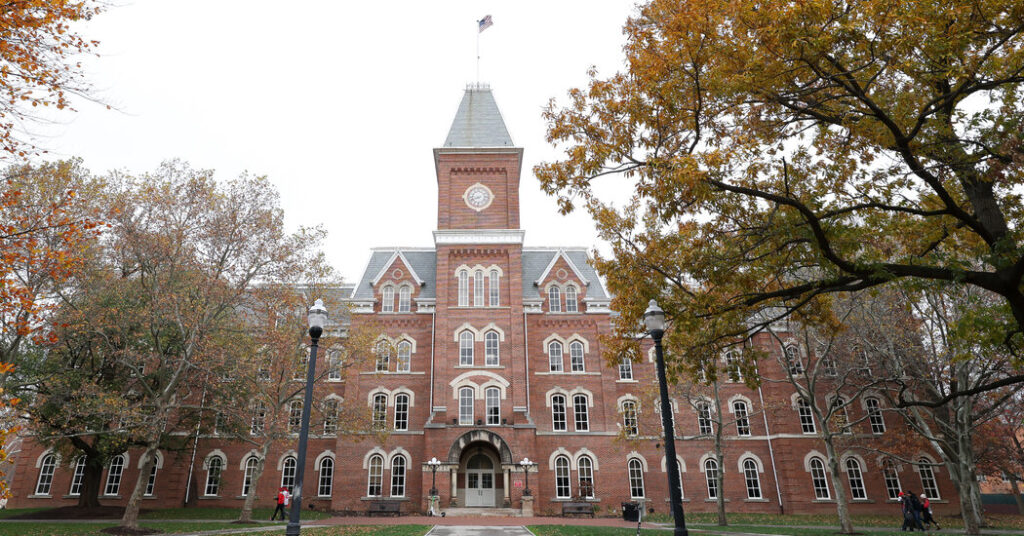
Their buildings can be architectural wonders. The discoveries made in their laboratories can be spellbinding and lifesaving.
But America’s colleges and universities are chronically searching for money, a reality that brought academic leaders and researchers into both Jeffrey Epstein’s orbit and his inbox. The schools had the prestige to lend him legitimacy. Mr. Epstein had the money to bankroll projects.
It worked well for some, until it didn’t.
Mr. Epstein, who in 2019 died by suicide in the jail where he was being held on sex trafficking charges, gave money, or simply dangled the prospect of it, before people on a range of campuses, including Harvard, M.I.T., Stanford, Bard College and Columbia.
Some schools have spent years trying to distance themselves from Mr. Epstein, donating his contributions and condemning his crimes. But recent document releases from the Justice Department have prompted new recriminations and regrets.
Many academics whose names appear within the Epstein files say they turned to him only because of his money and the possibility that it could underwrite college budgets and research efforts — even if their exchanges came after Mr. Epstein pleaded guilty in 2008 to soliciting prostitution from a minor.
“As I have said for years, engaging with Jeffrey Epstein was in service of one agenda, which was fund-raising for Bard,” the college’s president, Leon Botstein, said in a statement.
Nicholas Christakis, a professor at Yale, wrote in an email that he had only met Mr. Epstein once, “in the context of fund-raising for my lab.”
“We never got any funding from him,” he said, adding, “Like other academic scientists, I am responsible for the financial support of my lab.”
Antonio Damasio, a neuroscientist at the University of Southern California, said in an email that colleagues had told him about Mr. Epstein, saying that he was interested in science.
“When Epstein invited myself and my wife (who is also a well-known scientist) to have dinner at his New York home with other colleagues, we accepted and we both attended,” said Dr. Damasio, who said he had never received any money from Mr. Epstein.
Mr. Epstein’s motives for connecting with college professors and presidents were not always clear. He gathered celebrities and power brokers into his network; a Harvard professor who benefited from the Epstein largess once noted that the financier also collected scientists.
Mr. Epstein rarely followed through with the multimillion-dollar contributions he suggested were on offer, but he drew people in and appeared attentive to academia’s unending quest to pay its bills. Private philanthropy has long been an essential part of higher education’s business model, and some college presidents say they spend at least a quarter of their time fund-raising.
Much of the money that is collected goes toward endowments. Although the most recent federal data shows American colleges and universities collectively have more than $927 billion across their endowments, many of those funds have severe restrictions, limiting how they may be used and leaving academia more financially squeezed than the headline figure suggests. That is one reason researchers jockey ferociously for grant money and other gifts.
But reliance on private money, industry officials say, leaves schools vulnerable to soliciting or accepting contributions from sources that might be unsavory.
Rarely do the overtures blow up as spectacularly as the ones involving Mr. Epstein have. (The authorities have not accused any of the academics whose names have surfaced in the files of wrongdoing related to Mr. Epstein.)
Academia has been awash in speculation over Mr. Epstein’s motives for floating possible donations.
Mr. Botstein said in 2023 that Mr. Epstein “enjoyed humiliating and dangling prospects” and had “absolutely strung me along.” Others have wondered whether he luxuriated in conversations with some of the world’s brightest minds. Many also believe that Mr. Epstein sought to leverage academia’s reputation to clean up his own.
For example, a Harvard professor, whose program received millions from Mr. Epstein, greenlit proposals made by the financier’s publicist to feature Mr. Epstein on a university website. In a report Harvard issued in 2020, the university said the requests “appeared to be part of a larger effort to rehabilitate” Mr. Epstein’s image. (The university also noted that Mr. Epstein’s foundation’s website overstated its gifts to Harvard by tens of millions of dollars.)
“Having one of these universities as part of your philanthropic portfolio adds a tremendous amount of credibility, and I think that’s what a university should be worried about: Is an unsavory character using me to whitewash a lifestyle?” said Nicholas S. Zeppos, a former Vanderbilt University chancellor.
Universities have long debated approaches to so-called tainted money. Some academic leaders have argued that it is better for the money to be spent by universities, where the public good can be advanced, than for it to remain with nefarious sources.
“It’s a tough area for institutions,” said Gene Tempel, the founding dean emeritus of Indiana University’s School of Philanthropy and a former president of the university’s foundation. “They are in search of money, and the old saw about tainted money is tain’t enough of it.”
It was not always clear how much administrators knew about Mr. Epstein’s contacts with their schools. Most due diligence policies, industry officials said, are usually built around gift acceptance, not solicitation.
And with some notable exceptions — particularly Dr. Botstein and Lawrence H. Summers, who led Harvard — Mr. Epstein’s contacts with academia happened at the lower ranks of universities, in part because his potential gifts, while large, were not usually enough to merit the attention of campus leaders.
At the most elite universities, according to current and former industry officials, presidents rarely become substantively involved with wooing a prospective donor unless a contribution could amount to $10 million or more.
In many cases, it appears that Mr. Epstein was engaging with individual professors, sometimes without the knowledge of university fund-raising executives who might have been more skeptical.
“Even a dollar from someone with that background is not acceptable,” Mr. Zeppos said. “But to get presidential involvement requires a much higher threshold of potential gift activity.”
Even apart from Mr. Epstein’s 2008 conviction, James M. Langley, the president of a philanthropy consultancy, said the donor’s limited giving record should have raised alarms.
“One does want to be alert to all possibilities,” said Mr. Langley, who had held top posts at Georgia Tech, Georgetown and the University of California, San Diego. “But here’s something you learn from fund-raising, and that is if it’s too good to be true, it usually is.”
Mr. Langley said he nevertheless understood why professors engaged with Mr. Epstein.
“All of a sudden, this person of means is coming to you, so in some ways that may reinforce your view that the larger system doesn’t appreciate you as well as it should,” said Mr. Langley, who said Mr. Epstein’s apparent interest may have been “seductive” to researchers.
Dr. Damasio, the U.S.C. scientist, told a student publication there that he had been “looking for a prestigious philanthropist, not a criminal.”
Universities and professors are scrambling to manage the backlash from their associations with Mr. Epstein. The online presences and class schedules of some professors have vanished, and some schools, like Harvard, are exploring the ties of their major donors to Mr. Epstein.
Haverford College has come under pressure to rename the Lutnick Library after the extent of Commerce Secretary Howard Lutnick’s ties to Mr. Epstein emerged. The college’s president, Wendy Raymond, said in a community email that the school was “committed to our core values and cognizant of broader ethical implications raised by these disclosures” and that she and board members would “continue to monitor the situation.”
Some industry officials expect the Epstein disclosures to usher in new protocols regarding potential donors, though there is debate about whether they would prove effective.
Mr. Zeppos, the former Vanderbilt chancellor, argued that the episode had exposed “a vulnerability in the system.”
“Sometimes,” he said, “these things are just like airline crash cases that could be prevented — a set of circumstances that should set off alerts to everybody, but the system just fails.”
Alan Blinder is a national correspondent for The Times, covering education.
The post Epstein’s Ties With Academics Show the Seedy Side of College Fund-Raising appeared first on New York Times.