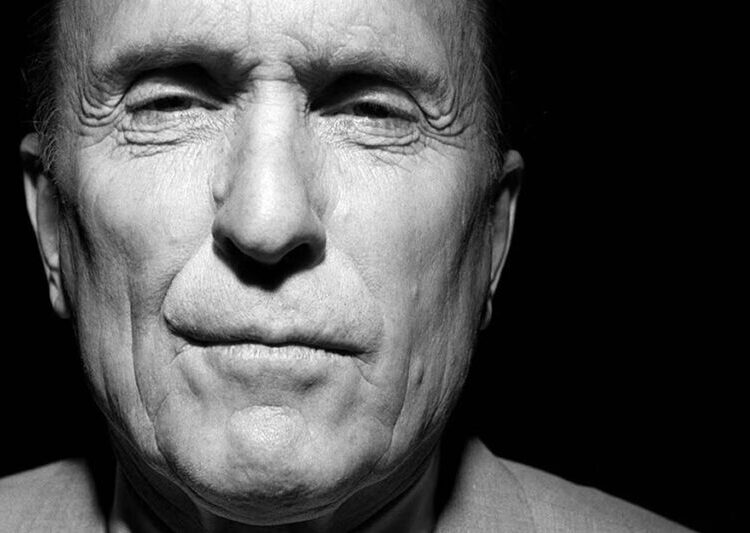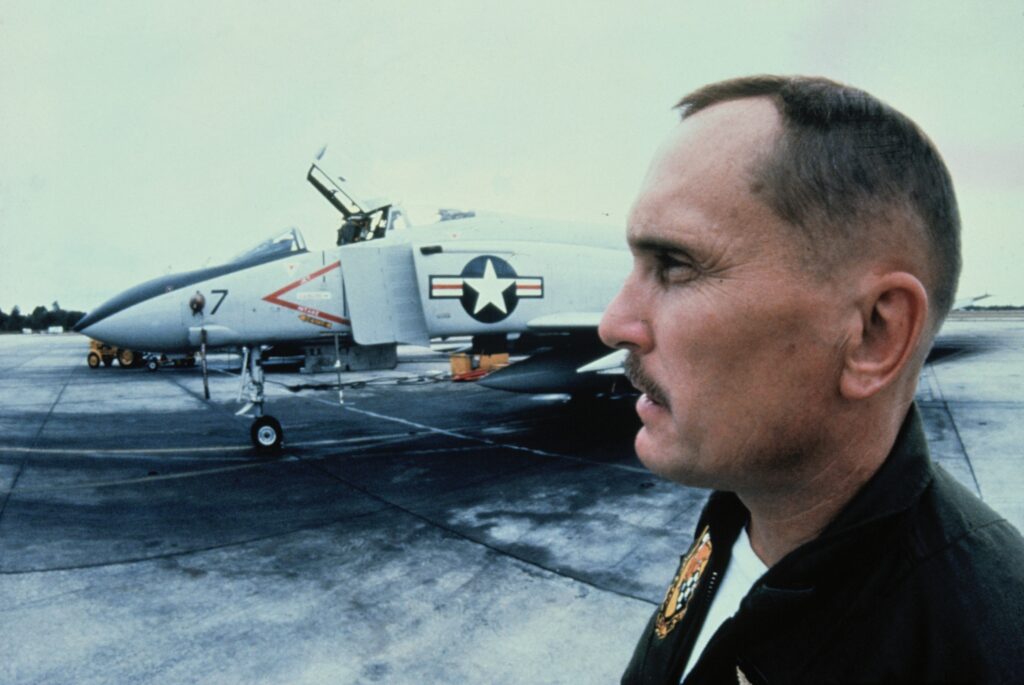
Robert Duvall, an Oscar-winning actor who disappeared into an astonishing range of roles — lawmen and outlaws, Southern-fried alcoholics and Manhattan boardroom sharks, a hotheaded veteran and a cool-tempered mob consigliere — and emerged as one of the most respected screen talents of his generation, died Feb. 15. He was 95.
His wife, Luciana Pedraza Duvall, said in a Facebook post that Mr. Duvall died at home, without citing a cause. He had long lived at Byrnley, a horse farm in Fauquier County, Virginia, near The Plains.
By his own account, Mr. Duvall was a late-blooming youth, a Navy rear admiral’s son whose only discernible talent in childhood was for meticulous mimicry. His repertoire included Western ranchers and the military brass, and his stage was the dinner table.
Metamorphosis became a hallmark of his career. Newsweek film critic David Ansen once called Mr. Duvall “a character actor who approaches each role with the diligence of an ethnologist on a field trip into the soul.”
Without matinee-idol looks — he had a sinewy frame, chlorine-blue eyes, a slightly bent nose and sandy brown hair slicked back on either side of his balding pate — he seemed destined to portray taciturn outsiders, macho oddballs and rugged eccentrics.
Mr. Duvall was a near-constant presence on-screen beginning with his movie debut as the ghostly, feebleminded Boo Radley in “To Kill a Mockingbird” (1962), based on the Harper Lee novel.
Over the next half-century, he had a few top-billed parts, notably his Academy Award-winning turn as an alcoholic country-western singer in “Tender Mercies” (1983). He performed the songs so authentically, with his lived-in tenor, that he was invited to record an album in Nashville with veteran music producer Chips Moman.
Mr. Duvall received Oscar nominations for his starring roles as a tyrannical, hypercompetitive military father in “The Great Santini” (1979), based on the Pat Conroy novel, and as a fallen Pentecostal preacher seeking grace in “The Apostle” (1997), which he also wrote and directed.
But in a career spanning about 140 film and TV credits, Mr. Duvall’s prime turf was the supporting role. “The ‘personality’ carries the movie, not someone like me,” he once told the Chicago Tribune. “But the star may have a mediocre part, and there I am in the second or third lead, quietly doing quality things.”
No two films showcased the spectrum of those “quality things” more than “The Godfather” (1972) and “Apocalypse Now” (1979), both critical and cultural juggernauts directed by Francis Ford Coppola and for which Mr. Duvall earned Oscar nominations for supporting work. In the first, he portrayed Tom Hagen, the discreet mob lawyer and the informal foster son of the Corleone family (whose patriarch was played by Marlon Brando).
Film scholar David Thomson called Mr. Duvall’s Hagen, a role he reprised in the 1974 sequel, a “detailed study of a self-effacing man,” one willing to suffer humiliation to earn his place as the non-Italian among Italians.
In “Apocalypse Now,” an epic film about war and madness set in Vietnam, Mr. Duvall played Kilgore, the surfing-obsessed lieutenant colonel who declares, in one of the movie’s oft-quoted lines, that he loves “the smell of napalm in the morning.” Instead of devolving into crackpot flamboyance, Mr. Duvall delivered, in the description of New York Times film critic Vincent Canby, a performance of “breathtaking force and charm.”
Canby called Mr. Duvall “one of the most resourceful, most technically proficient, most remarkable actors in America,” likening him to Laurence Olivier in his shape-shifting prowess.
Mr. Duvall was a convincingly British Dr. Watson to Nicol Williamson’s Sherlock Holmes in “The Seven-Per-Cent Solution” (1976), an eyepatch-sporting Nazi colonel who masterminds a plot to kidnap Winston Churchill in “The Eagle Has Landed” (1976), a hard-boiled Los Angeles police detective in “True Confessions” (1981) and an aging Cuban émigré in “Wrestling Ernest Hemingway” (1993).
Over and over again, he was a top choice of many directors for rural American characters. He was an illiterate sharecropper caring for a woman and her child in “Tomorrow” (1972), a psychopathic Jesse James in “The Great Northfield Minnesota Raid” (1972), a good-hearted Southern lawyer in “Rambling Rose” (1991) and a Tennessee backwoods hermit in “Get Low” (2009).
Perhaps his definitive country role was the wise and garrulous Texas Ranger Gus McCrae in the hit CBS TV miniseries “Lonesome Dove” (1989), based on Larry McMurtry’s Pulitzer Prize-winning novel about a cattle drive. It brought Mr. Duvall (later named an honorary ranger) many crusty cowboy roles. Unsettled by typecasting, he agreed to play Soviet dictator Joseph Stalin, not ultimately one of his better moves, in a TV film.
In preparing for a role, Mr. Duvall spent time with cowboys, day laborers, policemen, fighter pilots, ballplayers, Bowery drunks, Baptist ministers and ex-cons, scrupulously studying their rhythms of speech, their hand gestures, the twists of their personalities. He said he tried to find “pockets of contradiction” — shadings to suggest multidimensional character.
“I hang around a guy’s memories,” he told another interviewer. “I store up bits and pieces about him.”
‘Last resort’ becomes a long career
Robert Selden Duvall was born in San Diego on Jan. 5, 1931. He was the middle of three boys raised by their mother during their father’s long absences at sea.
Mr. Duvall described himself as an aimless youth, without distinction in the classroom or on the playing field. He frequently indulged in mischievous behavior with his siblings. “We used to put Tide in milkshakes for my mother,” he told The Washington Post in 1983. His practical jokes, including a penchant for mooning other actors, continued well into adulthood.
After Army service, he enrolled at Principia College, a small Christian Science school (his family’s faith) in Illinois. He was a social studies major on the brink of flunking out when a drama teacher remarked on his promise in several plays. His parents, pleased that he seemed to excel in something, pushed him to major in dramatics and then toward an acting career. “It was like a last resort,” he said.
He graduated in 1955, then attended the Neighborhood Playhouse workshop in New York, where classmates included Dustin Hoffman, Gene Hackman and James Caan. His breakthrough came in a 1957 Long Island production of Arthur Miller’s drama “A View From the Bridge.” The noted director Ulu Grosbard cast Mr. Duvall in the lead role, as a Brooklyn longshoreman struggling with his attraction to his niece.
“Even then he had the thing you go for as an actor and director, perfect control but the feeling of total unpredictability,” Grosbard later told the Los Angeles Times. “A lot of good actors will give you technique, precision and a character’s arc, and that’s important. But not that many give you the sense that this is actually what’s transpiring at the moment in front of your eyes.”
The one-night-only show sparked attention and proved “a catalyst for my career,” Mr. Duvall later said, leading to offers to play menacing roles on TV and stage. He made his Broadway debut in the thriller “Wait Until Dark” (1966), as a criminal who taunts a blind woman (Lee Remick), and played an ex-con in “American Buffalo” (1977), David Mamet’s first play to reach Broadway.
Meanwhile, Mr. Duvall gained a foothold in Hollywood. Pulitzer-winning playwright Horton Foote was instrumental in launching the actor’s flourishing movie presence. Foote, who wrote the screenplay for “To Kill a Mockingbird,” had been “bowled over” by Mr. Duvall’s balance of intensity and naturalism onstage and recommended him for the part of Boo Radley.
That led to memorable roles in some of the defining movies of the era. He played the pompous hypocrite Maj. Frank Burns in director Robert Altman’s “M*A*S*H” (1970). In Coppola’s “The Conversation” (1974), a much-admired drama of Watergate-era paranoia, he was a mysterious businessman who bankrolls a surveillance operation. Mr. Duvall played a corporate hatchet man in “Network” (1976), a brilliant satire of broadcast journalism morphing into ratings-driven entertainment.
Mr. Duvall also was top-billed in director George Lucas’s feature-film debut, the dystopian “THX 1138” (1971).
Later in his career, Mr. Duvall enlivened many a big-budget mediocrity with a gruff, leathery persona, on display in the Tom Cruise car-racing drama “Days of Thunder” (1990), the Nicolas Cage heist film “Gone in 60 Seconds” (2000) and the violent action thriller “Jack Reacher” (2012), also starring Cruise.
Still capable of deft underplaying, Mr. Duvall received Oscar nominations for his supporting roles in “A Civil Action” (1998), playing a wily corporate attorney who duels over a settlement with John Travolta’s lawyer character, and in “The Judge” (2014), as a domineering small-town magistrate accused of murder who is defended by his son (Robert Downey Jr.).
Mr. Duvall’s well-paying Hollywood projects subsidized his passions — small-budget films he wrote and directed, including “Angelo, My Love” (1983), about Romani people in New York; “The Apostle,” which was 15 years in the planning; and “Assassination Tango” (2002), about a Brooklyn hit man with a weakness for the sensual Argentine dance. Like the character, Mr. Duvall was a dedicated tango dancer.
His marriages to Barbara Benjamin, actress Gail Youngs and dancer Sharon Brophy ended in divorce. In 2004, he married Luciana Pedraza, an Argentine actress 41 years his junior, who appeared with him in “Assassination Tango.” Complete information on survivors was not immediately available.
Mr. Duvall said he abhorred acting that called attention to itself, leveling criticism of revered leading men such as Brando (“lazy”) or Olivier (“too stylized”). An actor was at his best and most real, he said, when he could summon emotions from his own life — without actorly ego.
“Being a leading man? No, I never dreamed of that,” he told the Chicago Tribune. “It’s an agent’s dream, not an actor’s.”
The post Robert Duvall, chameleon of the silver screen, dies at 95 appeared first on Washington Post.