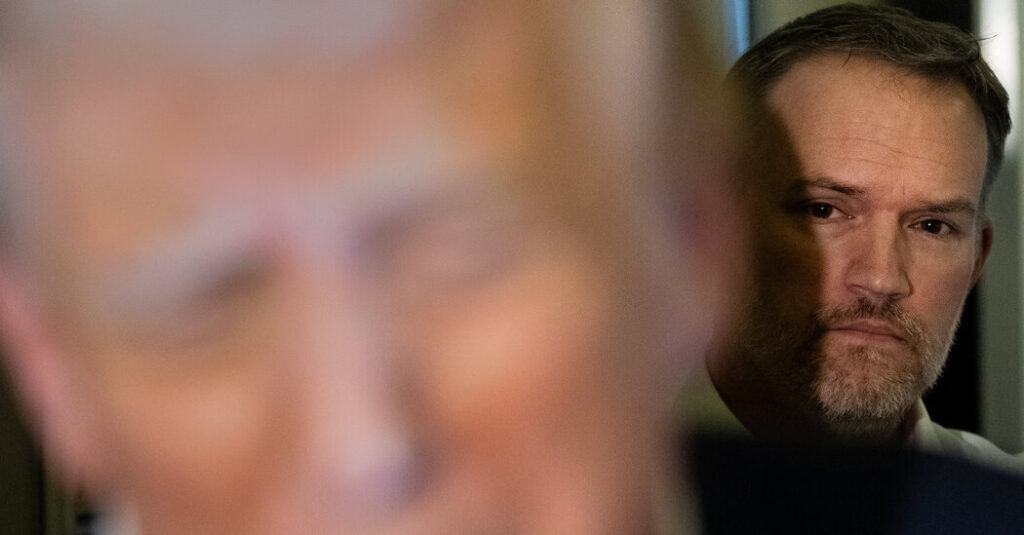
On Jan. 26, 2025, Jamieson Greer was teaching Sunday school to a group of 9-year-olds when one of his phones started blowing up with calls from the White House. Six days into the new administration, President Trump was already deploying his favorite weapon: the threat of crippling tariffs to bend countries to his will.
This time, the president was threatening Colombia, after it refused to accept U.S. military planes of deported immigrants. Mr. Greer would not join the Trump administration for some time yet, but he was already a key adviser on trade, flying to Mar-a-Lago in the weeks before to help plan Mr. Trump’s agenda.
“Why do you have two phones?” a student asked him.
“I have a kind of crazy job,” Mr. Greer replied.
As the United States trade representative, Mr. Greer, 45, has been a powerful but behind-the-scenes force in transforming the global economy. His calm demeanor is often overshadowed in a cabinet filled with outspoken, brash billionaires. Yet few have done more in Mr. Trump’s second term to put into practice the president’s vision of altering the system governing how trillions of dollars of goods move around the world.
Mr. Greer has provided the legal and policy framework to overhaul a global system Mr. Trump slams as unfair. He has helped the president raise tariffs to their highest levels in nearly a century while simultaneously leading negotiations with all of America’s biggest trading partners. So far, he has helped Mr. Trump reach initial trade arrangements with dozens of countries.
Interviews with Mr. Greer make clear that he is a true believer in Mr. Trump’s plan to use tariffs to revitalize the United States manufacturing sector. He and other advisers have ushered in steep import taxes to try to protect manufacturers from foreign competition, coax more factories into the United States and create more good-paying factory jobs.
“What the president has done is amazing,” Mr. Greer said in an interview in January. “He has restructured global trade.”
It’s not yet clear those initiatives will work. Manufacturing employs less than 10 percent of Americans, and the number of factory workers has been dwindling. While some manufacturers support protectionism, others say it raises their costs and makes U.S. industry less competitive. Consumers are also concerned about tariffs increasing prices, and polls show Mr. Trump losing support for his handling of the economy.
Though Mr. Greer credits the president’s tariff threats with giving him leverage in negotiations, Mr. Trump’s penchant for brinkmanship has clearly added uncertainty and complications to how countries deal with the United States. Mr. Trump has continued to threaten countries with tariffs, even if they have already agreed to trade deals, leaving companies unsure how permanent his policies are.
This year seems likely to bring more tumult, as the Supreme Court reviews whether to overturn many of these tariffs. The administration is also preparing for high-stakes meetings with China, and negotiations with Canada and Mexico that could transform or dissolve the North American trade deal.
Mr. Greer is often seen as a source of stability in the chaos. A former Mormon missionary and military lawyer, he has quietly navigated the demands of an unpredictable president, other big personalities in the cabinet, and the dozens of foreign leaders and company executives whose fortunes are tied up in trade. Friends say he has followed the advice of his mentor and former boss, Robert E. Lighthizer, who served as the U.S. trade representative in Mr. Trump’s first term: “You can get a lot done in Washington if you don’t care who gets the credit.”
Mr. Greer’s small agency has only about 250 people, and he has not always been included in important administration decisions. In April, as he was testifying before Congress to defend the global tariffs Mr. Trump had just announced, the president surprised lawmakers and Mr. Greer by suddenly pausing them.
But those close to Mr. Greer say he has built a solid relationship with the president. Mr. Trump has turned to him to coordinate issues beyond trade, like investment and security deals with Saudi Arabia, Cambodia and Thailand. Mr. Greer said that while he may not be a billionaire or political celebrity like other officials, he was chosen for a simple reason: “I know my brief.”
Reading ‘Les Mis’ in Mortaritaville
Mr. Greer is known as being preternaturally calm, a trait that some who know him say stems from being the father of five children. He credited his time as a military lawyer in Iraq, where he had to pause cross-examinations to shelter under a desk from mortar fire.
“Listen, as long as nobody’s bombing me, I’m in good shape,” he said.
Mr. Greer’s membership among Washington’s elite was not predictable. Raised in a working-class family in Paradise, Calif., he grew up in a mobile home, the fourth of five children, and worked during the summers and school year as a dishwasher and at McDonald’s. His parents valued education and Mr. Greer was drawn to the yellow-trimmed National Geographics that arrived in the mail each month.
He attended Brigham Young University and served for two years during college as a Mormon missionary in Belgium, France and Luxembourg. In a white shirt and tie, Mr. Greer spent his days speaking to locals and refugees from Kosovo and Rwanda, an experience that opened his eyes to international relations and taught him fluent French that he still uses in trade negotiations.
At B.Y.U., Mr. Greer joined the military and met his future wife, Marlo. After law school in Virginia and a stint studying in Paris, he served as a military lawyer in Kansas, Turkey and Iraq, where he was stationed at a base nicknamed “Mortaritaville,” reading “Les Misérables” in French between bombardments.
He was set on a path toward his future role as the architect of Mr. Trump’s trade strategy by what he called a “serendipitous” interview with Mr. Lighthizer for a job in Washington at the law firm Skadden Arps. Mr. Lighthizer said Mr. Greer impressed him as someone with “brains and values,” and hired Mr. Greer in 2012 to help the firm defend U.S. Steel and other American companies in trade cases.
That work gave Mr. Greer an advance look at what U.S. industries would face in the coming years, as Chinese exports heavily subsidized by Beijing flooded global markets. Jeffrey Gerrish, who worked with Mr. Greer at Skadden Arps and at the trade representative’s office, said Mr. Greer was “right on the front lines” as Chinese goods began decimating U.S. industry.
“He saw the kinds of impacts that it was having, not only on the companies, but on the workers and really entire communities,” Mr. Gerrish said.
Mr. Greer saw the influx of cheap goods as a national security issue, but few Republicans or Democrats agreed. That changed with Mr. Trump’s election in 2016, when Mr. Lighthizer became U.S. trade representative and appointed Mr. Greer as his chief of staff.
Mr. Greer became Mr. Lighthizer’s shadow, sitting behind him in Oval Office meetings and riding on Air Force One. To the surprise of foreign bureaucrats, Mr. Lighthizer sent the then-30-something Mr. Greer in his place to high-level meetings with the World Trade Organization, South Korea and Mexico. Together, they waged a trade war against China and reworked the North American Free Trade Agreement.
The administration had done as much as it could in the first term, Mr. Lighthizer said, but since then the country’s views on trade have shifted, and the president now has an even stronger mandate.
“The president is taking the next logical steps and Jamieson is the best possible person to implement it,” he said. “He had years of doing the law and he shadowed me for four years. How would you possibly prepare a person better?”
America First
After Mr. Trump left office, Mr. Greer went into private practice. And when the president won in 2024, Mr. Greer helped compile lists of trade loyalists for the new administration and drafted a trade memo that the president issued on his first day back in office, which teed up the possibility of tariffs to address more than a dozen trade issues.
Mr. Lighthizer, who had no desire to be the U.S. trade representative again, threw his weight behind Mr. Greer’s appointment. The decision was supported by Jared Kushner, Mr. Trump’s son-in-law, and others who thought the president would be better served by a trade expert in the cabinet than another billionaire.
By the time Mr. Greer was confirmed on Feb. 26, 2025, Mr. Trump was already wielding tariffs with abandon, in ways that were more chaotic than Mr. Greer might have preferred.
Out of all the options he could have used to impose tariffs, Mr. Trump chose an international emergency law that would let him immediately raise or lower tariffs, and keep them in effect as long as he liked.
But the law, the International Emergency Economic Powers Act, was vulnerable to legal challenges, which was one reason Mr. Lighthizer had not used it in Mr. Trump’s first term. Mr. Greer also saw it as more legally vulnerable than other options, but he had included it in the options he presented to Mr. Trump, and said Mr. Trump chose it because of its flexibility.
In February, Mr. Trump used the law to declare inflows of fentanyl a national emergency, and to deploy tariffs against Canada, Mexico and China, America’s largest trading partners.
In April, on what he called “Liberation Day,” Mr. Trump used the same law to declare trade deficits an emergency. He announced sweeping global tariffs as high as 50 percent, including tariffs of 34 percent on China, a move that set off a trade clash that remains unsettled.
The trade representative’s office was immediately inundated by requests from foreign officials seeking to avoid the tariffs. That kicked off months of furious negotiations for Mr. Greer, who flew more than 100,000 miles in 2025 and sometimes met with representatives of more than half a dozen countries each day.
Given the hurried timeline, Mr. Greer created a template of issues for countries to negotiate on. The resulting deals involved countries dropping their tariffs on U.S. agriculture and industrial goods, and the adoption of other policies aimed at nonmarket economies like China.
Many of the agreements ended up vague and high level, reflecting the rushed pace of the talks. Governments from Europe to Vietnam would later clash with the United States over the exact details.
Talks were also complicated by the fact that countries were subject to another set of national security-related tariffs that were the domain of Howard Lutnick, the commerce secretary. Those tariffs affected sectors like cars, pharmaceuticals and steel. Foreign countries complained that negotiations proceeded smoothly with Mr. Greer, but hit roadblocks with the Commerce Department.
With Japan, South Korea, Europe and others, Mr. Lutnick was focused on using his tariffs as leverage to encourage governments to contribute to funds he could use to invest in strategic industries. People familiar with Mr. Greer’s thinking said he disapproved of the approach, believing national security tariffs should be kept intact to protect vital industries.
Mr. Greer said in an interview that “tensions” was “not a word I would ever use,” but acknowledged the national security tariffs had added “an extra layer of complexity.”
Mr. Greer also bristled last year at ill-timed technology restrictions from the Commerce Department, former officials and others said. Shortly after Mr. Greer and Treasury Secretary Scott Bessent had negotiated a trade truce with China last May to restore the flow of minerals to the United States, Mr. Lutnick’s department announced that using Chinese A.I. chips anywhere in the world would violate U.S. rules. The Commerce Department later rolled out restrictions that added tens of thousands of Chinese firms to a blacklist cutting them off from American technology.
Both moves roiled the Chinese government, prompting Beijing to fire back with more curbs on mineral exports and sending Mr. Greer and Mr. Bessent back to the negotiating table.
Mr. Greer is widely known in Washington as a “China hawk,” and those close to him said he would probably prefer a tougher China policy, including fewer sales of advanced A.I. chips. But China had demonstrated that it had the power to shut down the American factory sector with its mineral curbs. Mr. Greer credited Mr. Trump with being tough and pragmatic on China, and recognizing that a broader conflict would be in no one’s interest.
“If people want to egg China and the United States on to have some big trade fight, I don’t think that’s going to be good for the world,” Mr. Greer said.
Managing trade
Mr. Greer has formed close alliances with others in the administration, including Mr. Bessent, whom he is working with to prepare for an April summit in Beijing between Mr. Trump and Xi Jinping, China’s leader.
In an interview, Mr. Bessent recalled an incident in which Mr. Greer, who is typically calm and fact-based, lost his temper after the Chinese misrepresented a historical fact during negotiations in Geneva, which took place in the palatial Swiss ambassador’s house overlooking a lake. “When Jamieson raises his voice, people take notice, because he doesn’t raise it very often,” he said.
Mr. Bessent said the “unheralded story” of the trade agreements made over the last year was how Mr. Greer and the president had forced other countries to bring their tariffs down, boosting U.S. exports.
“We reordered the global trading system, and made free trade back into fair trade,” Mr. Bessent said. “It is a complete rebalancing.”
But some critics say the tariff threats have damaged America’s standing in the world rather than helped it. And the coming year could bring more challenges for Mr. Greer.
If the Supreme Court strikes down Mr. Trump’s tariffs, Mr. Greer will be the one responsible for instituting other tariffs to replace them. He will also need to ensure trade arrangements struck with Japan, El Salvador, Switzerland and other countries don’t unravel if the tariffs that undergird those deals temporarily disappear.
With a midterm approaching and concerns about affordability growing, it also remains to be seen if the administration walks back more tariffs.
Mr. Greer has tried to mitigate what he views as unnecessary pain from tariffs by offering some industries exemptions, but he believes that tariffs are helping the economy overall.
Mr. Trump, too, seems as insistent about tariffs as ever, and as impulsive in their use. Last month, he threatened tariffs against European nations unless Denmark gave him Greenland. The Europeans responded by angrily pausing work on their trade deal, which Mr. Greer and his deputies had spent many months negotiating. Mr. Greer urged them to “compartmentalize” the issue.
Like Mr. Trump, Mr. Greer dismisses the idea that tariffs burden poorer Americans. He argues, instead, that the cost of tariffs is being spread through foreign supply chains, something many economists dispute. He also defended the idea of “managed trade,” saying that the more secure supply chains were, the less the government needed to intervene. “But we’re not really there yet,” he said.
Kitty Bennett contributed research.
Ana Swanson covers trade and international economics for The Times and is based in Washington. She has been a journalist for more than a decade.
The post The Quiet Architect of Trump’s Global Trade War appeared first on New York Times.