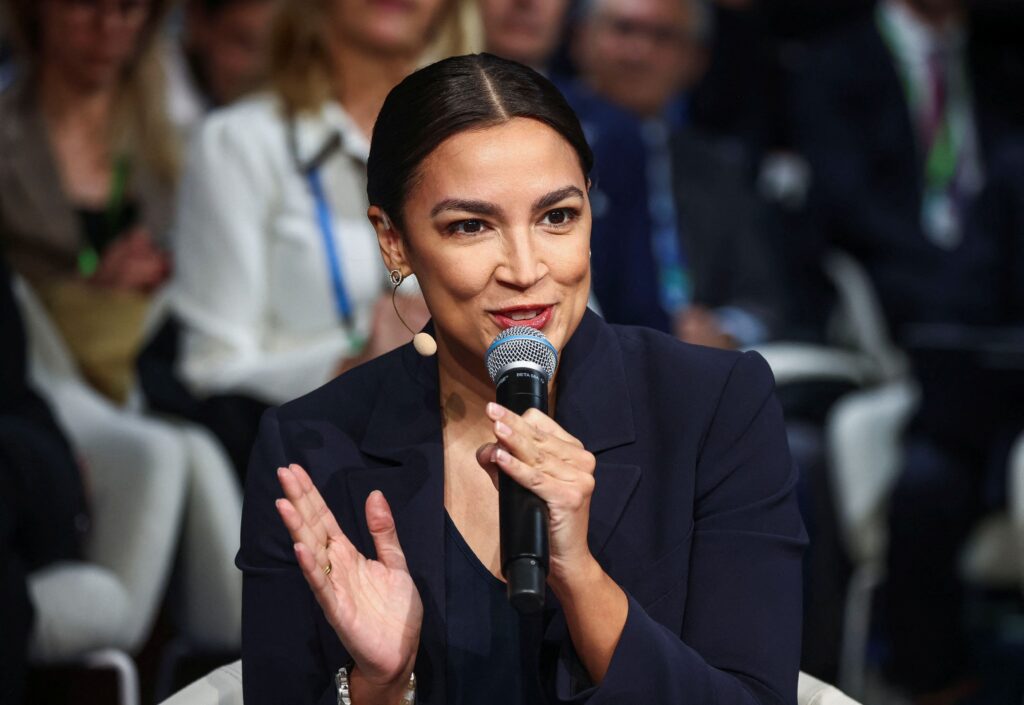
Lest anyone think I am taking the words of Rep. Alexandria Ocasio-Cortez (D-New York) out of context, here is, verbatim, her answer to a question during an appearance at the Munich Security Conference last week. I have removed the “uh”s and “um”s because even the best of us can utter those when speaking off the cuff. Asked, “Would and should the U.S. actually commit U.S. troops to defend Taiwan if China were to move?,” Ocasio-Cortez replied:
“You know, I think that this is such a, you know, I think that this is a, this is, of course, a very long-standing policy of the United States. And I think what we are hoping for is that we want to make sure that we never get to that point, and we want to make sure that we are moving in all of our economic research and our global positions to avoid any such confrontation and for that question to even arise.”
This was a yes-or-no question, and Ocasio-Cortez did not answer it. There’s been a lot of speculation about the congresswoman running for president in 2028. The question of what the United States should do if China invades Taiwan is probably one of the biggest and most consequential problems facing the next president — assuming, of course, that China doesn’t invade before Donald Trump’s second term ends. If Ocasio-Cortez has put any thought into this foreign policy challenge, she hid it well in Munich.
For starters, it was a little surprising that the congresswoman asserts that committing U.S. troops to defend Taiwan is a “very long-standing policy of the United States,” because it isn’t.
In 1979, the U.S. moved to recognize the People’s Republic of China and remove recognition of the Republic of China (Taiwan). But the U.S. has insisted since then that any differences must be resolved peacefully. The U.S. maintains formal relations with the PRC and has unofficial relations with Taiwan; America doesn’t have an embassy in Taiwan, but it does have an “institute” amounting to pretty much the same thing.
Whether the U.S. government wants to say so or not, Taiwan is an independent country by every relevant measure. It has defined borders and complete control over the territory within those borders. Its government is elected by the Taiwanese people, not by anyone within the People’s Republic of China, and makes its own decisions; it does not answer to Chinese leader Xi Jinping. Taiwan has its own constitution, its own currency, its own flag, its own national anthem, issues its own passports and competes as “Chinese Taipei” in the Olympics and World Cup. And it has its own military, prepared to defend its sovereignty — a military that is armed, in part, by the U.S.
One reason AOC may believe that the U.S. has “a long-standing” commitment to defend Taiwan is because Joe Biden, at least four times during his presidency, said the U.S. would do this. For example, on August 2021, Biden said, “We made a sacred commitment to Article V that if in fact anyone were to invade or take action against our NATO allies, we would respond. Same with Japan, same with South Korea, same with Taiwan.”
Each time, Biden staffers rushed to the press to insist that Biden wasn’t changing actually what has been the long-standing U.S. policy: “strategic ambiguity,” also known as “keep the Chinese guessing.” Some might have chalked Biden’s supposed slipup to his advancing age, but in this case he was correctly stating what U.S. policy ought to be, even if for no other reason than to make Xi believe that Chinese aggression would be met with an American military response.
Deterring a Chinese invasion of Taiwan must be a top five U.S. geopolitical priority, and some might put it at the top of the list. The consequences of an invasion would be catastrophic — a massive loss of life; destruction of Taiwan’s best-in-the-world semiconductor production; disruption of Pacific Rim trade with the potential to do serious and lasting damage to the global economy.
Anyone who wants to be the U.S. president needs to have a well thought-out plan to preserve the status quo in the Taiwan Strait. The question will come up again. If AOC wants to be taken seriously as a candidate, she needs a serious answer.
The post AOC tries strategic incomprehensibility appeared first on Washington Post.