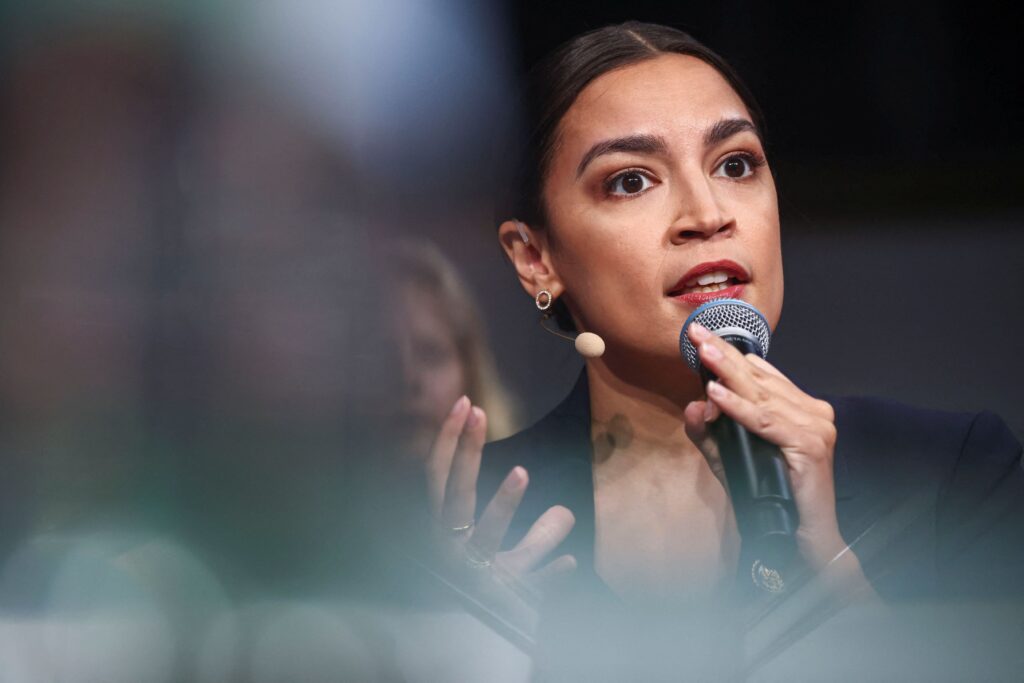
Secretary of State Marco Rubio got the most attention at the Munich Security Conference over the weekend, as he tried to reassure skeptical allies about America’s commitment to Europe. Yet the most revealing performance in Germany came from Rep. Alexandria Ocasio-Cortez (D-New York).
The usually poised politician often appeared out of depth as she tried to graft her class-warfare politics onto foreign policy. On a panel in Berlin, she called for a “class-based internationalist perspective.” In practice, this means that America’s approach to international affairs should simply prioritize her domestic vision.
“It is of the utmost urgency that we get our economic houses in order and deliver material gains for the working class,” she argued in Munich. “Otherwise, we will fall into a more isolated world governed by authoritarians who also do not deliver to working people.” This line isn’t new: In the Biden administration, national security adviser Jake Sullivan’s big idea was to integrate progressive economics and foreign policy.
Ocasio-Cortez is not wrong that authoritarians often come to power because of economic instability. Yet her idea of a foreign policy that would focus on delivering gains for only her preferred segment of American society would fail. Just look at the long list of left-wing dictators who divide their societies by class rather than facilitate growth for everyone.
The message to her European audience was, in short: The West is very bad, but the U.S. and Europe should remain allies anyway. She said that the U.S. had enabled genocide in Gaza and that President Donald Trump was treating Latin America as America’s sandbox. She used conspiratorial language about corporations and oligarchs controlling governments and dictating global affairs to the detriment of the poor people around the world.
It led her to sound more like a university faculty member than someone conducting foreign policy. Behold this difficult-to-diagram sentence: “What we are seeking is a return to a rules-based order that eliminates the hypocrisies around when too often in the West we look the other way for inconvenient populations, to act out these paradoxes.”
Away from class-warfare rhetoric, AOC was asked standard foreign-policy questions and stumbled. Would the U.S. defend Taiwan from a Chinese attack? “This is such a, a, you know, I think that, this is a, um, this is of course, a, ah, a very long-standing, um, policy of the United States,” she responded. She eventually added that it’d be nice to avoid getting to that point with Beijing.
Other possible 2028 candidates appeared, making Munich feel like New Hampshire. Michigan Gov. Gretchen Whitmer (D) played down her foreign policy chops but performed well, speaking about the domestic repercussions of tariffs, which are hammering her state’s economy. California Gov. Gavin Newsom (D) remained in attack mode, saying that Trump’s foreign policy wouldn’t last.
The 2028 Democratic presidential field is wide open, and foreign policy rarely drives votes. Yet there is a lane open in the party for a candidate who is proud of America, appreciates its allies, and doesn’t apologize for capitalism’s success around the world.
The post Class warfare comes to Munich appeared first on Washington Post.