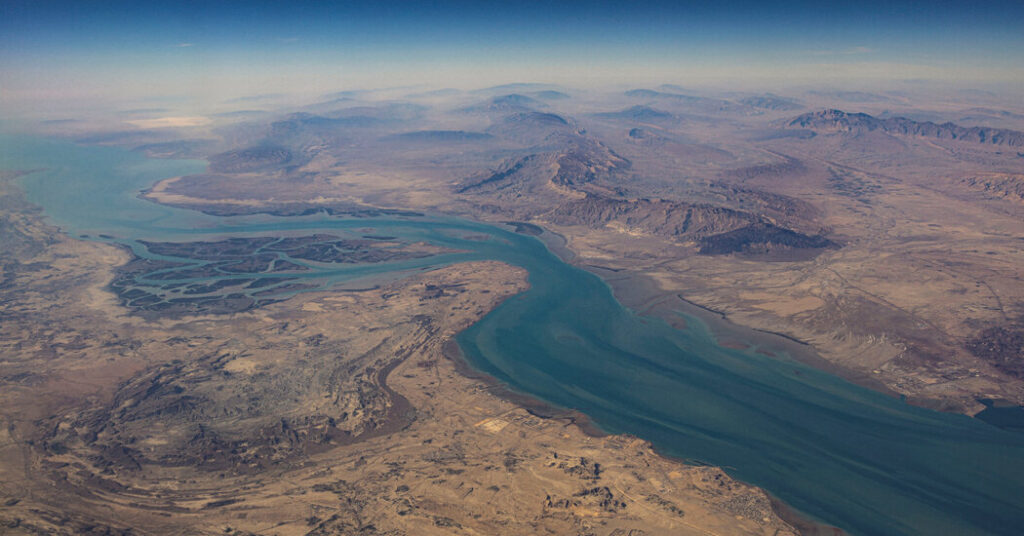
Iran held live military exercises on Monday in the Strait of Hormuz a day before nuclear talks between the United States and Iran were set to resume, an apparent show of its power as President Trump threatens military action and calls for regime change if diplomacy fails.
The drills, led by the Islamic Revolutionary Guard Corps navy, were meant to address “potential security and military threats,” the state-run IRNA news agency reported, citing the Revolutionary Guard.
They come after weeks of mounting tensions with the United States as Mr. Trump has ordered a buildup of American forces in the Middle East and threatened to strike Iran if its leadership does not agree to a deal on its nuclear program. On Friday, he made his most overt endorsement yet of regime change, saying it would be the “best thing” for Iran.
The Pentagon has been building up an “armada” in the region, to use Mr. Trump’s word. That includes the U.S.S. Abraham Lincoln aircraft carrier, accompanied by three warships equipped with Tomahawk missiles. That is at the center of a dozen warships in the region, including in the Arabian Sea, the Persian Gulf, the Red Sea and the eastern Mediterranean Sea.
The Iranian exercises come as another round of talks were set to begin in Geneva on Tuesday, with fundamental differences over Iran’s nuclear program.
“I am in Geneva with real ideas to achieve a fair and equitable deal,” Abbas Araghchi, Iran’s foreign minister, said on X on Monday. “What is not on the table: submission before threats.”
Analysts said they saw Iran’s exercises as an effort to discourage the Americans. Exerting control over the Strait of Hormuz — a narrow 90-mile waterway that connects the Persian Gulf to the open ocean and a key shipping lane for oil and gas — could be meant to show that Iran would be willing to go as far as closing the strait if it needed leverage.
“The Islamic regime foremost wants to strengthen its deterrence and signal preparedness to disrupt shipping traffic,” Farzin Nadimi, a fellow at the Washington Institute who specializes in the security of Iran and the Persian Gulf region, wrote in a WhatsApp message.
The ultimate goal, he added, would be to show the Trump administration “that Tehran can disrupt the flow of energy and force the price of oil and gasoline” to rise at American gas stations.
The Iranian drills were a risky attempt to show the Trump administration that a serious escalation could also hurt the United States, said Omid Memarian, an expert on Iran at DAWN, a think tank in Washington that focuses on American foreign policy in the Middle East.
“Iranian officials invoke this threat to warn Washington that a war with Iran would have serious consequences for global energy markets,” he wrote in a WhatsApp message.
But even if Iran appears to be trying to ward off American pressure, things could tip over into escalation during a heightened crisis, he said. And closing the Strait of Hormuz, without offering what he called a “credible diplomatic offramp” to address American concerns about Iran’s nuclear and missile program, would make the Iranian exercises “bluster without leverage.”
There are no such apparent offramps on the table for the talks. Mr. Trump has three main demands for Iran: ending its nuclear program and discarding its enriched uranium stockpile; reducing the number and range of ballistic missiles; and ending its support for militant groups across the region.
Senior U.S. officials are skeptical that Iran will agree to a deal that satisfies Mr. Trump. Iranian officials have said they are willing to discuss their nuclear program, as the regime faces serious threats to its existence because of both the Trump administration’s threats and domestic outrage over its brutal crackdown on protests, which have killed thousands of Iranians.
But the Iranian government has said they will not reduce uranium enrichment to zero nor budge on other American demands.
Aaron Boxerman contributed reporting.
Amelia Nierenberg is a Times reporter covering international news from London.
The post Iran Holds Exercises in Strait of Hormuz After Trump Threatens Military Action appeared first on New York Times.