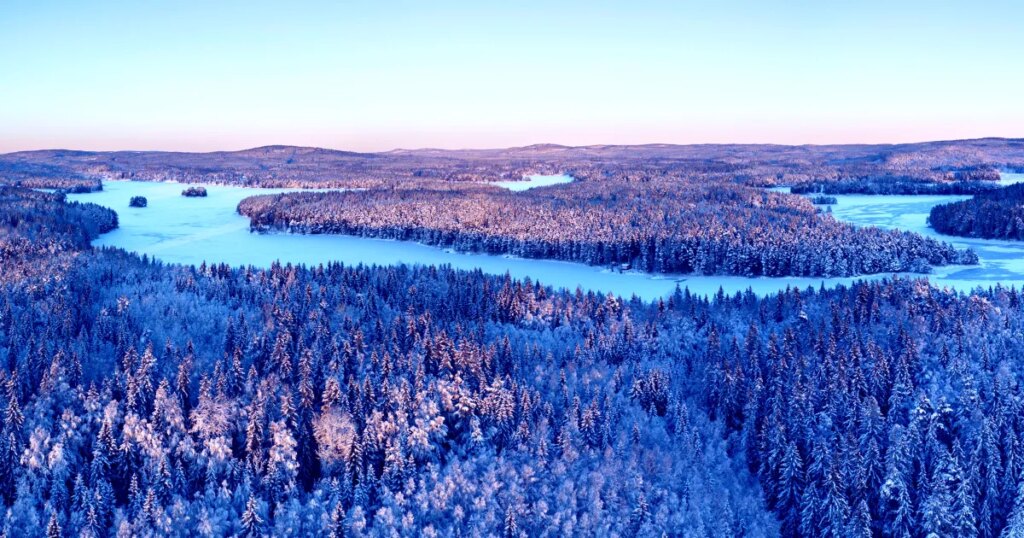
Climate change is leaving plenty of dramatic reminders behind as it reshapes our planet, from rapidly retreating glaciers to more frequent extreme weather events.
Forests are also bearing the brunt of global warming. Scientists recently examined satellite data ranging from 1985 to 2020 and made a striking discovery: that boreal forests, the largest terrestrial biome on Earth — and which are warming faster than any other type of forest — are steadily shifting northwards as they retreat from the heat.
Boreal forests play a key role as one of the world’s largest terrestrial carbon sinks. But how much longer they can sequester excess greenhouse gases in the atmosphere remains uncertain as global temperatures continue to rise.
As detailed in a new study published in the journal Biogeosciences, an international team of researchers — including from NASA’s Goddard Space Flight Center — analyzed imagery from the space agency’s Landsat satellites.
They created a detailed map of tree cover at a resolution of 100 feet to track changes over a 36-year time span. The finding was stark: that boreal forests not only had grown by 12 percent, but had shifted northward by 0.29 degrees of mean latitude.
“These findings confirm the northward advance of the boreal forest and implicate the future importance of the region’s greening to the global carbon budget,” they concluded in their paper.
The implications these changes have on climate change and the future of our planet are nuanced, given the degree of complexity involved. On one hand, a growth in young boreal trees could allow the forests to soak up more carbon in the atmosphere, an estimated 1.1 to 5.9 gigatonnes. To put that number into perspective, all of the world’s trees hold approximately 861 gigatonnes of carbon.
“These changes are not only spatially extensive but demographically consequential: they reflect a growing fraction of young forests with distinct structural and functional attributes that position them as dynamic agents of carbon sequestration,” the team wrote in their paper. “Understanding the contribution of these forests to current and future carbon stocks is essential for anticipating the net climate feedbacks emerging from boreal ecosystems.”
At the same time, an increasingly extreme climate could complicate the picture, sparking enormous wildfires across western Canada as outbreaks of destructive species like the bark beetle cause major losses of pine boreal forests.
Scientists are warning that shorter winters and hotter temperatures in the summer are also resulting in longer dry spells that can cause soils to dry out and harmful algae blooms to form in lakes.
In short, boreal forests may be growing and allowing them to suck up more greenhouse gases, but climate change is also putting them at a much higher risk of tree cover loss due to drought, wildfires, diseases, insect outbreaks, and so on, potentially offsetting any long-term benefits.
“Although the net trends are globally significant, they mask substantial geographic and temporal heterogeneity, as well as complexity in the ecological processes underlying forest change,” the researchers concluded.
“A more complete understanding of boreal forest dynamics will require integration of satellite time series with field-based measurements of canopy structure and the environmental drivers of growth, mortality, and species turnover,” they wrote. “Moreover, translating the resulting information into action to forestall and adapt to climate change will require effective communication across scientific, government, and commercial domains of human activity.”
More on climate change: Plants and Forests Absorbed Almost No Carbon Last Year, Shocking Climate Scientists
The post Forests Are Steadily Crawling North, Satellite Imagery Shows appeared first on Futurism.