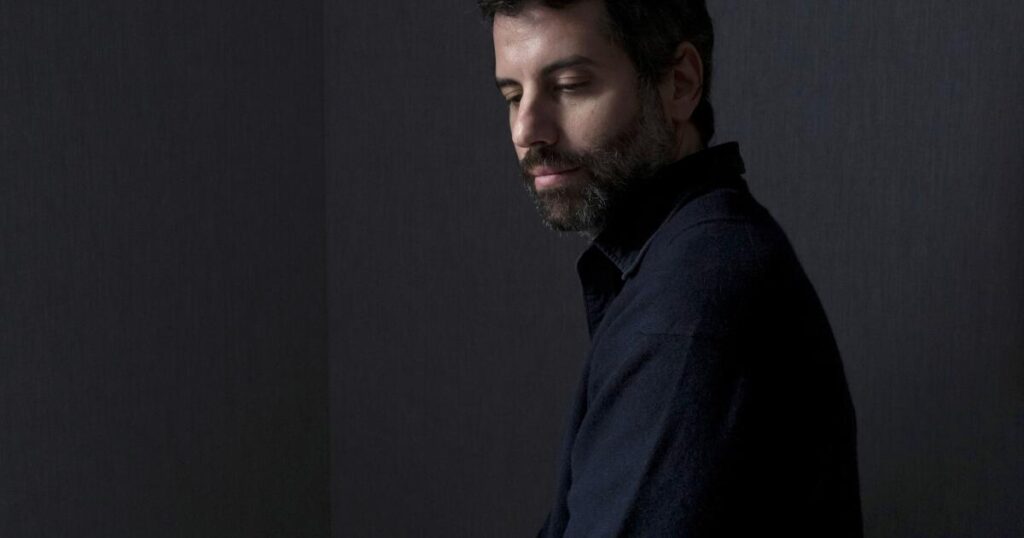
At first, Clint Bentley wasn’t sure if Adolpho Veloso would relate to “Train Dreams,” an adaptation of Denis Johnson’s 2011 novella. The story was distinctly American, about Robert Grainier, a logger and railroad worker living and working in Washington at the turn of the century. Veloso had grown up in São Paulo, a far cry from the Pacific Northwest, but the script struck a chord with the cinematographer, who first worked with Bentley on 2021’s “Jockey.”
“It’s about this guy who works away from home for several months with a bunch of people he never met before that he might never see again,” Veloso says, speaking from the Soho Hotel in London in early February. “When he goes back home, it’s always hard to reconnect with his place and his family, all of the things that changed while he was away. That’s basically my life.”
Veloso realized that if he could relate, then “everybody in the world could connect to it.” “Even though it’s a period piece, it’s so contemporary,” he says. “The main goal for me was to make those themes as simple as possible. We wanted to remove all those layers that period pieces usually have to allow the distance from the audience to the characters to be shortened.”
Sometimes, Veloso did that literally, by bringing the camera in close to the characters. But the most important element was natural light. There is only one scene in “Train Dreams” that uses any artificial light, a pivotal moment in which Robert (Joel Edgerton) runs through a wall of flames. Otherwise, Veloso relied on the sun, candlelight and fire to illuminate his shots. It required a specific shooting schedule, but also a degree of flexibility.
“We were shooting everything on location, so we could position the sets in places that would be better for lighting,” Veloso says. “But Clint was always open to changing things. If we were expecting a sunny day and suddenly it’s raining, then why not? Let’s just do the scene that way now. Often those little surprises and those adaptations would end up being better than what we planned.”
“Train Dreams” was shot around Washington state in real forests. Veloso wanted to treat the natural world as a character, rather than a setting, making it as important as Robert or his wife, Gladys (Felicity Jones). There are purposefully no drone shots.
“Whenever we would shoot nature, we would frame it the same way we would be framing a person,” Veloso says. “Whenever we were shooting Robert, we left a lot of space around him to convey the power that the environment has on us and what we feel, and vice versa. Sometimes it’s just an over-the-shoulder shot, like it’s a silent conversation between him and nature.”
Capturing the enormous trees that would have existed in the early 20th century was a challenge. The production went to protected parks, where they had to be cautious about not affecting the environment. “How do you shoot a movie where they’re supposed to be cutting those trees, but they cannot even get close to those trees?” Veloso says. “It was almost like shooting stunts.”
Bentley did find a logging facility that would allow the team to capture the actual felling of trees. For one of the opening shots, Veloso rigged a camera onto a tree right before it was chopped down. “We did use a camera that we could spare,” Veloso says. “But everything went fine and the camera survived.”
The film follows Robert for most of his life. To denote the passage of time and fallibility of memory, Veloso shifted the way he shot the character in each era. Robert’s childhood was filmed to evoke still images, as if he were only remembering photographs he’d seen. His adulthood incorporated a broader array of techniques. By the end, Veloso brought in a Steadicam to connote that Robert has found more peace in his later years.
“We had these rules we followed throughout the movie, but we tried to make sure they were not imposing anything that would feel wrong,” Veloso says. “We would improvise a lot, so we always had the rules as a guidance.”
The scenes where Robert is together with Gladys and their young child have warm lighting or the haze of golden hour. “All of those memories are probably sweeter than what actually happened,” Veloso says. “The first time there is a really striking sun in the movie, where everything feels harsh, is when he gets to his cabin after the fire and everything is burned and there’s just ashes.”
The final shots, of Robert flying in an airplane for the first time, were captured with practical trickery. Veloso attached cameras to a real plane to film the scope of the landscape, but Edgerton wasn’t allowed to go up because of insurance concerns. Instead the crew built a cockpit on a gimbal several feet in the air and maneuvered the actors across the sky as if they were really flying.
“It’s one of the most important scenes in the movie, so we couldn’t use a green screen,” Veloso says. “This had to feel as natural as everything else. It was a great collaboration from all departments to make it work. The light interaction is real and the sky is real. It had to feel as connected as everything else for the ending to work.”
Being recognized for his work on “Train Dreams” is meaningful to Veloso not just because of his hard work and vision. He’s also grateful to be part of a wave of Brazilian filmmakers who are getting recognition in recent years.
“Brazil has always had amazing movies, amazing filmmakers and amazing filmmakers working outside of Brazil in other countries,” he says. “But it’s amazing to now celebrate art the same way we used to celebrate only football. So it’s great to be part of that, and it’s also crazy at the same time. It’s overwhelming and surprising. It’s definitely changed a lot of things, and hopefully it’s going to mean more work and work that I can be really connected to.”
The post ‘Train Dreams’ cinematographer reveals the secrets behind the film’s natural wonder appeared first on Los Angeles Times.