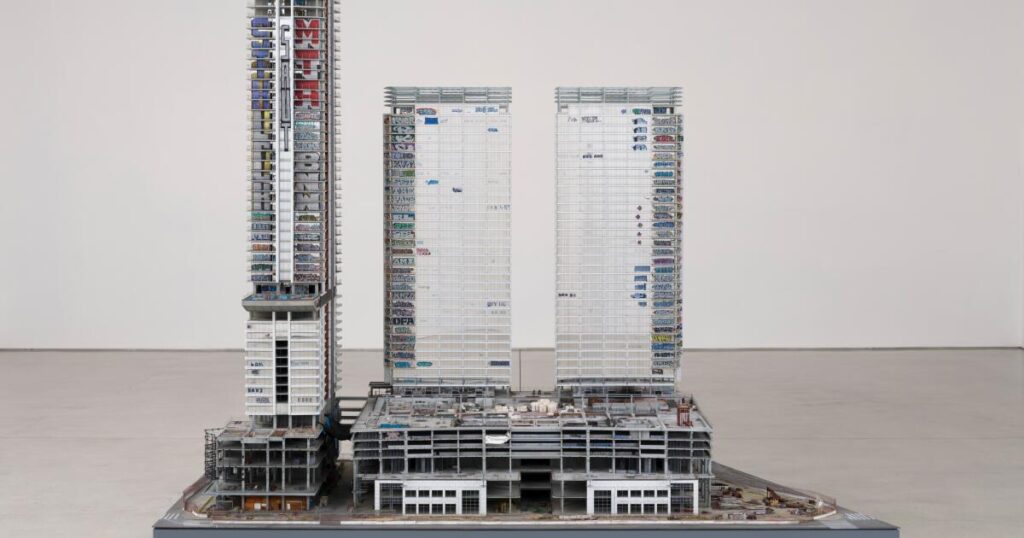
Oceanwide Plaza was supposed to be a trio of gleaming, high-rise mixed-use towers in the heart of downtown Los Angeles. Instead, their unfinished carcasses were abandoned when the developer ran out of money for the $1-billion luxury build in 2019; they now stand as a ruin of capitalist ambition, and an unintentionally spectacular canvas for daring acts of graffiti. An artist couldn’t have dreamed up a better monument to the hubris of overheated development in a city where so many remain unhoused.
Accordingly, L.A. artist Sayre Gomez has built an incredibly faithful scale model of the towers, now on view through March 1 in his exhibition, “Precious Moments,” at David Kordansky Gallery. Created from imagery of the actual towers captured via drone, the sculpture is over 8 feet tall and amazingly accurate, recording the details of each individual work of graffiti, the textures of concrete and iron, and the construction debris left haphazardly about the site. Gomez’s attention to recreating these nuances not only provides views of the towers that can’t be seen from the street but asks visitors to pay attention to the waste, neglect and thwarted possibility they symbolize in our urban core.
The work can be compared to Chris Burden’s erector-set sculptures, but with very different ends. Burden’s “Metropolis II,”perennially on view at Los Angeles County Museum of Art, is a dizzying, looping track for toy cars that zoom between shiny skyscrapers. It provokes wonder at the density and dynamism of a fantasy city. Gomez’s “Oceanwide Plaza,” by contrast, depicts something real and quite dystopian. The sculpture highlights the hollowing out of a dream of unbridled growth as it happens, in real time, in our city.
It may prove a serendipitous snapshot. Earlier this month, the city of L.A. struck a bankruptcy exit dealthat resolves creditor disputes and opens up the possibility of a sale, paving the way for change. Gomez’s sculpture thus becomes an important record of a precious moment: one in which the dregs of greed were laid bare for all to see.
What the model can’t capture is the way the graffiti tags on the towers often stand out, as if emblazoned against the L.A. sky. Surely, writing one’s name amid the clouds is a gleeful exploitation of the buildings’ arrested progress, laying claim to one of the few spaces where nature and the city reliably meet. Gomez takes up this theme in his photorealistic paintings, which often feature dramatic skies juxtaposed with decaying urban signs. “Ice Cream Groceries” depicts a tender, glowing sunset that would be right at home in a travel magazine or a religious pamphlet, except that it’s interrupted by the hulking frame of a busted grocery store sign. In “Vaccine Flag,” a vertical banner arcs gracefully across a soft gradient of L.A. haze, but the banner’s fabric is so tattered and decayed that its advertisement for vaccines is barely legible. The painting is both a lovely composition and a comment on the erosion of public trust in science.
Such images urge an ironic interpretation of the show’s title, “Precious Moments,” which refers to a line of collectible, often Christian-themed figurines that depict cute, mostly white children with doe eyes and oversized heads. Usually engaged in anodyne activities, they present idealized versions of childhood: full of stereotypical sweetness, innocence and light. Perched in the rafters of one gallery are two large dolls in the style of these figurines. Representing Gomez’s children, they evoke something closer to a parent’s reality: lovable kids, grungy and soiled. As “Oceanwide Plaza” subverts the fantasy of the miniature, the dolls do the same for the collectible figurine, asking what makes a moment “precious.”
The exhibition also includes murals featuring familiar childhood imagery: One is an illustration of an enormous traffic accident by children’s book author Richard Scarry. The cacophonous pileup of cars and trucks driven by a wide variety of animals feels like a metaphor for our hopelessly polarized, chaotic and heedless society. This is what people do all day! While Scarry’s books present such catastrophes with bright colors and good humor, Gomez undermines this cheer by superimposing on the mural a nearly all-black painting of a desolate tent encampment in front of a home destroyed by the Eaton fire. The dark underbelly of chaos.
Some of the strongest works in the show are paintings of windows, which depict at least three spaces: what’s behind the glass, the surface of the glass marked with stickers or signs, and a reflection of the outdoors. These images feel like little worlds pressed up against the surface of each painting, akin to the ubiquitous screens — phones, TVs, computers — that routinely flatten our reality. “Apartment Window” is nearly abstract, sandwiching a constellation of peeling, sun-bleached cartoon stickers between a reflected sunset and the stripes of vertical blinds. It’s a mysterious image, suggesting the waning of childhood joy. “Bay Window” is more disturbing, backing its sunset and cheery children’s stickers with crumpled brown drapes and a jumble of pill bottles. Harsh realities — in this case, disease and addiction — don’t often stay behind the curtain.
I was somewhat disappointed to learn that Gomez’s paintings are not based on spontaneous discoveries but on composites of photos he’s taken around the city. The images are purposefully composed, but why paint them? Why not make big printouts of the digital collages and call it a day? Gomez has left at least one clue. In the painting “Vertigo,” an image of a car that someone is clearly living in appears in front of a building topped by a large ad with a sexy, recumbent woman. Looking closely, I spied a thin black outline between the car and the building, a sliver of the car’s original background. By including this artifact of his digital process, Gomez acknowledges that the painting’s subject is not reality as experienced on the streets of the city, but a constructed proposition. By turning such propositions into paintings, he converts slippery digital imagery into something lasting and tangible. His precious moments are not memories of an idealized past, nor projections of a tantalizing dream, but interventions in our complex present that reveal beautiful and unsettling layers.
The post L.A.’s Graffiti Towers become miniaturized symbols of waste and neglect in Sayre Gomez’s arresting gallery show appeared first on Los Angeles Times.