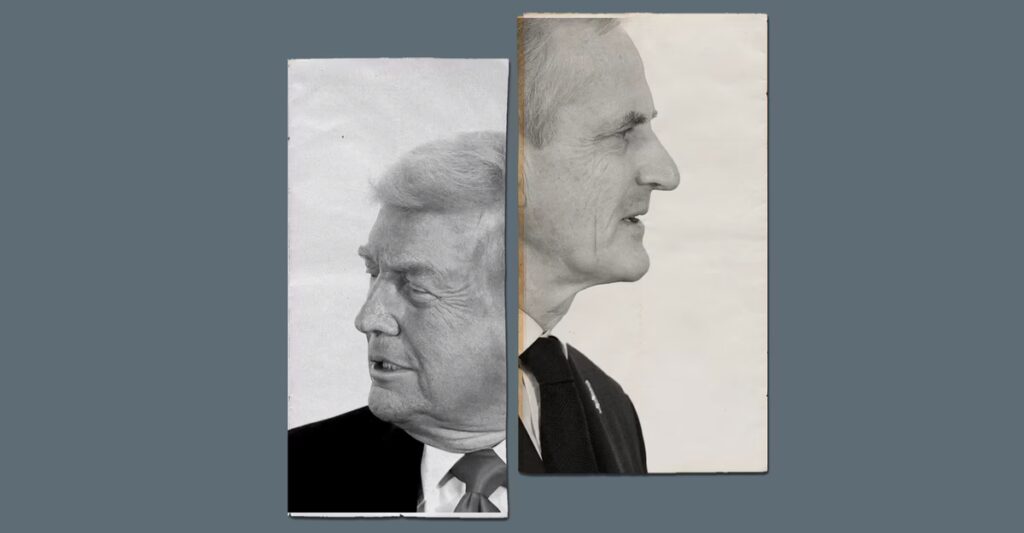
Jonas Gahr Støre, the mild-mannered prime minister of Norway and the scion of a wealthy industrial family, was returning home from a ski outing one Sunday last month when he decided to dash off a text message to Donald Trump. Composing it from the car, he proposed that the leaders talk to find an off-ramp from the looming crisis over Greenland, the semiautonomous Danish territory that the American president has been publicly threatening to seize.
Trump’s campaign poses a threat not just to Greenland and Denmark but also to NATO. The day before Støre’s text, Trump had vowed to impose tariffs on a handful of European countries that had sent soldiers to the Arctic territory in a show of unity with Denmark. The Norwegian prime minister suggested to Trump that they “deescalate,” entreating him, “so much is happening around us where we need to stand together.” The message was co-signed by another Scandinavian leader, Alexander Stubb, the president of Finland.
Two hours later, Støre was sitting at his desk at home when Trump’s reply arrived. “Dear Jonas: Considering your Country decided not to give me the Nobel Peace Prize for having stopped 8 Wars PLUS, I no longer feel an obligation to think purely of Peace, although it will always be predominant, but can now think about what is good and proper for the United States of America,” Trump wrote. He went on to declare that he had “done more for NATO than any other person since its founding.” And he concluded by insisting on “Complete and Total Control of Greenland.”
The exchange came up this weekend when we interviewed Støre on the sidelines of the Munich Security Conference. We were speaking about NATO, Arctic security, and the state of transatlantic relations. The now-infamous text exchange matters for all three. Trump had previously cited U.S. national security as the rationale for acquiring Greenland. But his message to Støre displayed a much more personal motivation—essentially a fit of pique at not being lauded by Norway’s most prestigious institution. What was it like, we wanted to know, to receive such a message from the American president, the leader of Norway’s most important ally?
“What did I think?” Støre said, raising his eyebrows. “I thought, Well, it’s just bringing the debate to a level where we don’t solve problems.” That seemed like an understatement, but he continued. “I’m not going to engage in a shouting match,” he said. “I’m not going to respond to it.” Støre did reply to Trump, he told us, sending back a short message that said, as he paraphrased it, “I take your message; I still think it’s useful to talk.”
In his first extended remarks about the back-and-forth, the prime minister told us that he was not surprised by the grievance-filled communication because he’s familiar by now with Trump’s fixation on the Nobel Peace Prize. He has repeatedly told the president that pressure won’t help his cause, given how prize decisions are made. “I reminded him every time that it’s not my decision; it’s not the government’s decision. This is an independent committee. It is staunchly independent,” Støre said. The process is so divorced from politics, he added, that “some of my diplomats say, you know, ‘If the prime minister would try to interfere with the Nobel committee, he would have to resign, because it would simply be unacceptable.’”
Trump seems not to accept that explanation. “He doesn’t listen on that frequency, I would say,” Støre said, holding up his hand to his ear. “So, here it came with that message.” Ten minutes after receiving Trump’s response, the prime minister got word from NATO colleagues that they had received the same missive. The White House had transmitted the reply to numerous European embassies in Washington, in essence presenting the president’s diatribe about being denied the peace prize as a formal White House position.
A columnist for Norway’s leading newspaper put it bluntly: “For the first time in Nobel history, war was threatened because a head of state did not receive the Peace Prize,” Harald Stanghelle wrote in Aftenposten. “It could not be more absurd.”
How and to whom the Nobel Peace Prize is awarded have been topics of both fascination and controversy since Alfred Nobel, a Swedish chemist who earned a fortune from the invention of dynamite, left provisions in his will for a series of prestigious awards in various pursuits, including literature and chemistry. The peace prize has been awarded nearly every year since 1901 by a committee of five members, all of them appointed by the Norwegian Parliament.
Their secretive deliberations take place at the Norwegian Nobel Institute, which Trump has pushed into an unwelcome spotlight. Its director, Kristian Berg Harpviken, told us that the institute has responded by trying to be more open about the way it chooses a winner each year, hoping transparency can help deflect the accusations of bias coming from Trump and his supporters. “The strategy for clearing the air is simply to talk about it,” he said in an interview in Munich. (When asked why the head of an institute that rewards initiatives of peace would attend a summit devoted to matters of war, Harpviken explained that such events help him give informed advice to members of the Nobel Committee.)
A sociologist by training, Harpviken responds to questions about Trump with a tired smile. “We cannot discuss specific names,” he said. During the hour we spent at an outdoor café despite the sleety winter weather, he referred to the U.S. president only as the “candidate in question,” and did his best to avoid expressing even the slightest hint of an opinion about him.
He focused instead on the history of the institute he has run since last January, and the way its traditions serve as the best defense against Trump’s attacks. “We see it as important that as many people as possible understand how it is that we work and what the principles are,” Harpviken told us. “Whether those lobbying for the prize are receptive to that or not is really beyond our control.”
Early on, the government in Oslo arguably used the prize as a tool of foreign influence. It was awarded in 1906 to Theodore Roosevelt, “clearly a very political decision at the time,” Harpviken said. The Norwegians had gained their independence from Sweden only the year before, and they wanted to attract Roosevelt’s attention and his support against “their European rivals, particularly Sweden,” he said.
Over the decades, as the prestige of the prize grew, the Nobel Committee developed safeguards against political influence. But it has not always stopped politicians from giving it a steer. One of them, according to a former Nobel insider, was Støre. In 2010, when he was serving as Norway’s foreign minister, Støre allegedly approached the then-chair of the Nobel Committee, Thorbjørn Jagland, and explained the damage that Norway’s economy would face from China if the prize were awarded to the dissident Liu Xiaobo, who was then serving a lengthy prison sentence. (Jagland divulged the encounter with Støre in his 2020 autobiography, Du skal eie det selv [You Yourself Must Own It.])
In a statement responding to Jagland’s account, Støre told us: “It is an important principle that the Norwegian Nobel Committee remain independent and free. As I did already in 2010, I categorically reject this assertion. I have never done anything to jeopardize the independence of the Norwegian Nobel Committee.” The committee granted the prize to Liu, and Beijing retaliated by imposing restrictions on Norwegian goods and cutting off diplomatic relations with Oslo for six years.
Many of the Nobel Committee’s decisions have caused international outrage. The choice of Aung San Suu Kyi, a dissident in Myanmar who received the prize in 1991, began to look problematic when Aung came to power in 2016 and defended the genocide that the Burmese military carried out against the Rohingya, an ethnic minority group.
Barack Obama won the 2009 prize less than a year into his presidential tenure. The speech he had delivered in Prague earlier that year, in which he pledged to work toward a world without nuclear weapons, helped convince the committee that he was a worthy recipient, even though he would in effect be honored for actions he had promised but not yet delivered. During both of his terms in office, Obama made extensive use of drone strikes in the pursuit of American military objectives in Afghanistan and the Middle East, leading to debate among Norwegian politicians and intellectuals about whether the prize had been a mistake.
[Read: Trump’s letter to Norway should be the last straw]
In recent months, amid the pressure from Trump and his supporters, Harpviken has spent a lot of his time explaining the committee’s standards of discretion and objectivity. All records of its deliberations remain sealed for 50 years after each prize is awarded. All members of the committee sign nondisclosure agreements, he said, and observe strict rules of secrecy about the candidates for the prize and the selection process every year: “Even my wife knows absolutely nothing about who is nominated.”
No politicians in Norway have tried to sway the committee’s views on whether Trump would be a deserving recipient of the prize, he said. “We haven’t had the embassy or officials knocking on our doors. Nothing like that.” The campaign from Trump and his supporters, he added, will not influence the committee’s deliberations in any way. “A candidate who is aggressively campaigning for him or herself will neither be penalized nor privileged,” he said. “We are very conscious about that.”
None of this means that Trump is likely to give up his quest. “President Trump deserves the Nobel Peace Prize many times over,” Anna Kelly, a White House spokesperson, said in an email.
Before his text exchange with Trump, Støre had not been planning to attend the upcoming World Economic Forum in Davos. He changed his plans because tensions over Greenland seemed likely to erupt in the Swiss mountain town. Støre sat in the audience as Trump brought his grudge against NATO to the crowd of the world’s elites, saying, as the prime minister summarized the message, We give everything to NATO, and we get nothing in return. The speech brought reason for some relief, because Trump ruled out the use of military force to take Greenland. Hours later, he also backed off his threat of tariffs after a meeting with NATO Secretary General Mark Rutte. A working group involving senior officials from the U.S., Denmark, and Greenland is now seeking a compromise that could allow an expanded U.S. military presence on Greenland.
But Trump’s underlying message about the dynamics within NATO was wrong, Støre said. NATO countries, including the United States, benefit enormously from Norway’s military expertise, especially in the Arctic, where the Nordic country shares a land and maritime border with Russia. Norwegian forces, with British and American counterparts, monitor Russian capabilities in the high north, Støre told us, feeding back information on where Russia is moving its submarines and how it tests its weaponry. “One hundred kilometers from that border you have the Russian nuclear-strike capacity,” Støre said. “And as I tell my American interlocutors, it is not primarily directly against me, but against you.”
[Read: Does America really want to pick a fight with Greenland?]
And much as they fail to appreciate the dynamics of the Nobel awards, U.S. officials don’t give due credit to Norway’s deep knowledge and experience dealing with Russia. “Norway has been Russia’s neighbor for a thousand years, and Norway has in fact been at peace with Russia for a thousand years,” Støre said, noting that his country is one of Russia’s only European neighbors with which it’s never been in direct armed conflict.
Støre credited Trump for initiating negotiations with Russia over a potential peace settlement in Ukraine, praise he told us that he shared with the president when he visited the White House last April. Washington, he said, still has a vital role to play: “It’s only the might of America that can bring the Russians to the table.”
In the aftermath of the Greenland crisis, Støre resorts to what is by now a common European exercise: finding cause for optimism in the otherwise bewildering interactions with Trump and his administration.
He is encouraged by the defense cooperation with Washington even when disagreements emerge, as they did when J. D. Vance told Europe’s governments at the 2025 Munich conference that they pose a greater threat to their own societies than Russia or China do. We spoke just before Secretary of State Marco Rubio addressed this year’s conference, padding the administration’s criticism of Europe with a softer tone. “In a time where politics may get rough in the dialogue, as in J.D. Vance’s speech here last year and President Trump’s speech in Davos, there is some stability in this defense-intelligence layer,” Støre told us.
As for his text exchange with Trump, he said, “I would simply, you know, pay tribute to Trump that he takes messages.” Joe Biden, he said, “never did.”
“I mean, you can access him,” Støre said of Trump, clasping his hands then resting them resolutely on the table before him. “We are leaders, and I appreciate that.”
The post Where Trump Went Wrong in His Quest for the Nobel Peace Prize appeared first on The Atlantic.