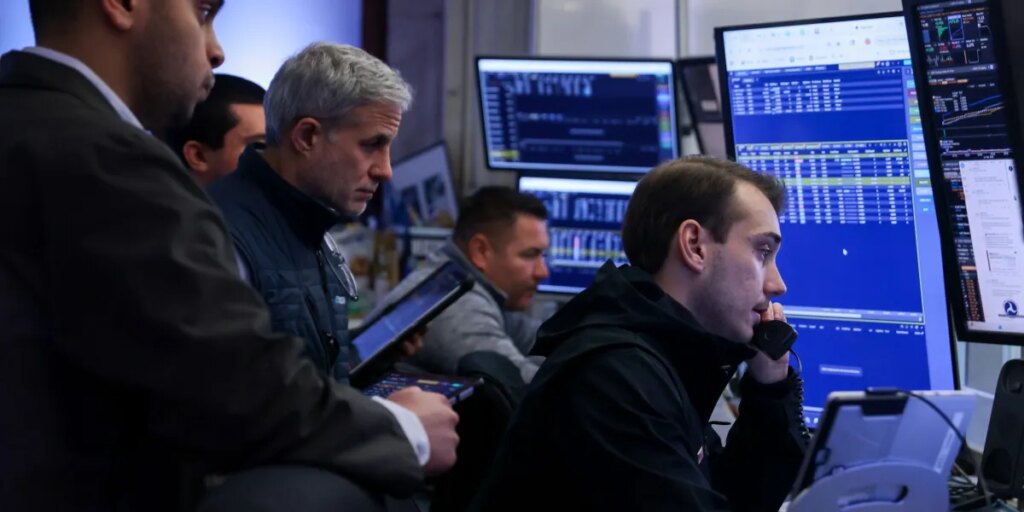
The stock market turmoil unleashed by the artificial-intelligence industry reflects two fears that are increasingly at odds.
One is that AI is poised to disrupt entire segments of the economy so dramatically that investors are dumping the stocks of any company seen at the slightest risk of being displaced by the technology.
The other is a deep skepticism that the hundreds of billions of dollars that tech giants like Amazon.com Inc., Meta Platforms Inc., Microsoft Corp. and Alphabet Inc. are pouring into AI every year will deliver big payoffs anytime soon.
The dueling anxieties have been brewing for months. But they’ve shifted to the center of the stock market over the past two weeks. The result has been a series of punishing selloffs that have hammered dozens of companies across a number of industries — from real estate services and wealth management, to insurance brokers and logistics firms — and wiped more than $1 trillion from the market values of the big tech companies investing the most in AI.
“There is a contradiction when it comes to what investors are worried about when it comes to AI,” Julia Wang, the north Asia chief investment officer at Nomura International Wealth Management, told Bloomberg Television. “Those two things can’t be true at the same time.”
The shift marks a major break from the sentiment of the last few years, when speculation that AI would set off a transformative productivity boom kept pushing stock prices higher. While big tech stocks kept rising — sending Meta surging nearly 450% from the end of 2022 until the start of this year, and Alphabet up more than 250% — the hand-wringing over whether it was a bubble about to burst did little to derail the rally.
That began to change late last month as earnings reports from some of the biggest tech companies started to spook investors, who are growing impatient that the spending has yet to produce a commensurate windfall in revenues.
Microsoft, Amazon, Meta, and Alphabet alone are expected to spend more than $600 billion on capital expenditures in 2026. That’s hoovering up free cash flows and loading the companies with depreciating assets, radically altering many of the characteristics that have helped fuel the firms’ rise over the past decade.
“This is a real no-win situation,” said Anthony Saglimbene, chief market strategist at Amerprise Advisor Services. “Investors were comfortable saying, ‘so long as it happens in the future, I’m comfortable with Microsoft or Amazon or Alphabet spending the money.’ Now they want to know more immediately when the payback will come — and we don’t have a clear picture.”
Since Microsoft and Meta kicked off the fourth-quarter earnings season on Jan. 28, Microsoft and Amazon shares have each dropped more than 16%, with Amazon mired in its longest losing streakin about 20 years.
Even Alphabet, which is widely regarded as the biggest AI winner in the group, is down 11% off a recent peak. Meta, whose strong revenue growth overshadowed higher-than-expected capital spending, has fallen 13% since an earnings-fueled rally. In total, nearly $1.5 trillion in combined market value has been wiped out from the group, pushing the tech-heavy Nasdaq 100 Index into negative territory for the year.
At the same time, investors are growing increasingly worried about the businesses that will potentially be swept aside — or at least significantly upended — by the new applications that are being steadily rolled out.
That has caused a series of stock market selloffs that have flared repeatedly and hit private-credit firms, video-game makers and software companies, among others.
The latest bout began after Anthropic PBC released productivity tools for lawyers and financial researchers, hammering the stock price of companies across those industries. Insurance brokers tumbled on another program tied to OpenAI. One from a little-known startup, Altruist Corp., battered wealth-managers like Charles Schwab Corp. and Raymond James Financial Inc. Even a press release from a former karaoke company with less than $2 million in quarterly revenue sent the stocks of logistics companies tumbling.
The market has seen previous AI-related routs that were later reversed, such as the one set off by the Chinese company DeepSeek early last year. And to many, the frantic selling looks like another overreaction — especially since AI, rather than displacing entire companies may very well wind up making them more profitable instead.
“Just because the exuberance of the past few years has been taken down, people are now acting irrationally, thinking AI has become a headwind to the economy,” said Bobby Ocampo, the co-founder and managing partner of Blueprint Equity.
However, he added, the underlying concerns are legitimate. “There are a lot of AI-first companies trading very aggressively, but it is still very much a landgrab. People are starting to realize they’re not meant to be super efficient or profitable in the near term.”
The spending spree has, of course, already been a boon to the companies that are on the receiving end of it, like Nvidia Corp. and memory chipmaker Micron Technology Inc. The shares of both soared over the past three years as sales surged.
But the pile of money the tech giants are throwing at AI is getting so big that there’s increasing skepticism about whether it can continue.
On Tuesday, UBS Group AG cut its recommendation on technology stocks from attractive to neutral, citing still lofty valuations and expectations that the recent pace of capital spending by big tech companies — often referred to as hyperscalers — is unsustainable.
“This level of capex will consume almost 100% of hyperscalers’ cash flow from operations compared with a 10-year average of 40%,” Ulrike Hoffmann-Burchardi, chief investment officer Americas at UBS Wealth Management, wrote in a note to clients. “That spending is now increasingly being funded by external debt or equity financing.”
At the same time, some are dubious of the fears that have rocked the market over the past few weeks. After all, given the relatively slow commercial adoption of AI, the way it will reshape business more broadly remains a subject of debate.
“It might take a lot for the market to snap out of the doom loop and realize fundamentals are strong, the companies building AI will benefit, and that more companies can benefit by growing revenue and so forth with AI,” said Ameriprise’s Saglimbene.
“When the market finally feels these companies aren’t going out of business, it will realize AI is a tool that can lead to greater profitability, and that the companies that deploy it will gain. But we’re going to be in a period of volatility for the foreseeable future.”
The post A stock market doom loop is hitting everything that touches AI appeared first on Fortune.