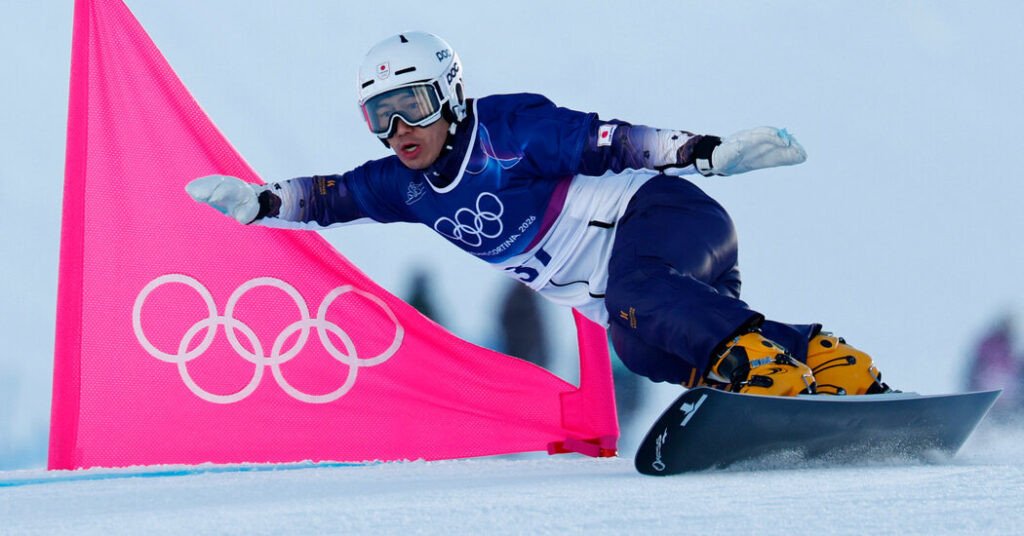
The Japanese snowboarder Masaki Shiba had just finished his first high-speed, head-to-head run in the parallel giant slalom at the Winter Games when he was abruptly disqualified.
It wasn’t a false start, or even a failed doping test. His snowboard had tested positive for traces of PFAS, or “forever chemicals,” which have been banned at the Winter Olympics for the first time this year because of their damage to the environment and the human body.
Shiba and two South Korean skiers were disqualified in the last week. They are the first known offenders of a new rule that bans the use of ski wax that contains these chemicals, which have moisture-wicking properties that can help skis and snowboards go a lot faster in the snow.
The snowboarder said he could scarcely believe it. He was aware of the ban, which has also been adopted at other top-tier events, and thought he had complied.
“I’ve competed with the same board and same wax,” he posted on his Instagram account, “and never once tested positive.”
PFAS, or per- and polyfluoroalkyl substances, are a class of chemicals that have a special bond of carbon and fluorine atoms, making them strong and resistant to water, dirt, heat and oil. For that reason, they’re used in everyday items as varied as microwave popcorn bags, water-repellent clothing, stain-resistant carpets, cosmetics, dental floss, nonstick frying pans — and ski wax.
The problem is that exposure to PFAS can cause damage to the liver and immune system. PFAS have also been linked to low birth weight, birth defects and developmental delays as well as increased risk of some prostate, kidney and testicular cancers.
Once they’re in the environment, they are highly mobile in water and air and don’t break down, earning them the name “forever chemicals.” They can contaminate the soil and drinking water, and can make their way into crops and livestock.
Researchers have also found elevated concentrations of PFAS in the soil at family ski resorts, on ski slopes and on cross-country trails after competitions. In 2023, to address rising concerns over human exposure and environmental contamination, the International Ski and Snowboard Federation banned the use of PFAS-containing ski wax.
Since then, top-tier events began to test skis and snowboards for PFAS. The 2026 Winter Olympics for the first time also incorporated that rule.
On Day 2 of the competition, Shiba was disqualified, ending what was most likely the 39-year-old’s last Olympics run. Then on Day 4, two South Korean skiers, Lee Eui-jin, 24, and Han Da-som, 31, were disqualified after the women’s sprint classic qualifier. In all three cases, their scores were voided for their use of PFAS-containing fluorinated wax, according to their official scoring records.
The South Korean news media quoted the Korean Olympic committee as saying the positive results stemmed from supplier error. Hayashi Wax, the manufacturer of the ski wax used by Shiba, said in a statement that it had discovered that a coach had mistakenly treated the athlete’s snowboard with a different brand of wax.
“It’s simply not true” that PFAS had been detected in its products, Masako Hayashi, the company’s chief executive, said.
In the grand scheme of things, the amount of PFAS shed by skis and snowboards into the environment is most likely tiny compared with the PFAS released from factories, wastewater treatment plants and a long list of everyday products.
But there’s been increased attention in recent years on PFAS used in sports and outdoor gear because of their potential to bring the chemicals to remote areas. A 2021 study detected PFAS on Mount Everest, probably left behind by outdoor gear used by climbers.
For recreational skiers and snowboarders, the Environmental Working Group, an advocacy group that tracks PFAS contamination, has this advice: If you get your equipment professionally serviced, ask that the shop use PFAS-free wax. And if you apply wax yourself, look for products labeled PFAS-free.
Hiroko Tabuchi covers pollution and the environment for The Times. She has been a journalist for more than 20 years in Tokyo and New York.
The post Three Olympic Athletes Were Just Disqualified for a Novel Reason: PFAS appeared first on New York Times.