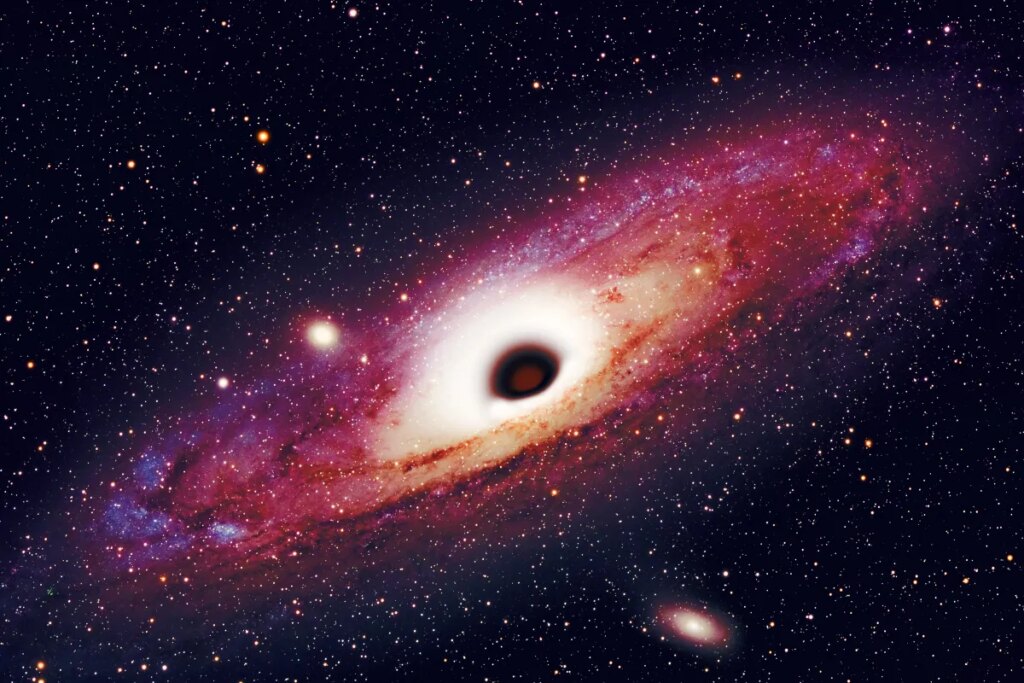
The traditional understanding is that the center of our galaxy is dominated by a supermassive black hole. The “supermassive” part isn’t a mere superlative; your typical black hole that forms from the explosive death of a star weighs up to dozens of times than the Sun, while a supermassive one like the Milky Way’s Sagittarius A* would be around four million times our star’s mass.
But new research challenges this long held idea. Instead of a black hole, there could be something else lurking there that’s also invisible to observers: a colossal clump of dark matter, the substance thought to account for 85 percent of all mass in the cosmos.
A new study, published in the journal Monthly Notices of the Royal Astronomical Society, argues this would be possible if the dark matter entity was made of subatomic particles called fermions. Compared to traditional dark matter, which forms more diffuse blobs or “halos,” fermionic dark matter would press together to form a more tightly packed core.
Dark matter, though a cornerstone of modern cosmology, remains hypothetical. Its existence was inferred after astronomers realized that the visible, ordinary matter contained in galaxies wouldn’t exert enough gravity to hold themselves together, given the speeds that galaxies rotate at. In their models, dark matter provides the gravitational glue that keeps these vast realms from flying apart.
Perhaps it isn’t a stretch that dark matter could form the center of galaxies, too. In their study, the team found that replacing Sgr A* with a fermionic clump reproduced the black hole’s immediate gravitational effects, including the orbits of fast-moving stars near the galactic center that zip around at speeds up to a few thousands kilometers per second called S-stars.
Additionally, the dark matter theory could explain another galactic phenomenon: why stars at the outskirts of the Milky Way appear to drop off in speed, called Keplerian decline. The researchers say that this could be explained by a combination of their dense dark matter core and the vast halo of dark matter that spans the galaxy.
“We are not just replacing the black hole with a dark object; we are proposing that the supermassive central object and the galaxy’s dark matter halo are two manifestations of the same, continuous substance,” said coauthor Carlos Argüelles, of the Institute of Astrophysics La Plata, in a blurb about the work.
But what about that groundbreaking picture of Sagittarius A* taken by the Event Horizon Telescope? The researchers argue that the glowing accretion disk of hot matter swirling around the galactic center could cast a similar shadow seen in the image.
“The dense dark matter core can mimic the shadow because it bends light so strongly, creating a central darkness surrounded by a bright ring,” said lead author Valentina Crespi, of the Institute of Astrophysics La Plata, in the writeup.
It’s a provocative theory, though not quite compelling enough to dislodge the black hole consensus just yet. But future observations that look for key black hole telltales could eventually vindicate the astronomers.
More on space: Physicists Think They Saw a Black Hole Explode
The post The Object at the Core of the Milky Way Might Not Be a Black Hole at All, Scientists Say appeared first on Futurism.