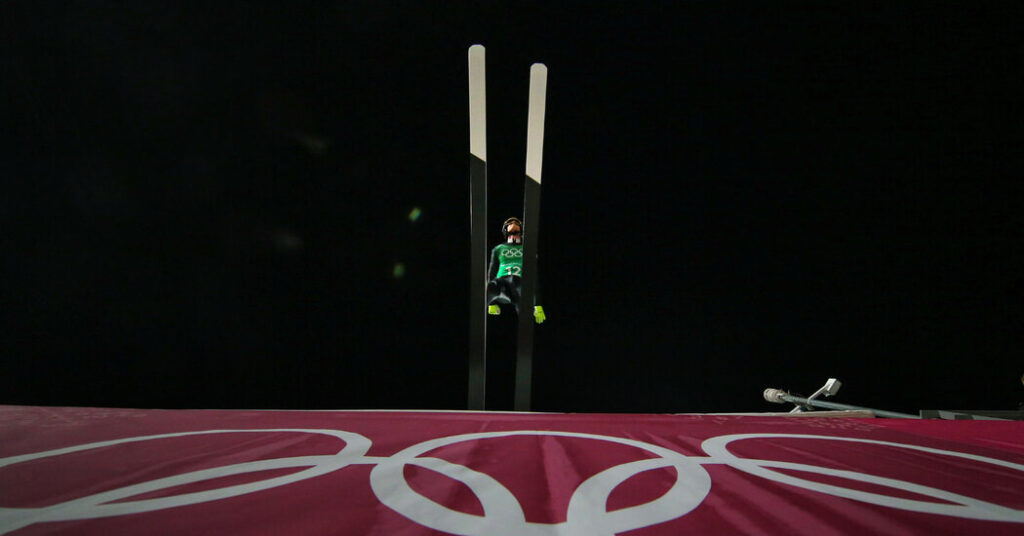
On Monday, two dozen Olympic ski jumpers will gather at the Predazzo Ski Jumping Stadium in the Italian Alps for the men’s super team competition, which involves racing down a 378-foot slope at speeds upward of 60 miles per hour, then leaping skyward and ideally landing near or surpassing the world-record mark of 146.5 meters, or just under 481 feet.
Ski jumping, which demands an intuitive senes of complex, fast-moving physics, is one of the more nerve-racking events at the Winter Olympics. To win gold — or even just to avoid crashing — athletes must harness the momentum gained as they hurtle down a ramp and then soar aerodynamically atop a massive pair of skis.
“A jump is a pretty complex thing that happens within 15 seconds,” said Christoph Leitner, a professor of electrical engineering at ETH Zurich in Switzerland. “There is this narrow window of 300 milliseconds, which is the actual leap. And all the positioning, the center of mass, everything must be stable when you arrive to optimize your performance and the length of the jump.”
Athletes have employed all kinds of methods to improve their jumps, including video feedback. In January, a scandal erupted in Norway after some athletes and coaches were caught illegally adding stitching into the crotches of the skiers’ stretchy speedsuits to increase the surface area and lift, thereby boosting their flying distance. International sports antidoping officials are also investigating rumors that, toward the same end, some ski jumpers may have injected their penises with a drug to increase the organ’s size and surface area.
Future Olympic ski jumpers may be able to take advantage of a different technological edge: Dr. Leitner and his colleagues have been refining a wearable device that tells jumpers in real time how to adjust their bodies during takeoff and flight for maximum distance.
The device, introduced at an Institute of Electrical and Electronics Engineers conference in 2023, uses sensors on an athlete’s ski boots that continuously measure both body position and the amount of pressure being applied to the skis. The sensors are linked to a pair of goggles, providing the jumper with instant feedback. Dr. Leitner said he hoped the setup would be available to help skiers train for the next Winter Olympics, which are set to take place in the French Alps in 2030.
For a ski jumper, the ideal body position maximizes the ratio between the lift provided by the skis, which behave like an airplane wing as air flows over them, and the force of drag as their body moves through the air. Skiers control their speed by applying pressure from their shins and heels to the insides of their ski boots.
As a jumper races down the ramp while wearing Dr. Leitner’s goggles, they see small red or green lights in the periphery of their vision indicating whether they need to make adjustments. The same data is fed to the laptop of a coach watching from the bottom of the hill.
The greatest engineering challenge, Dr. Leitner said, was translating the sensor data into a usable format for the athlete. Too much information could lead to overthinking and perhaps a loss of performance — or worse, a crash. But minuscule, peripheral lights should be enough to help jumpers make the necessary tweaks, the researchers concluded.
“We have created a sensor system that collects data and is able to process this data and save the data and transfer it to the cloud or give feedback to the athlete,” said Dr. Leitner, who added that the bulk of the data can be analyzed after a skier has landed safely.
The goggles can help diagnose problems with stance and pressure as a skier hurtles down the ramp before takeoff, according to Matheo Käch, who collaborated with Dr. Leitner and who is a coach and researcher at Swiss Ski, Switzerland’s ski federation.
“The coach is able to see where the highest pressure points are, and, before he realizes the jump wasn’t perfect, where the problem started,” Mr. Käch said.
The sensors on the boots also record signals that can help the athlete and coach determine whether the skier is too far back or forward on the skis and optimize the angle between the skis and the body — a critical calibration for generating lift.
For now, the device is being tested by junior ski jumpers and members of Switzerland’s “B” team. Preliminary results indicate that it improves performance, Dr. Leitner said. He and his colleagues hope to expand its use to other winter sports, where it might, for instance, help a biathlon competitor adjust his or her stance while shooting a rifle.
“The athlete does these jumps hundreds of times, so he knows exactly how his jump feels,” Mr. Käch said. “But we do not have measurements to these feelings. With this device, the coach can imagine what an athlete should feel.”
The post Could an Electronic Coach Help Ski Jumpers Leap Farther? appeared first on New York Times.