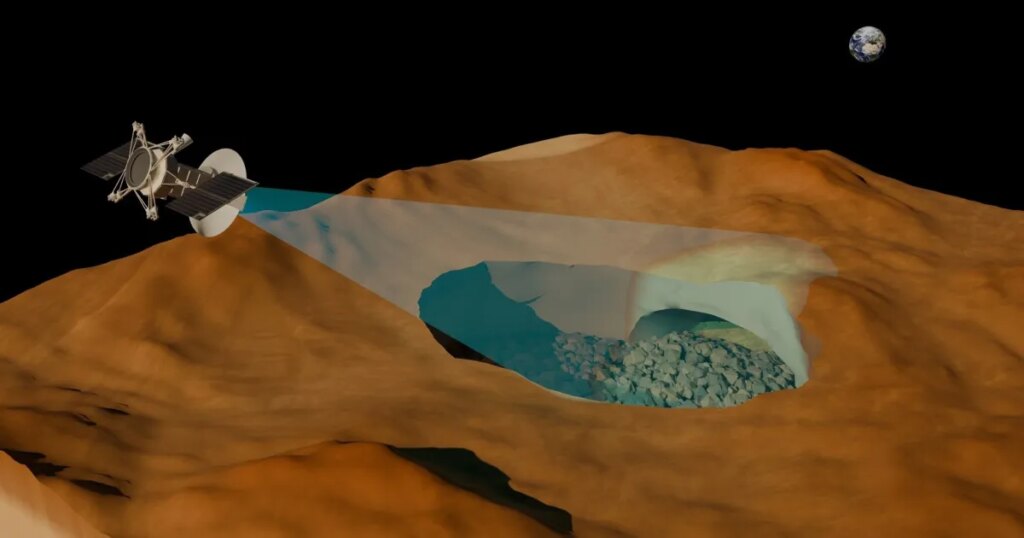
Astronomers say they’ve spotted a vast cave lurking beneath the surface of Venus — providing the strongest evidence yet that the planet is tunneled with lava tubes.
The discovery of the cave, described in a new study published in Nature Communications, adds to our understanding of how Venus was shaped by its hellish preponderance of volcanos.
“Our knowledge of Venus is still limited, and until now we have never had the opportunity to directly observe processes occurring beneath the surface of Earth’s twin planet,” said coauthor Lorenzo Bruzzone at the University of Trento in a statement about the work. “The identification of a volcanic cavity is therefore of particular importance, as it allows us to validate theories that for many years have only hypothesized their existence.”
Scientists have long suspected that Venus harbored lava tubes, which are also known as pyroducts. Its surface is scattered with perhaps tens of thousands of volcanoes, and is scarred with volcanic plains and lava channels. Several studies have indicated signs of recent volcanic activity on the planet. Clues like these indicated that Venus’s history was dominated by volcanism, but direct evidence of the lava tubes has, until now, eluded detection, while it remained unclear how Venus’ weaker gravity and far denser atmosphere than Earth would affect their formation.
On top of the obvious challenge of spotting something underground, optical observations of Venus’ surface are virtually impossible. The planet is permanently shrouded in a thick cloud layer of sulfur and carbon dioxide, trapping the Sun’s heat and contributing to its incredible surface temperature of over 870 degrees Fahrenheit.
Radar, however, can penetrate this sulfuric shroud. Instead of relying on fresh observations, the researchers combed through data collected by NASA’s Magellan spacecraft between 1990 and 1992 using its Synthetic Aperture Radar. “SAR works by transmitting radio waves towards the surface and measuring the time it takes for the waves to bounce back after interacting with the terrain,” the authors explained in the paper. “By processing the returned radar signals, a detailed backscattering map of the Venusian surface has been produced.”
The team analyzed the radar images “where there are signs of localized surface collapses using an imaging technique that we have developed to detect and characterize underground conduits near skylights,” said Bruzzone. (In geology, a skylight refers to a hole formed on a planet’s surface where the roof of a lava tube collapsed.)
Their analysis revealed a “large subsurface conduit in the region of Nyx Mons,” Bruzzone said, referring to a shield volcano that’s a mighty 225 miles wide. This conduit, or essentially a large cave formed by volcanism, they argue, is a lava tube, and a remarkably large one at that. The team estimates a diameter of around one kilometer, which is bigger than pyroducts found on Earth and Mars, lining up with scientists’ predictions.
“The available data allow us to confirm and measure only the portion of the cavity close to the skylight. However, analysis of the morphology and elevation of the surrounding terrain, together with the presence of other pits similar to the one studied, supports the hypothesis that the subsurface conduits may extend for at least 45 kilometers,” Bruzzone said. But “to test this hypothesis and identify additional lava tubes, new higher-resolution images and data acquired by radar systems capable of penetrating the surface will be required.”
More on Venus: Scientists Intrigued by Weird Structures on Surface of Venus
The post Scientists Spot Huge Cave on Venus appeared first on Futurism.