Is seeing still believing? Based on the evidence of the past week, it is hard to say.
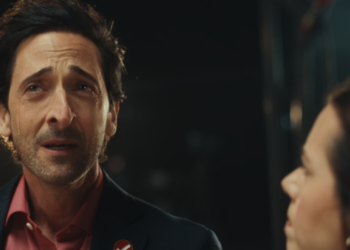
Consider Exhibit A: Rauiri Robinson, an Irish filmmaker and visual effects artist in Los Angeles, posted two short A.I.-generated videos on X, a hyper-realistic action-movie sequence depicting Tom Cruise and Brad Pitt fighting on a rooftop while arguing about Jeffrey Epstein. The clips were created, Mr. Robinson explained, by feeding a two-sentence prompt into Seedance 2.0, an A.I. video-creation tool newly released by the Chinese company ByteDance.
Its convincing imitation of an actual film sparked horror and outrage in Hollywood. “I hate to say it,” Rhett Reese, a screenwriter whose credits include the “Deadpool” films, wrote on X. “It’s likely over for us.”
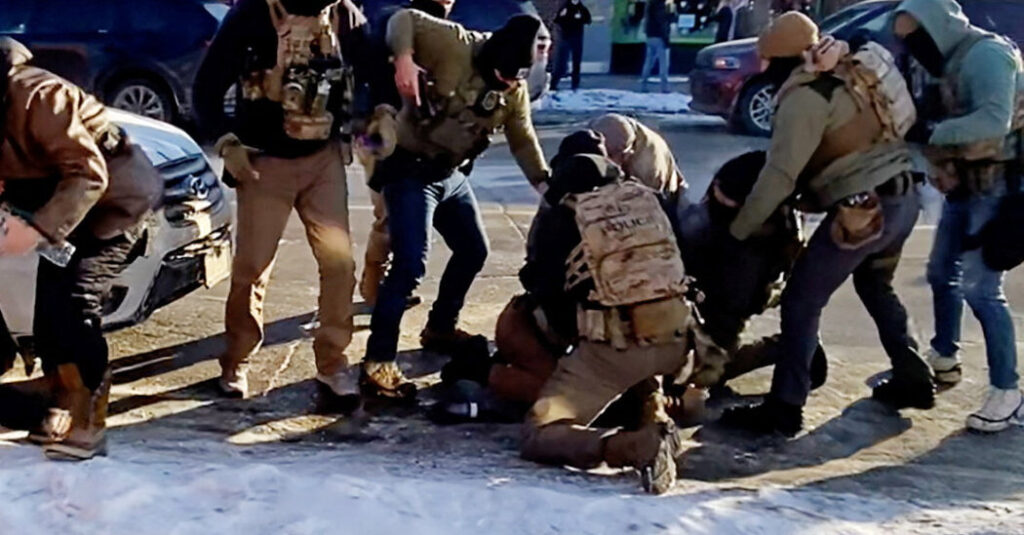
But consider Exhibit B: The announcement on Thursday morning by Tom Homan, Donald Trump’s border czar, that federal immigration agents would soon withdraw from Minnesota. Although Mr. Homan declared the operation a success, the decision seemed a tacit acknowledgment of the political damage inflicted by bystanders’ videos of two fatal shootings of Minneapolis residents by federal agents last month.
The videos immediately undercut the administration’s false and derogatory claims about the victims, drawing rebukes from even some Republican politicians and conservative commentators. “Escalating the rhetoric doesn’t help, and it actually loses credibility,” Ted Cruz, the Republican senator from Texas, said on his podcast in late January.
It is a paradoxical moment, in which documentary evidence is still able to land a few punches, even as new technologies threaten its credibility like never before.
“It feels deeply contradictory,” said Sam Gregory, the executive director of Witness, a human-rights organization focused on gathering video evidence.
Mr. Gregory’s organization has for years trained observers in recording video of human-rights abuses, and more recently has studied the challenges that A.I. poses to such efforts. The success of observers in documenting the tactics and behavior of federal agents in Minneapolis is “clearly an affirmation that we can still show what’s real with video,” he said.
In Minneapolis, activists have been able to gather more footage of confrontations with federal agents — including, sometimes, their own confrontations — than their counterparts in Los Angeles, Chicago and elsewhere have. This reflects an evolution in observers’ strategies for documenting the raids, but also conditions that are well-suited for gathering so much video: The Twin Cities are relatively small, and the federal government sent more agents there than it did to other cities.
“The fact that this was almost an optimized scenario,” Mr. Gregory said, “also reaffirms what a challenging moment we’re in.”
The preponderance of video evidence has also shaped the legal proceedings following the immigration raids.
On Thursday, a federal prosecutor asked a judge to dismiss charges in one of the most high-profile prosecutions stemming from the federal surge after video evidence undercut the claims of officers involved in the arrest, in which one of the agents shot one of the arrested men in the leg.
Todd Lyons, the acting director of Immigrations and Customs Enforcement, said in a statement Friday that the officers appeared “to have made untruthful statements” and had been placed on administrative leave.
The episode underscored how the ubiquity of video from a range of sources — body cameras, bystanders, home security systems — has changed legal proceedings, even as new technologies may call the integrity of video evidence into question.
Juries have come to assume that assertions made in court will be backed up with footage, said Shay Cleary, a managing director of the National Center for State Courts, where he consults on court use of information technology.
“People expect to see video evidence now,” he said.
The potential dangers of high-quality A.I. fakes, which are now easily produceable, are obvious. But at least in court proceedings, their impact is still mostly theoretical, Mr. Cleary said.
“For now, I think it’s more of a concern than a reality,” he said.
A more immediate concern, Mr. Gregory of Witness said, is that the existence of even rudimentary A.I. images can be used to discredit real footage.
An A.I.-altered image of Alex Pretti, one of the two Minneapolis residents killed by federal officers, was circulated widely online in the days after his death. It was even displayed on a poster on the floor of the U.S. Senate by Dick Durbin of Illinois, the Democratic minority whip. (“Staff didn’t realize until after the fact that the image had been slightly edited,” a Durbin spokesman told NBC at the time, “and regret that this mistake occurred.”)
The image was based on a real incident, but it was obviously tweaked and enhanced by A.I. to be clearer and more dramatic.
Mr. Gregory said that whether or not the creators of the doctored image were trying to deceive anyone, its wide circulation had made it a useful tool for discrediting real visual evidence.
“You just need to cast doubt,” he said. “And you can do it on very simple grounds.”
Kathryn Olmsted, a historian at the University of California, Davis, who has written extensively about conspiracy theories in American history, looks on the present moment, and its technological potential, with foreboding.
“I am terrified,” she said. “I just worry we’re headed into a whole new era of conspiracism.”
Mr. Robinson, the creator of the Epstein-themed A.I. videos depicting Brad Pitt, said he had picked the concept because it seemed openly absurd.
“I thought it would be funny to take the dumbest possible interpretation of a third-rail conspiracy theory,” he said.
Mr. Robinson said he was both interested in A.I.’s potential and concerned about its implications, for his own work and the world as a whole. “I’ve made short films that I spent literally two years on, and this stupid 15-second joke has gotten so much more attention and traction than any of that stuff,” he said.
He added, “I think a lot of people are burying their heads in the sand about what’s coming.”
Charles Homans is a reporter for The Times and The Times Magazine, covering national politics.
The post More Than Ever, Videos Expose the Truth. And Cloud It, Too. appeared first on New York Times.