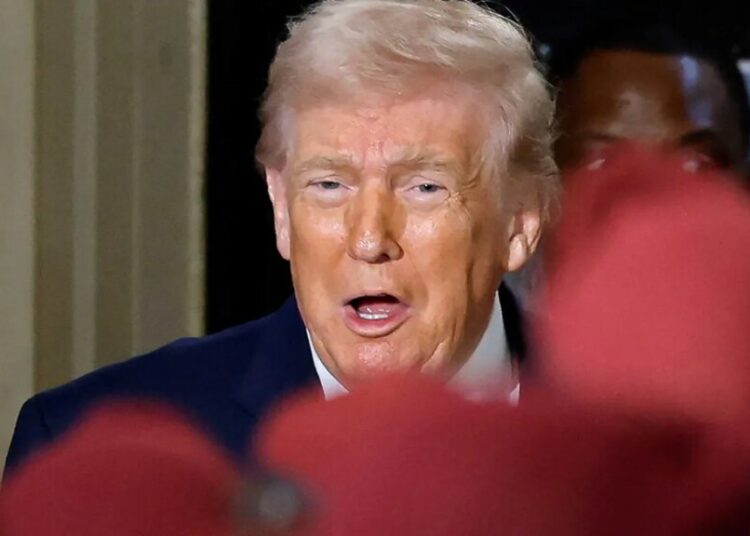
The racist online video that President Trump recently shared and then deleted generated a bipartisan furor because of its portrayal of Barack and Michelle Obama as apes. What was little remarked on was how it presented Mr. Trump himself — as the “King of the Jungle.”
After a year back in the White House, Mr. Trump’s efforts to promote himself as the singularly dominant figure in the world have become so commonplace that they no longer seem surprising. He regularly depicts himself in a heroic, almost godly fashion, as a king, as a Superman, as a Jedi knight, as a military hero, even as a pope in a white cassock.
While Mr. Trump has spent a lifetime promoting his personal brand, slapping his name on hotels, casinos, airplanes, even steaks, neckties and bottled water, what he is doing in his second term as president comes closer to building a cult of personality the likes of which has never been seen in American history. Other presidents sought to cultivate their reputations, but none went as far as Mr. Trump has to create a mythologized, superhuman and omnipresent persona leading to idolatry.
His picture has been splashed all over the White House, on multistory banners on the side of federal buildings, on annual passes to national parks and maybe even soon on a one-dollar coin. His name has been etched on the John F. Kennedy Center for the Performing Arts, on the U.S. Institute of Peace, on federal investment accounts, special visas and a discount drug program and, if he has his way, on Washington Dulles International Airport and Penn Station in New York.
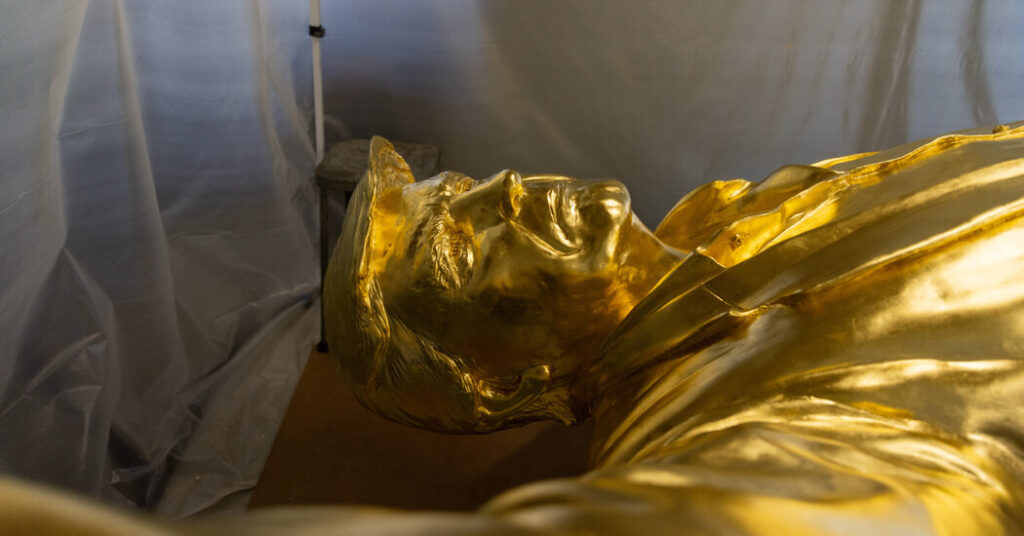
His White House is pressuring the Smithsonian Institution’s National Portrait Gallery to display portraits of Mr. Trump by his supporters. A group of cryptocurrency investors has shelled out $300,000 to forge a 15-foot-tall gold-covered bronze statue of Mr. Trump called “Don Colossus” to be installed at his golf complex in Doral, Fla.
His administration is considering designating a new class of battleships in Mr. Trump’s name. His allies are pressuring foreign leaders to endorse his bid for the Nobel Peace Prize and threatening consequences for resisting. Some supporters in Congress have even proposed adding his face to Mount Rushmore, an effort that, for the moment, has gained little traction.
This spree of self-aggrandizement goes beyond mere vanity, although Mr. Trump suffers from no particular shortage in that department. “I really have a big ego,” he noted at the National Prayer Breakfast this month, an assessment that drew no disagreement. What Mr. Trump is actually doing, though, is making himself the inescapable force in American life.
“This is not just egotistical self-satisfaction, it’s a way of expanding presidential power,” said Michael Beschloss, the presidential historian. “A president is more powerful, I assume he believes, if he is ever-present than if he keeps his head down.”
Cults of personality are traditionally associated with dictators and demagogues, not democrats. They are figures like Joseph Stalin, Mao Zedong, Benito Mussolini and more recently the shirtless, horseback-riding Vladimir V. Putin of Russia. But Mr. Trump does not seem concerned that he might be heading down a dangerous path.
Indeed, last month at the World Economic Forum in Davos, Switzerland, he suggested that authoritarianism was not necessarily something to eschew. “Usually they say, ‘He’s a horrible dictator-type person, I’m a dictator,’” he said after delivering a rambling speech. “But sometimes, you need a dictator.”
His staff did not reject the notion that he was fostering a cult of personality when asked for comment. Indeed, it released a statement seeming to argue that one would be deserved.
“President Trump is going to go down in history as the most successful and consequential president in our lifetime,” Steven Cheung, the White House communications director, said in the statement. “He built the most powerful political and cultural movement ever. His successes on behalf of the American people will be imprinted upon the fabric of America and will be felt by every other White House that comes after him.”
But even some former Trump aides said his fixation on glorifying himself served a hunger for dominance that had not translated into making the lives of everyday Americans better.
“This is a man drunk on power with an already enormous ego that was further inflated by winning the presidency again — and the popular vote,” said Sarah Matthews, who was a deputy White House press secretary for Mr. Trump in his first term before resigning in protest after the attack on the Capitol on Jan. 6, 2021.
Ms. Matthews, now affiliated with an opposition group called Home of the Brave, said that rather than focusing “on what’s best for the American people,” the president was concentrating on “building monuments to himself” and exacting revenge against perceived enemies. “It reinforces the perception that this presidency is more about elevating one man than serving the country,” she said.
The notion of a cult of personality has become an increasing theme of the political discourse in recent months. Consider the last 10 days alone: Curt Mills, the executive director of The American Conservative, referred to “the personality cult of Trump.” Gov. Kathy Hochul of New York, addressing a Democratic convention, said Republicans were “nothing more than a personality cult.” And Senator Chuck Schumer of New York, the Democratic leader, said democracy “will prevail over cult of personality.”
Other presidents have encouraged hero worship and plenty have been honored with monuments. But for the most part, they were more restrained than Mr. Trump, leaving the most ostentatious expressions of reverence to others and generally after they had left office.
George Washington set the standard from the start. Knowing that as the first president he would be establishing precedent, he deliberately shunned the trappings of royalty and declined to be called “Your Majesty” or “Your Highness,” opting instead for the more humble “Mr. President.”
It is true, of course, that the capital of the new nation was named after Washington during his presidency, a decision made by three commissioners he appointed. But historians said he had no known hand in encouraging it.
“He was surprised that the commissioners chose the name, though he did not object,” said David O. Stewart, a Washington biographer. “As near as the evidence shows, George Washington very much liked having the city named after him. He was not without ego, and devoted great energy and attention to developing the capital city.”
The famed Washington Monument, however, came decades after his death, much as the Jefferson Memorial, Lincoln Memorial and Kennedy Center were not erected or named until after the presidents they honored were gone. Mount Rushmore was carved after Washington, Thomas Jefferson, Abraham Lincoln and Theodore Roosevelt were all in their graves.
No sitting president ever had his face put on a coin while in office except for Calvin Coolidge, whose laconic personality did not exactly lend itself to cults. And Herbert Hoover would surely have preferred not having his name attached to the many Great Depression shantytowns called Hoovervilles, although the Hoover Dam was named for him while he was in office. (Franklin D. Roosevelt stripped the name; Harry S. Truman restored it.)
“Presidents don’t name things after themselves, people name things after presidents — and there is a big difference between the two,” said Jennifer Mercieca, a communications professor at Texas A&M University and the author of “Demagogue for President: The Rhetorical Genius of Donald Trump.”
“One is an expression of power and a demand for respect and status,” she said. “The other is an acknowledgment by the public of a job well done, a grateful public giving a president respect and status.”
Many presidents have enjoyed being the center of attention. Theodore Roosevelt’s daughter Alice Roosevelt Longworth notably said her father “always wanted to be the corpse at every funeral, the bride at every wedding and the baby at every christening.” Others struggled with that kind of politics. George H.W. Bush painfully tried to avoid the first-person singular “I” in sentences because growing up his mother taught him that it sounded boastful.
Boastful is not something Mr. Trump ever learned to avoid, nor can he fathom why predecessors passed on self-promotion. When he visited Mount Vernon during his first term, he expressed surprise that Washington did not name the estate for himself. “You’ve got to put your name on stuff or no one remembers you,” Mr. Trump told people.
With Mr. Trump, it goes beyond names and memory. He wants to be seen as superlative in every way — and flawed in no way. His first-term executive assistant Madeleine Westerhout wrote in her memoir that when she expressed concern one day that he seemed exhausted, she was remonstrated by Hope Hicks, the president’s close adviser: “Donald Trump is never tired and he is never sick.” To even question his health, he said in December, is “seditious, perhaps even treasonous.”
Personality-driven politics serve to bind followers of a movement to their leader more than to any particular policy prescription, making his success or failure their own. Veneration and loyalty are central and ideology secondary. The leader is presented as infallible, uniquely qualified, even divinely delivered for this moment in history.
Mr. Trump has played to these themes since taking the national political stage. “I alone can fix it,” he declared when running in 2016. “I was saved by God to make America great again,” he said on being inaugurated again last year.
The efforts to exalt himself, however, have accelerated in the past year far beyond his first term and have increasingly come to resemble eccentric regimes in far corners of the world. To those who have spent time in the former Soviet Union, the “Don Colossus” statue bears a striking resemblance to the rotating gold statue erected by Saparmurat Niyazov, the megalomaniacal former dictator of Turkmenistan who called himself Turkmenbashi and even renamed the months of the year after himself and his family.
“There is no settled definition of a cult of personality, but for us this qualifies,” Benjamin E. Goldsmith of the Australian National University and Lars J.K. Moen of the University of Vienna, who have studied Mr. Trump’s hold on his supporters, said in a joint email.
The two scholars, who published a paper on the phenomenon in the Political Psychology journal, said the personality cult allowed Mr. Trump to dominate Republican primary contests, right-wing media and his party’s majorities in Congress. Those who stand against Mr. Trump are seen as traitors.
“For us, this is the major threat to U.S. democracy from Trump’s cultlike following,” they wrote. “Congress is transformed into an enabler, even when the executive makes disastrous policies, undermines the rule of law or might attempt to fix elections. The system can transform into an electoral autocracy. Our bet is that we’re already far along that path.”
Peter Baker is the chief White House correspondent for The Times. He is covering his sixth presidency and sometimes writes analytical pieces that place presidents and their administrations in a larger context and historical framework.
The post Trump’s Relentless Self-Promotion Fosters an American Cult of Personality appeared first on New York Times.