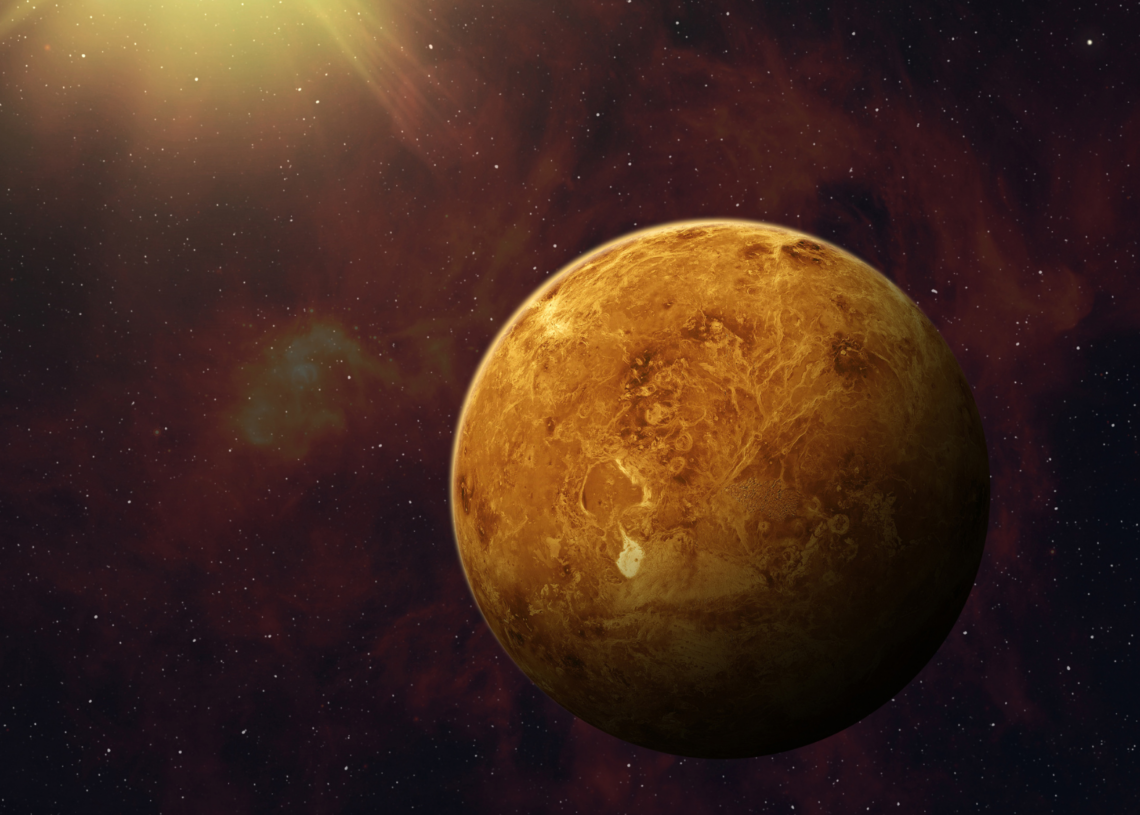
Planetary scientists have long suspected Venus was hiding something beneath its battered, sulfuric surface, namely, a vast underground network of lava tubes carved by ancient lava flows. Now, for the first time, researchers say they’ve found one.
Using radar data collected in the early 1990s by NASA’s Magellan spacecraft, a team led by Lorenzo Bruzzone of the University of Trento has identified what appears to be an empty subsurface lava tube, aka a pyroduct, in the planet’s Nux Mons region. The findings were published in Nature Communications and detailed in easy-to-understand language on the university’s website.
Venus is often considered Earth’s hardcore twin, mostly because it’s of a similar size and mass, it has a rocky surface, and because of its location in the inner solar system. That’s where the similarities end. Venus’s surface temperatures are hot enough to melt lead, and its atmospheric pressure would crush us if we stood on its surface.
Bruzzone’s team reanalyzed Magellan’s synthetic aperture radar images, focusing on signs of localized surface collapse. They found a “skylight,” a hole formed when part of a lava tube’s ceiling caves in. Beneath it, radar signatures revealed a large underground cavity.
The confirmed portion of the tube measures about 0.62 miles (or 1 kilometer) across, with a roof at least 492 feet (150 meters) thick. Based on surrounding terrain and the presence of similar pits nearby, researchers believe the conduit could extend as far as 28 miles (45 kilometers), though that remains unproven. What has been confirmed, however, are long-standing theories about Venusian volcanism.
Volcanic activity has shaped Venus’ surface, and previous radar data hinted that the planet may still be geologically active. Lava tubes are common on Earth and the Moon, where they’re being studied as potential shelters for future astronauts. On Venus, they’re harder to detect, buried beneath dense atmosphere and unforgiving terrain.
Upcoming missions, like NASA’s VERITAS and the European Space Agency’s EnVision, will carry more advanced radar systems, including ground-penetrating instruments capable of probing hundreds of meters below the surface.
The post Is Venus Full of Giant Lava Tubes? Scientists Say There’s at Least One. appeared first on VICE.