Ukrainian soldiers tend to find questions about the future unsettling. When I asked Capt. Mykola Serga, who was an entertainer before he joined the army, to describe the outlook of troops, he paraphrased Viktor Frankl: “The first to break were those who believed it would all end soon, just like those who thought it would never end,” he said. “The ones who endure are those who focus on the work at hand.”
Mr. Frankl’s “Man’s Search for Meaning,” originally published in the 1940s, has become a wartime best seller in Ukraine. It’s one of the books, alongside financial literacy guides and novels, that Captain Serga has delivered to the trenches as part of an initiative to sustain morale.
Russian soldiers crossed Ukraine’s northeastern border in February 2022 and moved west toward Kyiv. During the first hours of the full-scale invasion, everything was an emergency. Ordinary life was brutally interrupted.
Back then it felt as though something so shocking had happened that surely the rest of the world would come to our aid. The lesson of the past year, for better or worse, is that the world is not coming to save us. President Trump has made it amply clear that his priority is a quick settlement to the war, on whatever terms he can get. Europe, reeling as the trans-Atlantic security architecture falters, is figuring out how to defend itself from a more openly aggressive Russia.
And yet the clearer it has become that Ukrainians can truly rely only on ourselves, the less anxious the national mood has seemed. Previously, aid that dangled just out of reach was a disappointment. The acceptance that much of that aid is not coming — or at least not coming soon — has motivated us to continue to build up our own defense structures and capabilities.
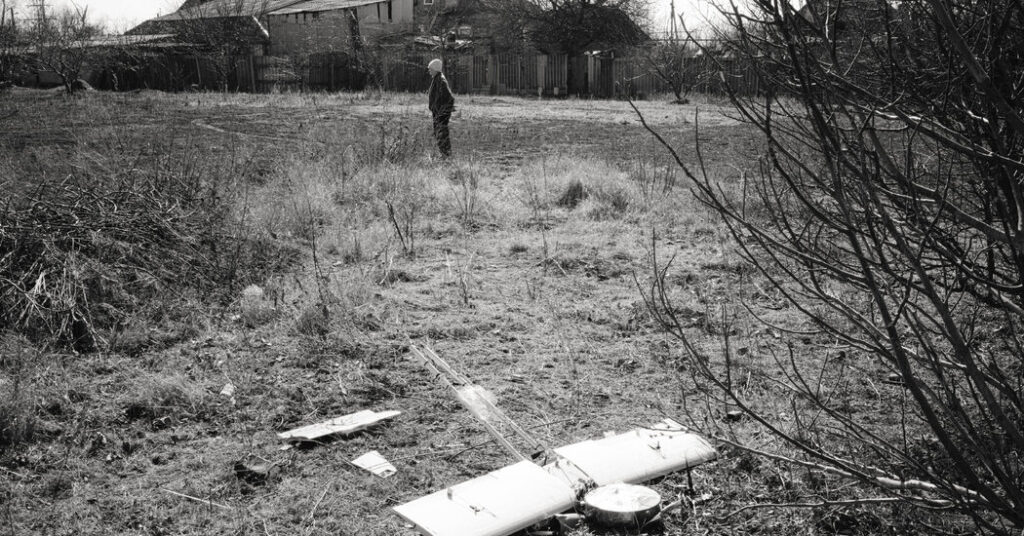
I spent a lot of last year — as I did in other years — traveling around Ukraine talking to people. What’s clear to me is that this war no longer feels like an interruption; it’s just reality. Ukraine’s military may be exhausted, but it’s also the most battle-hardened in Europe. The front line, with its split screen of futuristic unmanned drones and its trenches reminiscent of the wars of the early 20th century, may look like the future and the past at once. But it’s just our present, the only one we know.
In August I was about six miles from the front line, riding in a vehicle that looked as if it had driven straight out of “Mad Max.” Our truck, like others near the front, was wrapped in improvised defenses to avoid Russian drone surveillance: homemade nets, jagged spikes and welded frames.
Rough roads took us into the forest, where I stayed overnight with two drone units of the Code 9.2 Assault Regiment, which operates Vampires — Ukrainian-developed drones that can carry up to around 30 pounds of explosives for more than 10 miles.
I met a 23-year-old who went by the call sign Legat and said he left his master’s program in international law in Kyiv last February because he no longer believed in international law. And I spoke with Kapa, a 32-year-old construction worker from Kharkiv who said he enlisted around the same time because he thought it would be better to choose when he joined the army rather than wait to be drafted. (Legat and Kapa asked that I use only their call signs.)
I asked what they were using at the front that had come from America. They struggled to come up with anything. If it looked very different a year before, Legat and Kapa might not have known. To them, this was simply Ukraine’s war. Neither of them expected it to end anytime soon.
That month near Pokrovsk in Donetsk, I also met with Junior Sgt. Pavlo Vyshebaba, 39, a vegan, former animal-rights activist and poet in the “Minotaurs,” a mortar unit informally named for the labyrinths the soldiers have carved among the village’s houses to avoid Russian drones. (Mortars can halt an assault for 10 to 15 minutes, Sergeant Vyshebaba said, giving the drones time to arrive.) The risk of detection was so high, he said, that they could not even keep cats with them to deal with the abundant mice because cats could be detected by thermal imaging and give away nearby humans.
More recently, he was charged with integrating ground robotic systems into the unit, which were proving transformative — clearing paths, delivering mortars to the front and demining — and improving his mood. For this unit and others, technology was fundamentally reordering the battlefield, allowing Ukraine to stand its ground and make Russia feel the cost of the war.
Earlier in the summer I spoke to Andriy Zagorodnyuk, a former defense minister and now a security analyst, who described Ukraine’s approach to me as “strategic neutralization,” a long-term military approach to make Russia’s operations irrelevant. In other words, Ukraine is looking for pragmatic, economical ways to blunt Russian operations and make Russia’s losses significant enough for President Vladimir Putin to finally decide that Ukraine is simply not worth it.
Russia hurls waves of soldiers into frontal assaults, accepting staggering losses — a style of warfare known as the meat grinder. Last year Russia’s incremental territorial gains cost the Kremlin enormous amounts in men and matériel. Though recruitment in Russia is systematized with substantial cash bonuses paid to recruits, this is only enough to maintain troop levels at the current estimated rate of loss.
Ukraine could not emulate this approach even if it wanted to. Its population is much smaller, and it lacks Russia’s vast oil and gas reserves. But the difference is more essential: For Ukraine, the fight is to save lives. To sacrifice more lives than it must would run contrary to the very logic of the war.
It can seem that the world watches Russia’s war on Ukraine as if it were a film. When attention wanes, there is a demand for an ending — if not good, then bad. For Ukrainians, this is not cinema but reality. It will last as long as it lasts.
At a pipe plant in Nikopol, a city across the Dnipro River and less than five miles from the Zaporizhzhia nuclear plant, which Russia controls, I asked a crane operator, Yevhen Bilousov, when he thought the war might end. The factory was ringed with antidrone nets, its windows covered by metal sheets perforated by shrapnel holes, but the work carried on.
The question itself was meaningless, he told me, “because everything depends not on when but on how the war ends.”
Nataliya Gumenyuk is writing a book about drone warfare.
The Times is committed to publishing a diversity of letters to the editor. We’d like to hear what you think about this or any of our articles. Here are some tips. And here’s our email: [email protected].
Follow the New York Times Opinion section on Facebook, Instagram, TikTok, Bluesky, WhatsApp and Threads.
The post When Will This War End? The Question Is Meaningless. appeared first on New York Times.