Four years ago American officials arrived at the Munich Security Conference armed with satellite photographs of massing Russian troops and intercepts of conversations among Russian generals, arguing that an invasion of Ukraine was imminent. Most senior European officials dismissed the evidence, declaring that the Russian president, Vladimir V. Putin, was bluffing.
The war for Ukraine, which next week enters its fifth year, started a few days later.
This year the roles are largely reversed. The few American officials here, led by Secretary of State Marco Rubio, say only that they are negotiating to stop the killing before moving on to other subjects. And now it is the Europeans who are arguing that even a cease-fire or peace deal will not end Mr. Putin’s campaign of sabotage across Europe, and that his territorial appetites are unlikely to stop at the Ukrainian border.
The disputes this past year between Washington and Europe — over tariffs, Greenland, free speech for right-wing political parties and the Trump administration’s declaration that Europe is headed to “civilizational erasure” unless it controls its borders — have obscured a more fundamental shift. Leaders of several European nations said that after that series of shocks they are talking about “de-risking” from the United States.
It is a term previously reserved for describing a strategy of avoiding over-dependence on China, or fragile supply chains for Russian oil or critical minerals. It is now applied to the United States. The Europeans now warn of threats that the Americans, in their speeches to the conference, never acknowledged. And among them is Mr. Trump’s unpredictability.
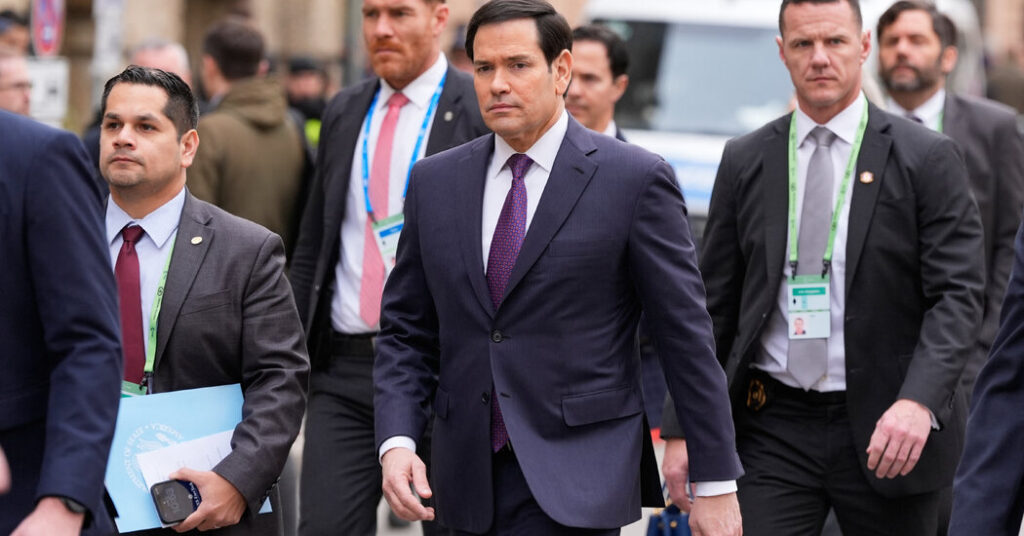
In his speech on Saturday, Mr. Rubio tried easing some of Europe’s fears, sounding a far more diplomatic tone than Vice President JD Vance did a year ago from the same stage. “We will always be a child of Europe,’’ he said, focusing on the depth and history of Europe’s settlement of North America rather than lecturing about the repression of far-right groups. While some of Mr. Vance’s themes were sounded, the softer delivery made it a lot easier for the heavily European audience to swallow.
But Mr. Rubio scarcely mentioned Russia, the source of the Europeans’ greatest security concerns, and offered no warnings to Mr. Putin, even though he spoke only hours before several American allies accused the Kremlin of using a banned toxin to kill Aleksei A. Navalny, the Russian opposition leader, in prison two years ago. Several diplomats noted later in the day that the absence of Washington’s imprimatur on the intelligence was telling.
At the same time, evidence of the damage done over the past year was everywhere. The Danes, still stunned by how quickly the prospect of military conflict with the United States flared in December and January, are publicly negotiating with Washington. But here in Munich, they kept asking the Americans whether they think Mr. Trump could suddenly revive his demand that the United States must own, not lease, the 836,000 ice-encased square miles of Greenland. (Very likely, the Danish prime minister, Mette Fredericksen, was told by several Americans.)
Chancellor Friedrich Merz of Germany chastised his fellow Europeans in a speech on Friday for their over-dependence on the United States for far too long — echoing Washington’s longtime complaint about Europe.
The purest crystallization of Mr. Merz’s concern underlies his yearlong conversation with President Emmanuel Macron of France about whether Germany should be covered under the French nuclear umbrella. Mr. Merz has repeatedly said that any arrangement for France to offer the ultimate protection to Germany would be coordinated with NATO and the United States.
But at the root of Mr. Merz’s nuclear initiative lies an obvious nervousness that Washington can no longer be trusted to risk New York while protecting Berlin. He clearly sees the need for a nuclear Plan B. That may take a while: It is far from certain that France’s small, independent nuclear deterrent is big enough to shield Germany, and perhaps Poland as well, or that the French would be willing to risk Paris to save Berlin.
The kind of backroom negotiation Mr. Merz is conducting never came up during the Cold War or the era that followed, nuclear experts say. But the slow separation from Washington is most evident in how the Europeans talk about the Russian threat, four years after the war with Ukraine began.
Leaders of many of the same European nations that argued four years ago that Mr. Putin would not risk invading Ukraine now warn that he may not stop at its borders. And they cite the increasingly bold acts of sabotage on their territory as evidence that Mr. Putin is conducting an active shadow war in NATO territory, a threat that Mr. Rubio also never touched upon in his Saturday address.
The attacks have included mysterious explosions at railroad yards, severed undersea fiber-optic communications cables, cyberattacks, and drone incursions over the Polish border. Prime Minister Keir Starmer of Britain said that Russia’s invasion of Ukraine and its “hybrid threats” against Europe left the continent with “only one viable option.” Europeans, he said, “must build our hard power, because that is the currency of the age. We must be able to deter aggression, and yes, if necessary, we must be ready to fight.”
Such reactions appear fine with the Trump administration, which argues that Europe has finally gotten the message — thanks to Mr. Trump’s pressure and Mr. Putin’s aggression — that it needs to take care of its own defense in every “conventional” domain of warfare. (Washington would still retain responsibility for nuclear deterrence and, if needed, nuclear response, the highest-ranking Pentagon official to attend the conference, Elbridge Colby, said in a speech before arriving in Munich.)
But there is little question that the Americans and the Europeans regard the current threat very differently. “In London and other capitals, the Europeans keep talking like this is 1939,” as the continent veered toward war, said Richard Fontaine, the chief executive of the Center for a New American Security and a former aide to Senator John McCain. “Nobody in the U.S. is thinking this is 1939.”
Perhaps the biggest concern voiced by European officials now is that Mr. Trump will agree to almost any kind of deal on Ukraine, to claim a victory even if it sets Mr. Putin up for future attacks. Petr Pavel, the Czech president, said, “A very quick peace will not result in a Nobel Prize for peace,” but in “another aggression.”
Ms. Frederiksen, the Danish prime minister, sounded a similar theme. “A bad peace deal in Ukraine will open the door for more attacks from Russia, in Ukraine again or in another European country,” she said on Saturday.
Other European officials noted that the Trump administration is already discussing potential business deals with Moscow — especially in the energy sector, presumably after a peace deal is negotiated. The Europeans, in contrast, are preparing for another year or two of war, and this weekend talked with Ukraine’s president, Volodymyr Zelensky, about new air defenses and a joint venture to build drones at a new factory not far from Munich. (Mr. Zelensky received the kind of thunderous applause in Munich on Saturday morning that he once heard in Washington, but has not gotten recently.)
One continuing subject of conversation at Munich is the makeup of a European and American “security guarantee” for Ukraine, should a deal be reached. Some of the outlines of the force are becoming clear: It would consist of about two brigades, or about 7,000 to 10,000 troops. That would not be enough to stop a major Russian re-invasion, but the betting is it may be enough to deter one.
Still unclear, however, is where it would be located: Inside Ukraine or outside. Moscow has stoutly insisted it would not accept any deal calling for European troops inside Ukraine.
Mr. Rubio was a lot more cautious about whether a deal is forthcoming than President Trump has been. Mr. Trump keeps emphasizing that Mr. Putin “wants a deal.”
But Mr. Rubio clearly has his doubts. “We don’t know if the Russians are serious about ending the war,” he said, adding that the United States would continue to pressure Russia with sanctions and to sell weapons that will ultimately be used by Ukraine in its defense.
“What we can’t answer, but we are going to continue to test, is an outcome Ukraine can live with and Russia can accept. That’s been elusive to this point.”
Edward Wong and Jeanna Smialek contributed reporting from Munich.
David E. Sanger covers the Trump administration and a range of national security issues. He has been a Times journalist for more than four decades and has written four books on foreign policy and national security challenges.
The post Once the Americans Warned of the Russian Threat. Now, It’s the Europeans’ Turn. appeared first on New York Times.