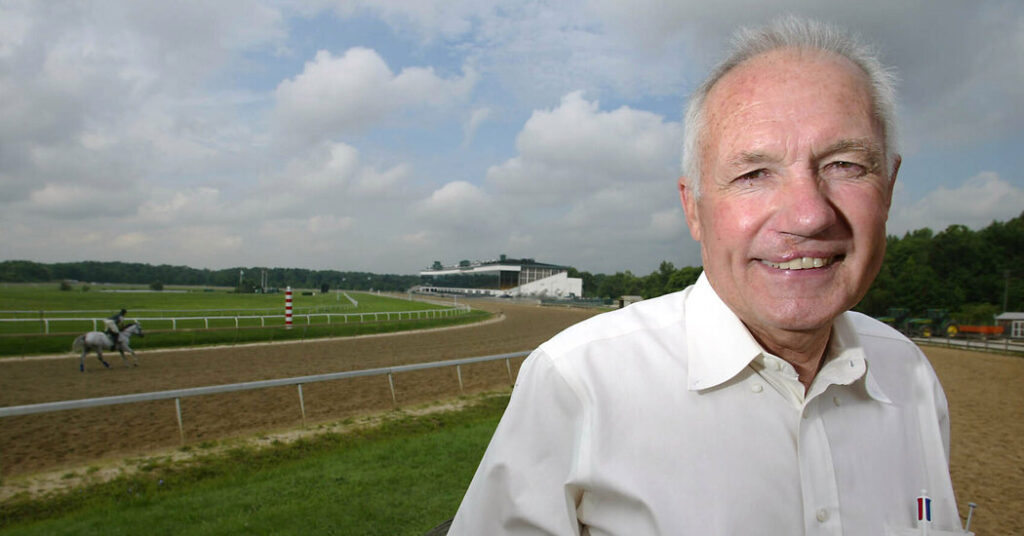
King T. Leatherbury, a longtime horseplayer who brought savvy handicapping skills to picking the low-priced horses he trained in a Hall of Fame career spent mostly on Maryland tracks, died on Tuesday at his home in Mitchellville, Md. He was 92.
His son Todd confirmed the death.
Mr. Leatherbury — King was his mother’s maiden name — won 6,508 races, the fifth most wins among thoroughbred trainers in North American history. From 1974 to 1984, Mr. Leatherbury won at least 200 races annually; from 1975 to 1978, he won between 304 and 365 races each year.
He was not a traditional horseman who spent his days, with a stopwatch in hand, watching his horses gallop past him in workouts. He veered from the standard trainers’ path early in his career.
“The first couple years, I’d walk every one of my horses to the track and watch them gallop,” he told The Washington Post in 2003. “But I felt it was just a waste of time. What is there to see?”
In an interview, Todd Leatherbury added, “He used to say that he could sleep with the horses in their stalls, but would they run any faster?”
Instead, he worked from his home office reading handicapping publications like The Daily Racing Form and The Ragozin Sheets, analyzing horses’ speeds and past performances. He found undervalued horses in claiming races, where each horse is available for a set price, say $5,000, before a race when interested buyers can put in claims.
After the race, ownership of a horse goes directly to a single claimant, if only one claim has been entered; multiple claims are settled in a random drawing, and the money goes to the previous owner. If there are no claims, a horse stays with its owner. He became known as the “King of the Claimers.”
Once he took control of a horse, Mr. Leatherbury found ways to improve its performance by adding equipment, like blinkers; by running it in a longer or shorter race, or on a dirt track if it had only run on grass; or by entering it in a race with inferior competitors. He delegated the implementation of training regimens to his staff but, unlike most other trainers, Mr. Leatherbury was not often with them.
He was not well known nationally — and only sometimes sent horses into higher-quality stakes races where the horses cannot be claimed — but was a dominant figure in Maryland, where he won 52 titles for training the most winners during a specific amount of time at the Pimlico Race Course and Laurel Park. He won four more titles at Delaware Park, in Wilmington.
In 2015, Mr. Leatherbury was inducted into the National Museum of Racing and Hall of Fame in Saratoga Springs, N.Y. He figured that he had been a 20-1 long shot to be elected to the hall, despite having won 6,405 races by then.
“I never won a Triple Crown race or the Breeders’ Cup, and I never had a super horse,” he told The Baltimore Sun when he was inducted. “I had to work with what I had. Nobody came to me and said, ‘Here’s a barn full of stakes horses.’”
King Taylor Leatherbury was born on March 26, 1933, in Shady Side, Md., near Annapolis. His father, William Taylor Leatherbury, drilled water wells and owned and bred some horses. His mother, Evelyn (King) Leatherbury, ran the home.
While studying business at the University of Maryland — where he received a bachelor’s degree in business in 1956 — he scheduled his classes to be in the mornings so that he could go to the tracks in the afternoons. Later, while serving in the Army, he used his weekend passes to go to racetracks.
“That’s when I made up my mind to be a horse trainer,” he told The Evening Sun of Baltimore in 1961, when the six horses he trained were owned by his father.
His horses won 10 races in 1959. He hit 91 wins in 1971 and, the next year, 130, which started a 25-year run when he saddled between 113 and 365 winners.
When Mr. Leatherbury was on the verge of his 5,000th victory in 1993, he told The Post: “I’m not a horse lover, per se. I’m a horse-racing lover. It’s the game of horse racing that excites me.”
His games-playing was evident in his history with Port Conway Lane, a gelding he bought as a yearling in 1970 for $7,000 from Creek Hill Farm in Kentucky; he then lost him to a claim; and, over the years, claimed and lost him a few more times. When he had him, Port Conway Lane won more than 40 of his 53 wins over his 12-year career. Mr. Leatherbury claimed him in time for the horse’s 50th win — then lost him a few days later.
Mr. Leatherbury’s most successful horse was another gelding, Ben’s Cat, whom he had bred and owned. Not knowing how good Ben’s Cat was going to be, Mr. Leatherbury started him out in 2010 in two claiming races, but no one claimed him.
From then on, the horse ran in allowance races, which feature promising horses, and stakes races. In all, Ben’s Cat won 32 races out of 63 starts and earned $2.6 million, through 2017. He helped revive Mr. Leatherbury’s career, which was nearing its end, and was the Maryland-bred Horse of the Year four times.
“No question about him being the one who kept my name up in the lights, so to speak,” Mr. Leatherbury told The Sun in 2017.
Mr. Leatherbury had his last victory in 2022 and retired the next year.
In addition to his son, Mr. Leatherbury is survived by his wife of 62 years, Linda (Heavener) Leatherbury; another son, Taylor; and a grandson.
Unlike widely known trainers, such as D. Wayne Lukas, Bob Baffert and Todd Pletcher, Mr. Leatherbury never won the Kentucky Derby, Preakness Stakes or Belmont Stakes — the races that comprise the sport’s Triple Crown.
Winning the Preakness, which is held at Pimlico, would have been a major achievement for Mr. Leatherbury, the trainer who had won the most races in Maryland.
But in 2005, Mr. Leatherbury downplayed the possibility of winning the Preakness, because he didn’t think that his horse, Malibu Moonshine, was good enough.
“Sure, it would be exciting to win, and I think it would bring tears to my eyes,” he told The New York Times. “It’s just that I’ve had so many good things happen to me that this would be just one more thing.”
He added: “I know it would make for a good story. I’ll give you that.”
Malibu Moonshine lived down to his expectations. She finished eighth.
Richard Sandomir, an obituaries reporter, has been writing for The Times for more than three decades.
The post King Leatherbury, Trainer and Trader of Horses, Dies at 92 appeared first on New York Times.