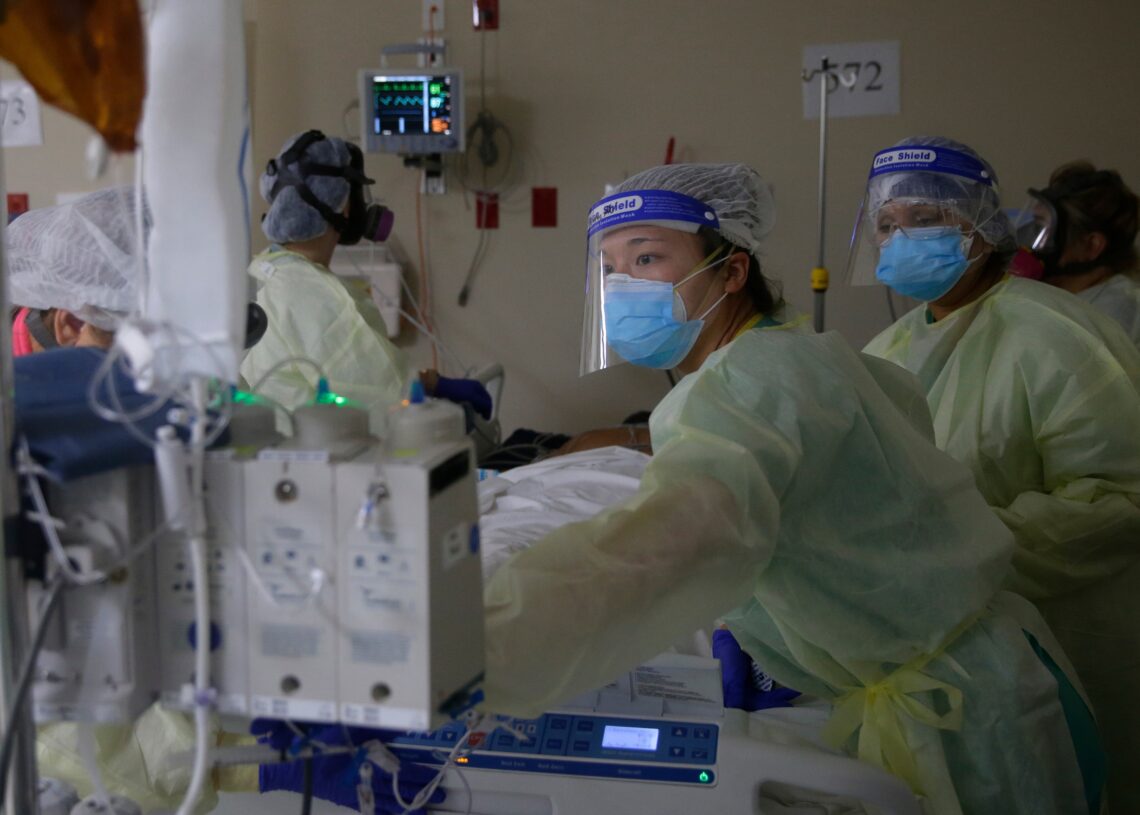
Nearly all of the jobs added to the U.S. economy in recent months have come from one industry: health care.
Health care and social assistance accounted for 95 percent of the 130,000 jobs added in January. That builds on similar trends throughout 2025, when the industry buoyed an otherwise slow labor market, as the nation’s hospitals, clinics and nursing homes kept hiring even as many employers pulled back.
Without health care and related jobs, the United States would have nearly 400,000 fewer jobs than it did a year ago, according to Labor Department figures through January.
“Health care is holding up this lopsided jobs market,” said Laura Ullrich, director of economic research in North America at the Indeed Hiring Lab. “Not all of that is a surprise: If you’d gone back to 2000 and asked, ‘What are going to be the jobs of the future 25 years from now?,’ health care would’ve been at the top of that list. But what is surprising is how strong growth has remained even as everything else slows down.”
Health care and social assistance now makes up about 15 percent of all jobs, nearly double the share it did in 1990. The industry’s reach has grown rapidly over the past 35 years, making it the dominant force in the labor market.
That steady growth — driven in large part by an aging population — became even more pronounced after the pandemic. Like many other industries, health care suffered a sudden loss of jobs early in the covid pandemic as clinics and nursing homes shuttered, and elective procedures were put on hold. But since then, hiring has picked up rapidly, especially in “mid-level” positions such as physician assistants and nurse practitioners, according to Neale Mahoney, an economics professor at Stanford University.
More than 1 in 6 Americans is now 65 or older, an age group that spends an outsize amount on medical care. The country’s first baby boomers are beginning to turn 80 — and will continue doing so, doubling the number of Americans over 80 by 2045, according to estimates from the Brookings Institution.
But it isn’t just that Americans are getting older. Many — especially baby boomers — are also getting wealthier, thanks to fast-rising home values and stock prices. That’s led to rising demand for cosmetic procedures and other nice-to-haves, helping drive growth and hiring across the industry.
“A lot of health care spending is directly connected to wealth,” Ullrich said. “Baby boomers are spending on hospital stays, ambulance rides and long-term care. But they’re also springing for full-body scans, plastic surgery and expensive dental care.”
Notably, the number of home health care jobs is up by roughly 20 percent since January 2020, reflecting Americans’ growing desire to age at home.
By comparison, overall health care hiring has increased 11.7 percent in the same period, while the broader job market has grown by 4.3 percent.
Brandon Rees, 44, graduated from nursing school in June — and already had a job lined up at a heart institute. She makes $34 an hour as a critical care nurse in Fort Wayne, Indiana, and says she’s much happier than she was in her previous career as a software developer.
“I always kind of had it in the back of my head that this is something I’d want to do, and I absolutely love my job,” she said. “Plus there’s pretty unlimited earning potential: I can always pick up extra shifts.”
That burst of demand has led to higher pay across the industry. Health care wages grew by 1.3 percent in 2025, after adjusting for inflation, more than double the overall rate of 0.5 percent for all jobs, according to analysis by Mahoney and Caleb Brobst at Stanford.
Many jobs in health care require specialized training and certifications, leaving employers with a limited pool of candidates. Job postings for personal care and home health aides, physicians and physical therapists are outpacing most other industries, according to Ullrich of Indeed. And, she noted, nurses are still receiving outsize signing bonuses, in contrast with the rest of the labor force.
“Demand is high but the supply of workers is constrained,” Ullrich said. “That’s why health care wage growth has remained so strong.”
Bryan Samuelson, 38, a registered nurse at a hospital in Portland, Oregon, is making more than double what he was as a software test engineer for. There were other reasons he wanted to switch careers: The tech industry felt shaky, with constant layoffs, and he felt like he’d hit a ceiling without further coursework.
“There was just no stability in that industry,” he said. “Going back to school for nursing ended up being the best thing I ever did — there is so much versatility in health care.”
While it’s clear health care jobs are carrying much of the labor market’s gains, economists say it’s less clear how long this lasts or what happens next. The Trump administration’s hard-line immigration policies are making it tougher for some foreign doctors, home health aides and others to work in the United States, which could further cut into the supply of available workers. Recent nurses strikes across the country also underscore the need for safer staffing levels and other workplace protections across the industry.
In addition, recent cuts to Medicaid and the Affordable Care Act could have a chilling effect on demand, especially in rural areas and small towns. There could also be a shift in the types of care people seek — with more Americans relying on emergency rooms instead of traditional clinics, if their insurance coverage lapses, for example.
Still, economists say it’s likely that health care workers will remain highly coveted, even if other parts of the economy begin slowing.
“We’re likely to see some acute labor shortages in health care, especially as immigration falls to zero,” said Sam Kuhn, an economist at the recruitment software company Appcast. “But is demand for health care workers going to continue? I would say yes.”
Nick Mourtoupalas contributed to this report.
The post If not for this one industry, the U.S. labor market would look a lot worse appeared first on Washington Post.