Inside the glass-walled studio, three talk-radio hosts are having a wonderful time. They are sitting around a table, headphones on, relaxed and garrulous; their stream of conversation, much of it in French, is a patter of news, political invective, call-in chat, history quizzes. They groove to the D.J.’s pop selections — Reel 2 Real’s “I Like to Move It” (move it) — or they sing themselves. It’s 1994, in Rwanda. “Be happy, friends!” they sing, in between calling for their neighbors’ deaths. “God is always just!”
The director Milo Rau’s chilling “Hate Radio,” from 2011, which began performances on Thursday at St. Ann’s Warehouse, is essentially a diorama: It draws from archival material to recreate a 1994 radio broadcast by the infamous RTLM, the station Hutu hard-liners used to direct attacks against the country’s Tutsi minority during the 100-day genocide. We listen as the hosts — who foreshadow familiar podcast and influencer types like the hipster vulgarian and the tradwife — spew racist propaganda: “These people are nihilists,” the presenter Kantano Habimana (Diogène Ntarindwa) claims, bizarrely, as he urges his audience toward slaughter.
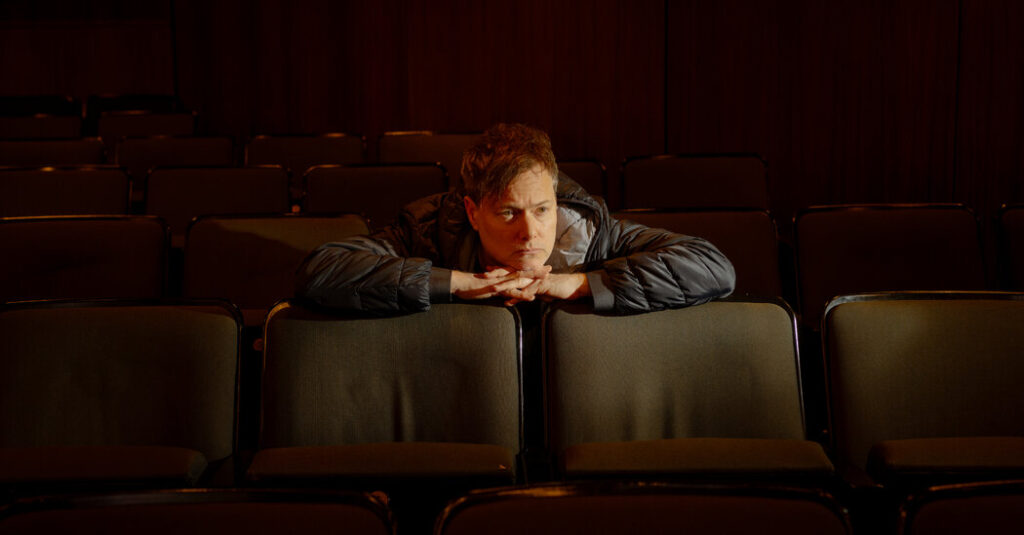
In 1994, Rau was a 17-year-old in Switzerland, a country that had always believed itself to have a kind of kinship with Rwanda. (“Rwanda was called the Switzerland of Africa,” Rau said, for its mountainous landscape.) The horrors of the genocide seemed close, certainly closer than the ones in history books. Rwandans wore the same T-shirts he did; they, too, listened to MC Hammer. (I spoke with the peripatetic Rau via Zoom — he was groggy after opening a new play, “RAGE,” at the Royal Dramatic Theater in Sweden; in two days he needed to be in Brussels, and Hamburg a few days after that.)
“I was always interested in Auschwitz and the Holocaust,” said Rau, a writer-director-activist who might be the single most influential theater maker in Europe. “But this was the first genocide that happened with the music I listened to.” RTLM’s use of pop, which snared young Rwandan listeners in a way that the stodgier state radio could not, became part of its power. “We were educated in school that Nazis were boring. But then you find out you can play Nirvana and make some jokes, and it has the same effect? That was for me a mind-blowing thing.”
It’s difficult to maintain any kind of analytical distance while watching “Hate Radio.” The audience reads supertitles and listens to the show through headphones, so the hate vibrates directly against your skull. Rau, when he is working with his company, the International Institute of Political Murder, isn’t particularly interested in distance though: IIPM dissolves barriers between performance and life in often uncomfortable — and almost always exhilarating — ways. Rau “holds a mirror up to theater” as much as he does to nature, said Carol Martin, the author of “Theatre of the Real,” a 2013 book that analyzes such work. “He’s both inside and outside the frame.”
The company’s shows typically examine an episode of historical violence: In “The Last Days of the Ceausescus” (2009), Rau, Simone Eisenring and Jens Dietrich reconstructed the perfunctory 1989 trial and summary execution of Nicolae Ceausescu; in “Five Easy Pieces” (2016), IIPM collaborated with the children’s theater company CAMPO to make a live-shot documentary onstage about the Belgian child-murderer Marc Dutroux. A child plays Dutroux’s father; a child plays a victim. When it came to what is now NYU Skirball in 2019, I remember wondering if Dutroux’s poison might be osmosing its way into Rau’s tiny actors, or if, as it seemed, the performance was giving them tools to resist it.
His work is not uncontroversial — which may be to the purpose. The German writer and scholar Florian Malzacher describes this branch of Rau’s work, rather coolly, as manipulative; it only “looks very Brechtian,” he said. To achieve Brecht’s alienation effect, the strings show: Actors might, say, introduce themselves with their real names, to prevent us from being seduced by their pretending. Yet in Rau’s exquisitely made pieces, those same techniques don’t produce alienation. “It’s still about grand emotions,” Malzacher said, when I reached him by phone. “It’s like a magician who shows you how the trick works” and then it “works even better.”
Malzacher does greatly admire Rau’s less theatrical work, his hybrid projects like legislative actions, mock trials or political assemblies. In these, Rau follows Joseph Beuys, the utopian avant-garde artist and theorist of “social sculpture,” who argued for the social organism as a kind of communally devised work of art. For instance, in 2015, Rau created “The Congo Tribunal,” a 14-hour public hearing about atrocities in eastern Congo, in which real judges, real politicians, real rebels and real victims all testified. Rau appeared too, directing a film of the event. (Many of his theater-pieces are made alongside, or inside of, a documentary.)
He’s now three years into his stewardship of one of the world’s biggest theater festivals, the Vienna Festival, which he declared the “Free Republic of Vienna” — and is now trying to encode his changes into its constitution. From that position, he started the Resistance Now Together campaign, calling for the European Parliament to establish a European Artistic Freedom Act. After a far-right Slovakian government sacked the artistic director Matej Drlicka from the Slovak National Theater, Rau — who has himself been summoned before the Austrian Parliament after calling specific politicians Nazis — rallied for an inter-European movement to protect artists from autocrats. (This weekend, in Hamburg, the Resistance Now project mounts a five-session “Trial Against Germany,” a “legal-theatrical” investigation into whether the far-right AfD party should be banned.)
The U.S. theater scene certainly has no public intellectual (or attention-grabbing aesthetic provocateur) like Rau. So it’s useful that he’s sending three pieces to New York in just two months, a kind of micro-syllabus in hard realism. After “Hate Radio,” he will stage the French writer Édouard Louis’s monologue “The Interrogation” (2021), at NYU Skirball from March 26-28. And, on March 29, Skirball will host him at Judson Church, where he and the French dramaturg Servane Dècle will present “The Pelicot Trial” (2025), a four-hour reading of documents from last year’s trial of Dominique Pelicot, who serially drugged his wife, Gisèle Pelicot, and was convicted — as were more than four dozen men he invited to rape her.
In a way, Rau and Dècle’s production operates as a bookend to “Hate Radio”: Both demonstrate how a mass of people can eagerly dehumanize another. “Virginia Woolf said something like, ‘What outside is fascism, is sexism at home,’” Rau said. As countries everywhere seem to be sliding back toward their worst natures — a party founded by Nazis gaining strength in Austria, say — Rau continues to examine the gruesome, diligent attention to cruelty you find in Auschwitz, Rwanda, the Pelicots’ bedroom. “You see it in ‘Hate Radio,’ how it goes slowly,” he said. “And then it goes very fast.”
The Louis monologue, a confessional solo about the way art can consume identity, addresses the obvious question about making such work: What does it cost? Where do the limits of self and performance collide? During the time of the “Hate Radio” broadcasts, one of the production’s stars, the comedian Ntarindwa, was 17 years old, too — and a soldier in the Rwandan Patriotic Front.
Yet each of Rau’s performers, somehow, finds their way to the task. “That’s always what I say to the actors of “Pelicot.” I tell them, ‘It’s strange, I know, to go onstage and speak the whining monologue of a rapist,’” Rau said. “‘So you have to do three things: You have to try to understand this figure; you have to do it in a way that we understand. But the first thing is, you have to understand why you do it.’”
Suddenly, on our Zoom, Rau bent down and grimaced. Was he OK? “No, no,” he assured me, “somebody put the needle here on the ground, and it was going in my foot.” He laughed and held it up. “So, OK, this time my problem of violence is not so big.”
The post ‘Hate Radio’ and Other Transmissions From the Theater of the Real appeared first on New York Times.