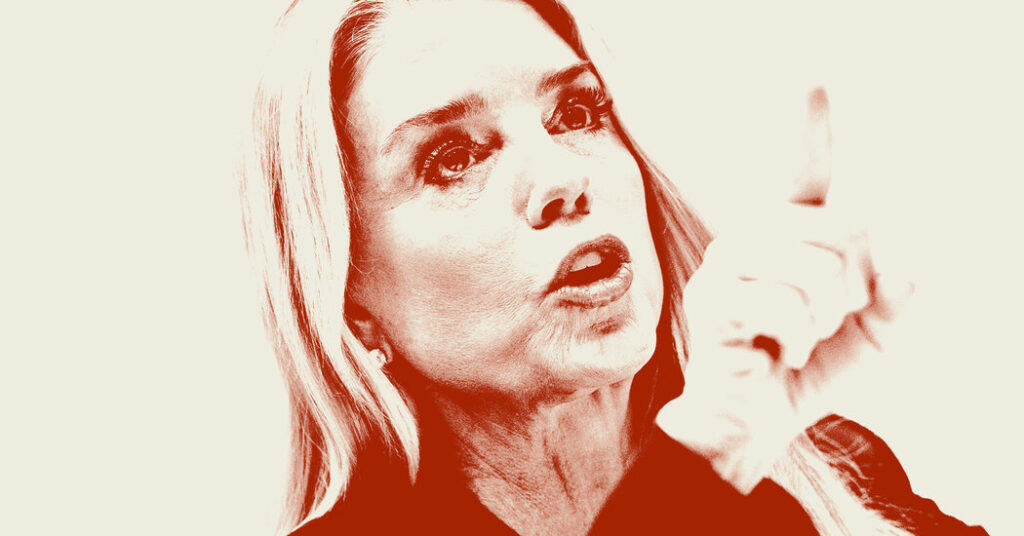
Attorney General Pam Bondi’s combative testimony before the House Judiciary Committee this week offered a glimpse of what’s happening inside the Republican Party: a full-scale meltdown. In this round table episode of “The Opinions,” the columnists Jamelle Bouie and David French join the national politics writer Michelle Cottle to unpack the intraparty wars now fracturing not only the right but also the left — and discuss why President Trump’s second term is proving to be a “great illuminator of the true core of people.”
Below is a transcript of an episode of “The Opinions.” We recommend listening to it in its original form for the full effect. You can do so using the player above or on the NYTimes app, Apple, Spotify, Amazon Music, YouTube, iHeartRadio or wherever you get your podcasts.
The transcript has been lightly edited for length and clarity.
Michelle Cottle: I’m Michelle Cottle. I cover national politics for New York Times Opinion. And this week, I am coming to you from beautiful Austin, Texas, where I am wallowing in the very juicy Senate race that’s going on in the state. But do not fear. I still have with me my usual partners in crime: columnists David French and Jamelle Bouie. Guys, welcome. How’s it going?
David French: Michelle. Hot take on calling Austin beautiful.
Cottle: What? Why the hate? Why the hate, David?
French: I’ve never figured out why Austin took off before Nashville, when Nashville is objectively the superior city to Austin. But that’s just a “me” thing.
Cottle: I got no beef with Nashville. I went to school there. I love it. So we’re just going to let that slide. There’s room for both, David. There’s room for both. Jamelle?
Jamelle Bouie: Hello. I have no opinions on either Nashville or Austin. They are parts of the country I visited, and they’re fine, in my opinion.
Cottle: He is overwhelming us with his passion.
Bouie: There are other places that I would rather go. And you may notice, I’m losing my voice a little bit, so apologies if I start cracking like a 13-year-old.
Cottle: It’s going to just make you sound very emotional for today, which is going to really work with our topics. As listeners are all too aware because, in part, we keep reminding them: This is a midterm election year. And thanks to some early primaries and special elections, we’re already seeing some emerging themes in both parties, which, Jamelle and David, I trust that you are both prepared to dig into.
But first we have to talk about this week’s Pam Bondi meltdown.
The attorney general appeared before the House Judiciary Committee on Wednesday. She was ostensibly there to answer questions about the Department of Justice’s handling of the Epstein files, but she clearly had no intention of answering much of anything.
Her testimony turned into this kind of wild back and forth with lawmakers. Some of them angry about the fact that many of the victims’ names were released, while the names of possible perpetrators were redacted. But Bondi, to her credit, gave a truly electrifying performance, I have to say. Not in a good way, but still wild entertainment.
So we are taping this on Thursday morning, so as always, facts on the ground may change before you hear it. But, Jamelle, I have got to get your thoughts so far on this spectacle. Not just on how Bondi did, but also on how members of the committee, like lots of Democrats and even a Republican or two, responded to her, just stonewalling.
Bouie: I’ll answer the second part of the question first. I think Democrats in those handful of Republicans like Thomas Massie did quite, quite well, you know?
No administration wants their attorney general looking like a raving lunatic for the cameras. And that’s what came across. I think any person who watches that hearing does not think: Oh, Pam Bondi, you know, a reasonable, sober-minded political official, a law enforcement official. But that they think: Pam Bondi — a lunatic. And I think that the fact that Democrats are able to evoke that reaction from Bondi is a political win for Democrats.
Even if Trump is sitting back in his chamber — I don’t know, I’m imagining him like Jabba the Hutt in the palace, like looking at television — even if that’s the situation and Trump is enjoying it, it’s political malpractice to allow something like this to happen.
As for Bondi’s performance. You know, my honest reaction when I saw her kind of unravel, and she’s flipping through her papers, looking for various burns to use against Democrats, my thought there was: This person is a lightweight, right? Like you should be able to handle pressure from the congressional committees responsible for oversight.
You should be able to handle pressure from your political opponents. That kind of pressure should not result in you having a visible meltdown for the public. And to my mind, this is just a defining aspect of Trump’s second term, really, as opposed to the first, where many of the high-level positions were taken up by people you might find in any Republican administration.
Here we have people like Bondi who should not be within a hundred miles of these jobs, who are demonstrably unsuited and unqualified for these jobs. And we’re seeing why, right? Both in terms of performance and in terms of substance. They just cannot do what they’re tasked with doing. Whether that’s good or bad. Even the corrupt stuff Bondi’s supposed to be doing, she’s not good at.
Cottle: Well, I did wonder, like you, how President Trump was looking at this performance, because she did not seem tough and defiant.
She seemed petulant and panicked and 100 percent on the defensive, which is not going to do anything to help the president overcome lingering suspicions that he has something to hide. Her performance with her burn book was a little like the scene out of “Mean Girls.”
And I totally agree that Democrats brought the heat. I mean, they’ve been slammed for not being tough enough on this administration. But they were not giving an inch as far as her distractions and deflections go. All she was doing was name-calling and bringing up former votes they had taken on completely unrelated things.
She accused Representative Becca Balint of having forwarded some kind of antisemitic agenda. I mean, and to her credit, the congresswoman, who is Jewish, went nuclear. She’s like: “Oh, do you want to go there, attorney general? Do you want to go there? Are you serious? Talking about antisemitism to a woman who lost her grandfather in the Holocaust?” I mean, it was a complete cage match with this stuff. And so, David, I wanted to get you in here to talk about what you are seeing in response on the right, or also just how you viewed the whole spectacle.
French: Yeah. I mean, the most telling moment was when she tried to stop questioning about Epstein, which was ostensibly the subject of the testimony, by saying the Dow was at 50,000.
Cottle: Oh my God.
French: Which is about as relevant as saying, “Why are we talking about Epstein when the Knicks won last night?” I mean, you know, it’s that kind of non sequitur. But that tells you more than anything, Michelle, who our audience is. Because who is always talking about the Dow, right? Who is always pointing at the Dow? That is the one external check that Trump pays attention to, is when the stock market crashes, and he will do things or stop doing things, and when it rises, he crows about it. So that tells you all of this was for the audience of one — and that’s Donald Trump.
And you know, one of the things I think the second Trump term is showing is that Trump is performing a function of “the great illuminator” of the true core of people. Because he really is putting in front of Pam Bondi: Hey, Pam, here is your job in one corner. And here in the other corner is reason, logic, morality, and decency. You have to give up all of those things. But if you do, you can continue to be the attorney general of the United States. And this is the test he’s putting in front of basically everyone in Republican politics right now.
And I will say, Michelle, that you’re beginning to see — not in the administration, but sort of out in the commentary class — you’re beginning to see cracks. Now, some of it is from people like Erick Erickson, whom I know, who has departed from the president before. I mean, he’s not somebody who is a yes man to President Trump.
He’s one of the few Trump supporters who is, you know, actually calling him out regularly. Others like Andy McCarthy, of National Review, who is running a really remarkable series on Trump corruption. And all of these things are coming up and bubbling up, and others are taking on members of his administration in other ways.
But again, it’s still the same pattern. The same pattern is that Trump is being failed. It is “Pam Bondi, you’re botching the Epstein release.” It’s “Pam Bondi, you’re doing this wrong, Pam Bondi, you’re doing that wrong.” When the bottom line is that Pam Bondi would not be doing any of this stuff, but for her boss.
The frustration, though, that she’s experiencing, I think, is that she’s doing everything that Trump wants her to do, and it’s falling apart because what Trump wants her to do is crazy.
Trying to indict six members of Congress, Democratic members of Congress, over an ad that just repeats some of the messaging in the Department of Defense Law of War manual. What is she going to do next? Indict the authors of the D.O.D. Law of War manual for saying there are circumstances where unlawful orders must be disobeyed? Is she going to indict Pete Hegseth, who said the same thing several years ago? I mean, it’s a remarkable development and I think it was just so clearly illuminating to people. It was just right there how craven and ridiculous it all gets.
Cottle: Jamelle?
Bouie: Can I add two things? Well, one comment, then I’ll add two things. One comment is that it is very funny to see the kind of, like, “good czar, bad boy” dynamic happening, I think, among commentators. It’s sort of a classic rationalization for bad authoritarian governance, which is a bit redundant. Authoritarian governance is bad as a matter of course, but it’s just funny to see.
The two comments I wanted to make — David, you said that Trump puts your job on one side and your morality and so on, so forth on the other side. And this gets back to what I said a little earlier, which is that — I mean, this is one of the things about this administration is that he’s selected for people whose sense of morality in the first place is somewhat deficient, right? Like Pam Bondi, you know, not known for running, sort of, like a clean A.G. office in Florida, right? Not known for being a super scrupulous person. So, she’s primed to do exactly what Trump wants her to do.
And the second substantive thing — third thing total — and this is my hobbyhorse, as you guys know. Yours to an extent, too, David. To me, this just lays bare the insanity of the idea that the entire executive branch must follow the political priorities of the president, right? Like, D.O.J. independence wasn’t just something that emerged to frustrate the aspirations of strong executives. It serves a practical purpose.
And the practical purpose is that when you’re asking the attorney general to do things like prosecute members of Congress. You’re asking the attorney general to do things like investigate the partners of people killed by your government, as was the case after Renee Good was killed. What will happen is that the good faith, highly competent, patriotic prosecutors that work for you, they’ll quit. They don’t want to do that. They want to do the thing that they signed up to do, which was enforce the law and try to bring some measure of justice to people who have been victims.
And so what you’re seeing in the D.O.J., and in offices like in Minnesota, is an exodus of attorneys. And so not only is Trump asking Bondi to do insane things, and she’s trying to do them, but in trying to do them, she’s hollowing out the D.O.J., and rendering it unable to do its actual job. And I think you can see this everywhere.
Everywhere that the Supreme Court in particular has essentially given the sanction to this notion of a unitary executive — whose job isn’t to execute the will of Congress, but to be able to bend the executive branch in service of their political agenda — everywhere that touches, you see dysfunction. And I don’t think it’s just because of Trump, I think it’s because the very notion is actually at odds with any idea of good governance.
Cottle: Well, you do wind up with this cycle, where the good people leave — those who have a moral core or who have a respect for our kind of government and the Constitution. And so then the Trump administration can continue its hiring of people who, let’s just say, have a certain ethical flexibility, and whose guiding star is the political whims of an autocratic leader as opposed to any kind of actual values.
Bouie: And those people are often, like, themselves — bottom of the barrel, right?
French: I mean, the incompetence that we’re dealing with here, it’s not just corruption — it’s corruption plus staggering levels of incompetence. And when you combined them all, you reached almost the incompetence-corruption singularity, with the effort to indict the six Democratic members of Congress. I mean, that was impeachable stuff. That is absolutely impeachable stuff. It’s not just a direct attack on a competing branch of government. It’s also a direct attack on free speech, just basic free speech. I mean, this is about as core of speech as you can imagine.
And guys, let me just say this: If any of you listening are lawyers or want to be lawyers, if this ever happens to you, just quit and go sell cars or something. They could not get a single grand juror — not a single grand juror, according to reporting from The Washington Post — to go along to indict. And you know, the old saying is that a prosecutor can indict a ham sandwich. The statistics are staggering. If you actually look at grand juries refusing to indict, there are tiny few circumstances in which that happened until 2025 and 2026, and now you’re beginning to see it with some regularity. That’s staggering level of incompetence tied to the corruption.
And then this whole bizarre thing that happened earlier this week, where there was a botched test of a laser or directed energy defense weapon that was apparently aimed — at first it was going to be a cartel drone, according to Pam Bondi. Other reports say it was a party balloon that then resulted in an impulsive shutdown of flights into and out of El Paso, which is not a small place. I mean, it’s a parliament of clowns at some point. And yet, the Trump administration has really absorbed this ethos of “no apologies, no scalps.”
And so this is just going to keep happening. It’s sad, but it’s a reality.
Cottle: So it’s pretty clear Trump’s not going to pay a price for this directly. I mean, in part because he’s a lame duck, so he’s not going to need to stand for office again. His party, however, could take a beating for enabling, and in some cases, encouraging this sort of nonsense.
If you were talking about electeds, the midterms are coming up. But even before then, do we think there’s any chance — speaking to your point about, you know, Pam Bondi was performing for an audience of one, and her performance is getting pretty roundly trashed — do you think that her days are numbered? Do we think there’s any chance she’ll maybe pass some point where she’s such an embarrassment that they start thinking about getting rid of her? Or do you think that just because she’s loyal and she’ll dig in and make a fool of herself, then she just keeps on keeping on?
French: I should say predictions are perilous with Trump sometimes, but I’d say I don’t think her job is secure. I think this is one of those classic situations of “be careful what you celebrate.” If one attorney general resigns here — because in all likelihood, Pam Bondi would lose her job because she was not sufficiently effective at carrying out the vengeful agenda. And not because the vengeful agenda was creating embarrassment for Trump, which is the truth, but because she’s just not good at it, and I think that that’s the next shoe to drop.
Cottle: Oh my God. Could it be that this is Matt Gaetz’s big moment for a comeback?
Bouie: I mean, this gets to the point I was going to make, which is that, OK, let’s say Bondi goes and it’s Matt Gaetz. It’s some other C.H.U.D. that the president wants.
And for those of you who don’t know, “C.H.U.D.” refers to a cannibalistic humanoid underground dweller, from the 1984 film.
Cottle: You just had to go there. Uh, I’m sorry. We have to take a beat on that. Continue. Sorry. I’m OK.
Bouie: Gaetz isn’t going to be any more competent? Right. He might be more aggressive, but it’s still going to be the same basic problem of, a) what you’re asking these people to do is stupid, in addition to being corrupt and unconstitutional and, b) the mere act of trying to get anyone to do it that degrades the capacity of the agency itself. So it just makes things worse.
Cottle: I want to go to a different kind of swirling chaos on the right, and that is the fight over control for the Senate and whether we’re going to get some guardrails back on this administration. We’ve got the midterms coming up and already we have some primary action going on.
I’m here in Texas. This is a particularly juicy Republican primary going on. Just this week, Turning Point Action, the political arm of Turning Point U.S.A. — which is the conservative student group that Charlie Kirk co-founded — they endorsed the Texas attorney general, Ken Paxton, in the Republican Senate primary. This, surprisingly, perhaps for a lot of people, sparked some pushback and outright disgust in certain conservative circles.
Now, on its face, this is a conservative group endorsing a very conservative candidate. David, why don’t you tell us what the big deal is going on here?
French: What I’m about to say at this moment in time in American history is going to sound like a big claim, but I think it stands up: Ken Paxton might be the most corrupt, prominent politician in America.
Cottle: Well, that is a bold statement. That is a bold statement.
French: Just top to bottom, personal, policywise, etc. He’s been under a criminal investigation for a very long time. He had a remarkable circumstance happen not long ago when a big chunk of his own office quit and blew the whistle on his corruption leading to his impeachment in a Republican-dominated Texas House.
He escaped conviction because the Senate was really at a loss of political will, which is what happens all the time in impeachment proceedings nowadays. This is somebody who has tried to ride out the storm quite successfully, I might add, by just wrapping both arms around Donald Trump — including both arms around these stolen election claims. He is a serial adulterer. Not that that matters anymore. But what’s so gross about it is this is the same T.P. U.S.A. that after Charlie Kirk’s horrible assassination, was proclaiming the beginning of a religious revival in the United States of America. And by the way, here’s this corrupt adulterer that we’re going to throw our weight behind.
So what you’re looking at here is the total abandonment and even just outright hostility towards the idea that personal character has any bearing on anything at all so long as you’re going to advance the Trump agenda and punch the left in the face.
I think it’s just a perfect representation that the Republican Party has moved on — not all Republicans, but the vast majority have moved on so completely from the idea that there is any demand for any requirement of integrity at all, so long as you are seen as most effective at attacking the left. It’s so toxic, and yet it might actually work in Texas. Michelle, I’m hoping you’re down there saying, no, David, it’s not going to work.
Cottle: I hate to disappoint you, but pulling out that line, “punch the left in the nose” is exactly what we’re talking about here, because John Cornyn is very conservative. We’re not talking about a squishy RINO (Republican in name only) versus a MAGA conservative.
Talking to voters down here, Cornyn’s vote with Democrats to pass a very modest gun control bill is something that ticks off a lot of the Republicans in Texas. But it is the bigger issue that he is seen as out of step with the modern Republican Party. He’s too much a part of that old kind of gentleman’s Republican set that used to rule the day, I guess back in the George Bush era.
Bouie: That’s so funny because Cornyn is a dedicated partisan, and I think David’s right to say that it’s not just this obsession with punching the left and almost a worship of the will to power. The thing Paxton has that Cornyn may not is that Cornyn may feel some obligation to do the public good on occasion — like voting for the gun control bill.
He says: I’m conservative, but this would help people, broadly speaking, and doesn’t cut too much against my own conservative views. And I have, as a lawmaker — not simply as some sort of vessel for partisan rage — as a lawmaker, I have this responsibility to lawmaking. That’s why I’m here. And the Paxton type is someone who rejects any obligation whatsoever except to the acquisition of power for oneself.
French: I’ll say this about what Jamelle said about integrity: I think that Jamelle just hit the nail on the head here, and integrity now is a liability in Republican politics for one very clear reason. And that is, it means you have some guardrail.
Bouie: Yeah.
French: So Senator Cornyn has guardrails. He’s a hard-core conservative, but he has guardrails. He voted to certify the election — that was defying Trump. But this is where we’ve gone. We really went from a moment when, for example, white evangelicals in 2011 were the group most likely to say that character mattered, to, by 2015 — or maybe early 2016 — becoming the demographic least likely to say that character mattered.
And now we’ve gone full-on to a place where, in some parts of the heavily evangelical Republican base, character is just a liability, because you cannot have any lines when you’re taking on the left. There can be no lines at all.
Cottle: Well, here’s the last thing I’ll say on this, which is that what I’ve found talking to some Paxton supporters, is that it’s a matter of redefining what character is.
Character matters, but it’s kind of the character definition of: Are you fighting the good patriotic MAGA, stop the godless liberals fight? That’s much more important than whether or not you have slept around on your wife or you are corruptly using your office. So it’s in their view — because there’s always a good spin — character matters, just not in the way that you might think. So ——
Bouie: That’s so funny. Character matters but if I’m going to give character ——
Cottle: But I’m going to redefine it.
Bouie: This Baroque definition that no one else follows. Yeah, sure. If my grandmother had wheels, she’d be a bicycle, right? Like sure, of course.
Cottle: So now I want to switch to the Democrats who, like the Republicans, are trying to figure out which way their party is headed and who’s going to lead them there. So on Tuesday, the progressive organizer Analilia Mejia declared a slim victory in a special election in New Jersey for the House.
Jamelle, why don’t you give us a take on what was going on with this race, because she was not the favorite by any stretch. What does her victory tell us about the mood of Democratic voters there?
Bouie: Sure. So for a little more context, this was a race to replace Mikie Sherrill, who’s now the governor of New Jersey. This is her district. My sense of what happened here is that the former representative, Tom Malinowski, was favored to win. He was in a good position to win. But two things happened. The first is that, perhaps sensing what is changing among Democratic voters, Malinowski — who was a very pro-Israel Democrat when he was in Congress — was willing to say he would put some conditions on aid to Israel, given conditions in Gaza.
And AIPAC, the kind of lobbying group, unleashed millions of dollars in ads against him for not having a categorical hard line. Mind you, it’s not as if Malinowski was saying that Israel’s conduct in Gaza was a genocide, unlike his opponent who was saying that it constituted — or I believe she was saying it constituted a genocide. She is an even more resolute opponent of aid to Israel.
So AIPAC is unloading millions of dollars in ads against Malinowski and in particular they are targeting him for being kind of soft on accountability for ICE, like having voted for funding for ICE. Mejia, by contrast, was very much running on: I will hold ICE accountable, abolish ICE.
And I think that is also going to be a litmus test, and it’s going to be part of a larger litmus test of whether to hold this administration accountable. What is your attitude toward this administration going forward? Is it going to be, let’s do some reform here and there and try to get past the worst? Or is it going to be, we want to hold these people accountable in dramatic ways?
Democratic voters have bloodlust right now — that’s the best way to put it — and they don’t want Democratic lawmakers who aren’t willing to reflect that back at them.
Cottle: So here’s the interesting thing, the party’s very angry and they’re very angry at the failures of the establishment.
In a couple of cases you have progressives who come out swinging, but then you also have moderates in different places like the governors, Mikie Sherrill in New Jersey and Abigail Spanberger in Virginia, who were not super progressive candidates, but they were still very critical of the failures of the establishment, Washington and things needing to change. We are seeing that all over.
I do think there is a kind of movement that transcends your spot on the ideological spectrum — people just want leaders who clearly get that something has to change. It’s very anti–status quo. It’s also very willing to push back against a kind of corrupt and disturbing administration. So I do wonder about the degree to which people will really drill down on progressive versus centrist, when I think more of this comes down to: Are you willing to throw some punches and be honest about the failures of, you know, your team and the other team, in terms of the establishment?
Bouie: While there is some connection, I think, between that and ideology, I think you’re right to say it’s not necessarily connected. You can have a moderate policy program and still be a very anti-establishment figure. What’s interesting, though, is that this may just be inherent to Democratic Party politics, regardless of where you fall on the spectrum: The anti-establishment energy is not anti-institutional energy. This isn’t so much, we want to tear down institutions. This is: We want the institutions to work better — in the sense that corrupt people are making them work worse. So it’s not quite the same.
I’ve seen comparisons — not here in our conversation, but elsewhere — between this and Tea Party energy. That’s where I’d say there’s a big difference. The Tea Party, in a lot of ways, was not just anti-establishment, but anti-institutional. And this is kind of funny — this is a very funny anti-establishment, pro-fight energy, but in the service of reinvigorating institutions, so that they actually work.
French: I look at the Texas primary where you are, Michelle, and to me right now, Texas is the center of the American political universe because the two primaries are so instructive and will be so instructive. The Texas Democratic primary really shows the embodiment of two very different approaches.
Cottle: Just to be clear, Jasmine Crockett and James Talarico on the Democratic side — nobody has a scandal and nobody has gone super nuclear on the other at this point.
French: Right. So it really is putting before Democratic primary voters that these are two very different approaches. Both of these politicians are very good representations of these two different approaches. And which one do you want? I’m going to be so fascinated to see the results of that because it is a race that’s untainted — wow, a race untainted by scandal? Who’s ever heard of such a thing?
Cottle: I know. Go figure. That’s insanity.
French: So I think that’s going to be very, very interesting. But it is absolutely the case that a lot of the establishment that has tried to rise up to defend American institutions has its own abundant flaws. I do think that if I were going to point to a politician, just to show the kind of person who might fit this profile — and, Jamelle, you guys can tell me if I’m wrong here, this is just me talking out loud — I’d say Mark Kelly.
Nobody would say he hasn’t fought enough. They tried to indict him. He has fought hard against the Trump administration, yet he’s not in the most progressive wing of the Democratic Party. Is that a profile people would really like? I don’t know. I don’t know. It’s going to be interesting to find this out.
Bouie: Some of this is just going to be hard to answer. If there’s a Democratic trifecta in 2029, I think the big political question is going to be: Does the Democratic Party push forward on its substantive agenda, or does it engage in a cleanup operation? I think American politics is quite bad at accountability. We don’t like the idea of dwelling on the past.
You know, readers of mine will know that I’m a big Lincoln head, and this is — I mean, Lincoln was chosen as the Republican nominee in 1860 in part because everyone’s like, well, he’s just a moderate guy. He’s a moderate antislavery guy, and he might be easily manipulable by a William Seward or these other people who will be in the cabinet, and we can trust that he won’t go too far afield.
And no one at the time could really sense Lincoln’s own kind of iron will. So when secession starts to happen, even Seward, he was like, maybe we should make some concessions here. We don’t want secession. And Lincoln is almost — not alone, but close to being one of the handful of people who was like, no, let them secede. If they’re going to do it, let them do it, and we’ll respond. And that reaction, that willingness not to bend, is hard to predict. It’s hard to see where that can come from — it might come from places you expect, and it might not.
So when thinking about the candidates Democrats might be attracted to, I don’t know. This is one of those things you kind of find out in the doing — in the campaigning, in the situations, and in everything that unfolds. It’s hard to say.
Cottle: I have to say, if we managed to get Lincoln into a podcast, that actually seems like a good spot to land. Congratulations, Jamelle. Well done.
French: Always good to land on Lincoln.
Bouie: I can work Lincoln into literally any conversation.
Cottle: Challenge accepted. This could be a future plan.
So we’re going to pivot now to everyone’s favorite part of the show: Recommendations. What are the eye-pleasing, stomach-soothing, brain-stimulating, Zen-inducing joys you want to share with us this week, guys? Jamelle, you go first.
Bouie: Sure thing. Last week I recommended a Criterion Collection of films by Black filmmakers, with a focus on the work of Charles Burnett. This week I want to recommend another Criterion Collection collection — not Black History Month-related. These are the films of Mervyn LeRoy, who was a Hollywood studio director during the pre-Code era.
It’s a great collection — I want to say maybe 10 or 11 films, a bunch of movies — but they’re all short, and they’re all terrific. In particular, you’ll want to watch the films that star a young Edward G. Robinson, who everyone will recognize because he’s one of the most caricatured actors ever, known for that signature, like, “Eh, see?” kind of thing. But I highly recommend the collection — “Gold Diggers of 1933” is another fun picture — and I really recommend you just check it out.
Cottle: Love it. David?
French: So I had a choice in my mind: was I going to go low, or was I going to go high? I decided not to go low — which would have meant recommending HBO’s show “Industry,” which is grim-dark — so let me go high.
I recently reread, for maybe the 15th time in my life, one of my top five books. It’s very short: “The Screwtape Letters” by C.S. Lewis. And let me make a plug for people to read it. C.S. Lewis was a Christian theologian, most famous for “The Chronicles of Narnia” books. But this is one of his most famous works, with a really interesting conceit. It’s a series of letters between a junior devil and a senior devil as they try to tempt this poor English bloke into hell.
Even if you’re not a Christian, it’s a really good read because of the insights it has into human nature and all those subtle ways in which we can corrupt ourselves, and all the subtle ways in which often our best intentions are turned against us to make us worse people. It’s really fascinating. And even though it was written in the World War II era, it’s very relevant, because human nature is not this changing, shifting thing.
It’s a very short read, a very fun read, and very charmingly written, but it’s also relentlessly insightful about the human condition. So I’m going to go high this time, Michelle. I’m going to go high.
Cottle: All right. Well, I’m just going off book completely and I’m going to say that I have been exploring the mocktail menus at restaurants lately. Whether you’re doing dry January or you’re just cutting back for health reasons or whatever, a lot of people are drinking less. I have to say that drink masters are applying themselves at high-end restaurants. A new mocktail bar just opened up in D.C. — I’m sure there’s tons in New York — and they are amazing. They are so delicious.
I’m just going to throw this out there and say, I used to kind of turn up my nose snob on this, but these guys have upped their game. It’s good for your health. Give it a shot next time you’re out for a kind of fancy meal and see what you get.
So that’s it. I think we’re going to just land it there. Thank you so much, as always. I’m going to go back out into the wilds of Texas. I’m doing a tour of — you can’t tour the whole state, but I’m hitting Tyler, Texas, to the north and Austin and San Antonio and Houston. It’s going to be magic. I’ll bring you back a hat.
French: Michelle, beware the lasers of El Paso.
Cottle: Oh, I’m not going to West Texas. It’s too scary out there. I’ll get shot down. All right. Bye, guys.
Bouie: Bye.
French: Bye, Michelle.
Thoughts? Email us at [email protected].
This episode of “The Opinions” was produced by Derek Arthur. It was edited by Alison Bruzek and Kaari Pitkin. Mixing by Daniel Ramirez. Video editing by Lisa Angell. The postproduction manager is Mike Puretz. Original music by Pat McCusker and Isaac Jones. Fact-checking by Mary Marge Locker. Audience strategy by Shannon Busta and Kristina Samulewski. The director of Opinion Video is Jonah M. Kessel. The deputy director of Opinion Shows is Alison Bruzek. The director of Opinion Shows is Annie-Rose Strasser. Special thanks to Aaron Retica.
The Times is committed to publishing a diversity of letters to the editor. We’d like to hear what you think about this or any of our articles. Here are some tips. And here’s our email: [email protected].
Follow the New York Times Opinion section on Facebook, Instagram, TikTok, Bluesky, WhatsApp and Threads.
The post Pam Bondi’s ‘Cage Match’ and Trump’s Fraying Coalition appeared first on New York Times.