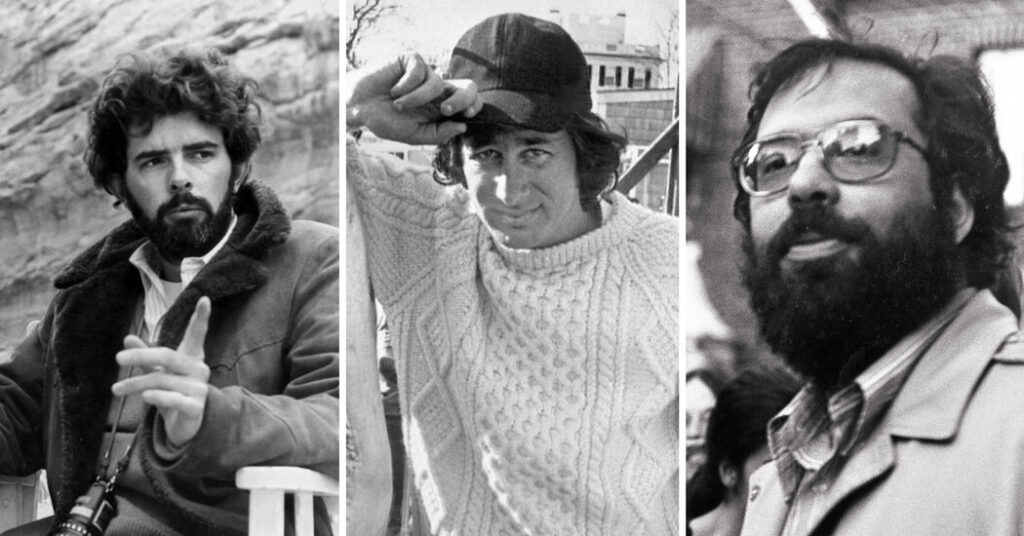
THE LAST KINGS OF HOLLYWOOD: Coppola, Lucas, Spielberg and the Battle for the Soul of American Cinema, by Paul Fischer
Francis, George and Steven — as Paul Fischer cozily refers to them throughout his book about the early careers of Coppola, Lucas and Spielberg — were young men hungry with ambitions at the start of the 1970s. Before long those dreams led to “The Godfather,” “Star Wars” and “Jaws,” transforming the landscape of movies. Sound familiar? That story really is. “The Last Kings of Hollywood: Coppola, Lucas, Spielberg and the Battle for the Soul of American Cinema” creates a breezy narrative as faux-intimate as its use of first names, as hyperbolic as its title. If you’ve never heard the bedrock sagas about how Coppola feared being fired from “The Godfather” and the mechanical shark in “Jaws” malfunctioned, Fischer has written a lively introduction. But for millions of moviegoers even slightly aware of the careers of these now-revered filmmakers, who are very much alive and thriving, this narrowly focused work offers only a smattering of new details.
The story is still amazing. These three took advantage of an alchemical moment when the studios’ decline and the fresh wind of the 1960s allowed them to turn personal visions into Hollywood success. Between 1972 and 1977, Coppola transformed the pulp novel “The Godfather” into an artistic masterpiece about crime and family, Lucas created the enduring Jedi mythology of “Star Wars,” and Spielberg’s “Jaws” invented the summer blockbuster.
“Each one of us was tough,” the director Brian De Palma, who came up along with the book’s subjects, told Fischer about the rebellious attitude his generation brought to the game. “And we could outlast. Because they [the studios] don’t have any convictions.”
Fischer maps out a trajectory about how those ’70s renegades flourished and by the ’80s became industry titans themselves, but that idea is often buried under the book’s real thrust: a string of anecdotes, many from previously published sources, about the ups and occasional downs of their friendships and collaborations.
Coppola, now 86, is the oldest of the three, with an outsize personality that dominates the book. He spent lavishly in his personal and professional life and operated on instinct on his movie sets — a pattern that extends through “Megalopolis,” his 2024 self-financed extravaganza. Lucas is the opposite. Five years younger than Coppola and taciturn in public, he is a practical, technical wizard. One of Fischer’s more illuminating observations is that as a film student Lucas only wanted to make abstract work “without the need for story or character,” far from the swashbuckling heroes he would later create, including Han Solo and Indiana Jones.
The Lucas-Coppola bond was symbiotic and dynamic at first. Lucas prodded Coppola to make “The Godfather” because the production company they founded together, American Zoetrope, needed money. And after the commercial failure of Lucas’s first feature, the dystopian sci-fi film “THX 1138,” Coppola urged him to add a little relatable emotion next time, which led Lucas to make the hit “American Graffiti.” But American Zoetrope’s finances were a shambles, with Coppola squandering money on big parties and an antique espresso machine for their headquarters. The partnership ended and the friendship was tense for years after a dispute about which of them would direct “Apocalypse Now” — famous today for its troubled production and acknowledged as another Coppola masterpiece.
Emotion onscreen was never Lucas’s strength. Heartfelt emotion, even and especially in aliens like E.T., has always been Spielberg’s. His “Close Encounters of the Third Kind,” a U.F.O. story with a poignant theme about family, came out the same year as Lucas’s visually dazzling, emotionally chilly “Star Wars,” 1977. But together they forged a strong creative partnership beginning with Lucas’s idea for an old-fashioned adventure film that became “Raiders of the Lost Ark,” directed by Spielberg. If Lucas was the entrepreneur who shrewdly kept the rights to the “Star Wars” sequels and merchandising, and Coppola the mercurial artist struggling through bankruptcies, Spielberg, the youngest, was the even-tempered prodigy who could work with studios and apparently bend them to his will. Yet despite his career’s importance and his long friendship with the other two, he is oddly overshadowed in the book.
It would have been helpful to have more firsthand accounts here. De Palma and Walter Murch, the editor and sound designer who worked closely with Lucas and Coppola, are among the few valuable sources who spoke on the record. Fischer interviewed hundreds of people, but among the few dozen he mentions in the voluminous notes, none are Coppola, Lucas or Spielberg. Whomever he talked to off the record might have added some color but not much reliable insight. At drug-fueled parties at the actress Margot Kidder’s, Fischer writes, Spielberg stood back and watched “with the quiet longing of a young man who knows he’s too square to ever be the life of the party.” Well … maybe?
Fischer’s writing style is fluid but occasionally cringey. When Spielberg spots a yet-to-be-published book in a studio executive’s office, Fischer writes, with a flourish, “Its title was ‘Jaws.’” His previous books benefited from taking on lesser-known histories. “A Kim Jong-il Production” is an account of the North Korean leader’s kidnapping of a filmmaker and an actress, and “The Man Who Invented Motion Pictures” is about a Frenchman who, some claim, made films before the Lumière brothers, commonly credited with that.
Powerful though they became, Coppola, Lucas and Spielberg are hardly the final kings. A recent Hollywood Reporter article headlined “The Last King of Hollywood,” for example, questioned whether the title would go to Ted Sarandos of Netflix or David Ellison of Paramount, both trying to buy Warner Brothers in a battle that is still playing out. That tug of war, although outside the scope of Fischer’s book, suggests how limited its perspective is and how dubious its title. There will always be a new king — or maybe queen? — as long as there’s a Hollywood, which at the moment is still, if barely, standing.
THE LAST KINGS OF HOLLYWOOD: Coppola, Lucas, Spielberg and the Battle for the Soul of American Cinema | By Paul Fischer | Celadon | 462 pp. | $32
The post How Coppola, Lucas and Spielberg Transformed Hollywood appeared first on New York Times.