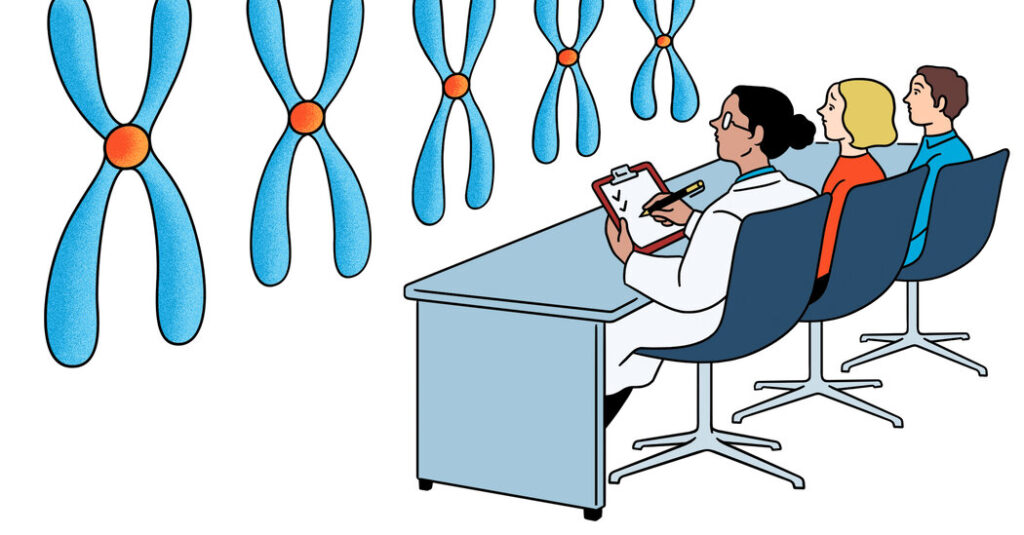
Shortly after my son was born, he was diagnosed with cystic-fibrosis-related metabolic syndrome, a condition that sometimes becomes a full cystic-fibrosis diagnosis. Children born with my son’s gene combination (one C.F.-causing gene and one with varying clinical consequences) have a chance — low, but not so low as to be disregarded — of transitioning to C.F. by age 8. (Those who do often have a better prognosis than classic C.F. patients.) Many others are thought to be healthy throughout their lives, though there’s little data on the outcomes.
My son, who’s almost 3, is asymptomatic and thriving. His syndrome mostly just means annual visits to a C.F. clinic for monitoring. But for future pregnancies, we are debating whether we should do I.V.F. with genetic testing of the embryos before implantation. If my husband and I each carried typical C.F.-causing variants, this testing would be a no-brainer. But with such a small risk of illness, does this type of embryo selection border on eugenics, especially now that a new class of drugs has transformed life for many with classic C.F.? I’m also concerned that I’m being influenced by my desire to have a daughter, which we would be able to select for. And I’m troubled by knowing that I would have selected against my son’s embryo, when he is now a healthy and joyful child whom I love beyond measure. Still, I hear of older children with my son’s combination having to dedicate 30-plus minutes a day to breathing treatments. What is the most ethical course? — Name Withheld
From the Ethicist:
There are important ethical questions about choosing not to implant an embryo because the resulting child would have a risk of growing up to have a serious illness. Among bioethicists, the “expressivist” argument captures the worry that when we prevent people with a condition from being born, we’re expressing disfavor toward actual people with that condition. But you already have a child with this condition, whom you couldn’t love more.
Nor do we usually think that curing a child of a disease expresses contempt for children who have the disease. If you were able to use gene therapy to eliminate a child’s cystic fibrosis, it would be clear that you were fighting the condition, not rejecting the person. And if you used embryo selection to spare a child at risk of C.F.? There’s a metaphysical difference here — selection changes which child exists — but not necessarily a moral difference. In choosing to implant an embryo without the C.F.-associated gene variants, you’d surely be expressing a judgment about states of health, not a judgment about the worth of existing people.
The word “eugenics” trails a dark history of coercive sterilization, racism, ableism and more. But, in general, sound arguments aren’t tethered to a specific word. You should be able to rephrase the concern using other words. So make the argument again with plain terms like “selection” and “risk.” If the conclusion doesn’t feel so compelling without “eugenics,” then the word may be doing too much of the thinking for you. Believing that a life without a disease is, other things being equal, better than one without it doesn’t entail believing that the person who has the disease is, for that reason, of lesser value. Wanting a daughter in your family, in turn, doesn’t commit you to the opinion that girls are better than boys. On an individual level, at least, it needn’t entail a ranking of human worth.
Many people, to be sure, oppose abortion and embryo disposal across the board: In their view, the fact that an embryo could grow up to be someone who would have a life worth living means that it should not be denied that life. If you share that view, I.V.F. with genetic testing will be hard to justify. The philosophical issues here are intricate and much debated, but those who accept abortion will reject the claim that the prospect of a life worth living is, by itself, enough to grant an embryo a right to life. You can honor the value of life without treating every potential one as a mandate.
Readers Respond
The previous question was from a reader who wondered whether he was obligated to stay friends with someone who had helped him through a hard time. He wrote:
Six years ago, I moved to London with my wife. In my first job here, I got along really well with someone from my team. … In 2022, my wife and I split up, and I found myself heartbroken and completely alone. Although my friend and I were no longer working together, I was desperate for company, so I reached out. We started hanging out regularly. He helped me heal from my breakup, and I couldn’t have done it without him. … But as I recovered from my heartbreak, I started to notice he had some views on gender, minorities and the current state of the world that I couldn’t disagree with more. … I’m starting to think that this might be something nonnegotiable to me, but the idea of cutting ties with someone who helped me more than anyone when I needed help the most makes me feel very ungrateful. Should I “break up” with him? — Name Withheld
In his response, the Ethicist noted:
You’re treating your friend’s views on these topics as an unchangeable given. Maybe for good reason. It’s possible that you’ve contested some of his unpalatable opinions and he’s just dug in. Still, one thing friends can sometimes do is draw on a stock of trust and good will to have harder conversations than strangers can. So, if you haven’t, it may be worth talking through your disagreements. But you’re not required to hang out with someone whose views make you feel you’re betraying your own commitments. … Friendship isn’t a debt instrument. On the contrary, it’s supposed to be of ongoing value to both parties. … We can enjoy someone’s company not despite but because of our disparate outlooks. There are limits, though. If what you’re encountering goes beyond disagreement and leaves you feeling compromised, you’re entitled to step back.
(Reread the full question and answer here.)
⬥
I disagree with the Ethicist here. Compassion and empathy can coexist with other qualities. Cherry-picking what you do and don’t like about someone — after they’ve helped you in a time of crisis — is indeed the definition of a fair-weather friend. The letter writer saw fit to appreciate his friend’s compassion and empathy when he needed it, so presumably there’s something there to like. — Sheena
⬥
“Any port in the storm” doesn’t mean you have to stay in the port forever. Friendships pass away for many reasons. Be gentle and kind, but move on. — Kelly
⬥
Many years ago, I had a “good-time Charlie” friend. I used him because he made me laugh, and he used me for … I don’t know what, but he did get pleasure from me laughing at his antics. At any rate, he had moral flaws I could not make excuses for, so I stopped hanging out with him and I have zero regrets. The circumstances that brought the letter writer and his together no longer exist. It’s right to re-evaluate the relationship and do what is best for you. — Dave
⬥
Society has become too polarized, perhaps because we simply write off those who have views different from ours. I have several close friends whose views are antithetical to mine, but I would not end those friendships because of those differences. We talk about the issues, respectfully disagree and move on to topics where we can agree. Friendship does not require lock-step thinking. It often requires tolerance. — David
⬥
Many people change as they grow older. They are often influenced by their friends in positive ways — even ways that can be beneficial for society. There are individuals who are currently doing great harm who might not be doing so if they had had a patient friend’s positive influence. From an ethical perspective, the positives of maintaining the friendship for the letter writer, the friend and even society could outweigh the negatives. — Alan
The post My First Child Has a Genetic Syndrome. Can I Use I.V.F. to Spare My Second? appeared first on New York Times.