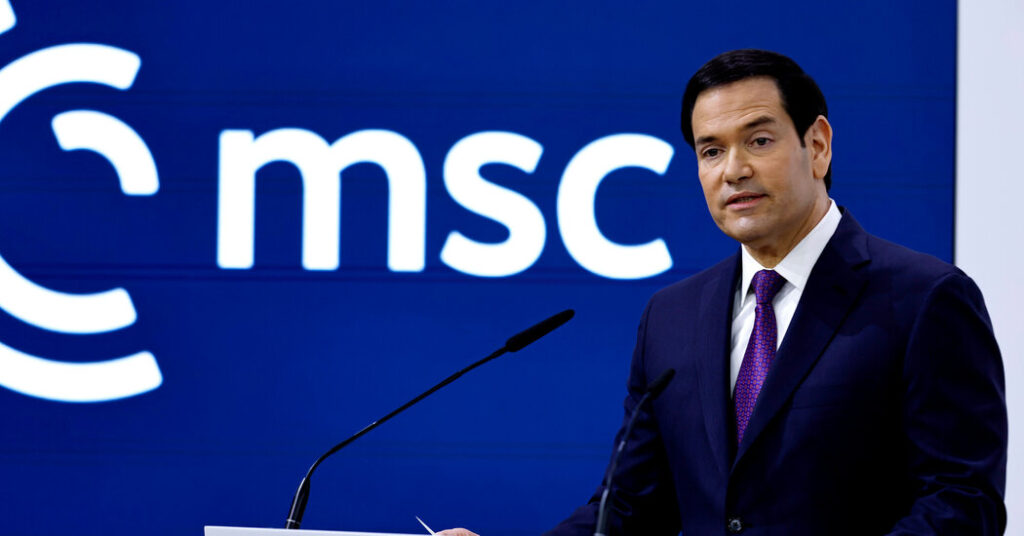
When Secretary of State Marco Rubio spoke on Saturday of the United States being descended from Europe, he drew applause from the mainly European audience here at the Munich Security Conference.
“For us Americans, home may be in the Western Hemisphere, but we will always be a child of Europe,” he said. He stressed that countries on both sides of the Atlantic were “heirs to the same great and noble civilization,” and mentioned the cultural gifts that Europe had bestowed on the world — from ancient universities to the Beatles and the Rolling Stones. That line got laughs.
But his speech also conveyed the message that any ruptures between the United States and Europe were because of the Trump administration’s view that Europe had strayed too far from that shared culture and vision.
He voiced far-right ideas in a few parts of his speech, in particular in a line in which he talked about the “civilizational erasure” that threatens the United States and Europe. He spoke several times of the dangers of “mass migration” and the need for nations to place much stricter limits on who enters their borders and settles in their lands.
This was a central theme in the speech that Vice President JD Vance delivered in Munich last year, which alarmed European officials and drew scorn.
Still, the diplomatic tone that Mr. Rubio struck sent a ripple of relief through the main conference hall. Mr. Rubio came to Munich aiming to reassure European nations that the Trump administration did not intend to widen schisms that have emerged in relations in the past year. He told reporters in Washington on Thursday that he thought his speech would be “well received.”
Mr. Rubio also spoke in vague terms of a shared future. He told the Europeans that “our destiny together awaits.” He said he wanted to make it clear that “America is charting a path of a new century of prosperity, and that once again we want to do it together with you, our cherished allies and our oldest friends.”
Mr. Rubio said the U.S.-Europe alliance cannot allow itself to be crippled by the “malaise of hopelessness and complacency” and paralyzed by fears of climate change and new technology.
And he emphasized the need for greater defense spending by European nations, an idea that over the last year has become one that European leaders are voicing as well.
“We want allies who can defend themselves so that no adversary can ever be tempted to test our collective strength,” Mr. Rubio said.
That same demand is being made here at the conference by Elbridge Colby, the Pentagon’s undersecretary of defense for policy. Though it is one that first alarmed European officials when the Trump administration began emphasizing it early last year, the notion is now being embraced across this continent. That is also partly because of Russia’s persistence in carrying out its war in Ukraine.
European officials say their countries need to be self-sufficient because Washington’s foreign policy sometimes directly threatens European interests, most notably in President Trump’s recent insistence that the U.S. government play a significant role in the control of Greenland, an autonomous territory of Denmark.
Mr. Rubio did address some specific shared security issues, including efforts to push Russia to end its war in Ukraine.
“We don’t know if the Russians are serious about ending the war,” he said when asked about the conflict in a brief onstage chat after his speech. “We’re going to continue to test it.”
He said the United States plans to continue to pressure Russia with economic sanctions and to sell weapons to Europe that will ultimately be used by Ukraine in its defensive efforts.
European officials, however, are wary of Mr. Trump’s history of voicing admiration for President Vladimir V. Putin of Russia.
Mr. Rubio also said the United States and European nations should try to carry on positive conversations with China, given China’s status as a superpower, without compromising their national interests. Mr. Trump halted his trade war with China because of the leverage wielded by the Chinese government on processed critical minerals and rare earths.
“It would be in geopolitical malpractice to not be in conversations with China,” Mr. Rubio said. The two nations can find areas of cooperation, he said — a message that he eschewed in his previous job as a U.S. senator, when he advocated hard-line policies on China. But Mr. Trump often speaks of seeking a partnership with China, and he and Xi Jinping, the leader of China, are planning for a summit in Beijing in April.
After Mr. Rubio’s speech, Wolfgang Ischinger, the chairman of the security conference, asked the American diplomat onstage whether he had heard the room’s collective “sigh of relief.”
Edward Wong reports on global affairs, U.S. foreign policy and the State Department for The Times.
The post Rubio stresses shared history and defense goals to Europeans but also warns of ‘civilizational erasure’ appeared first on New York Times.