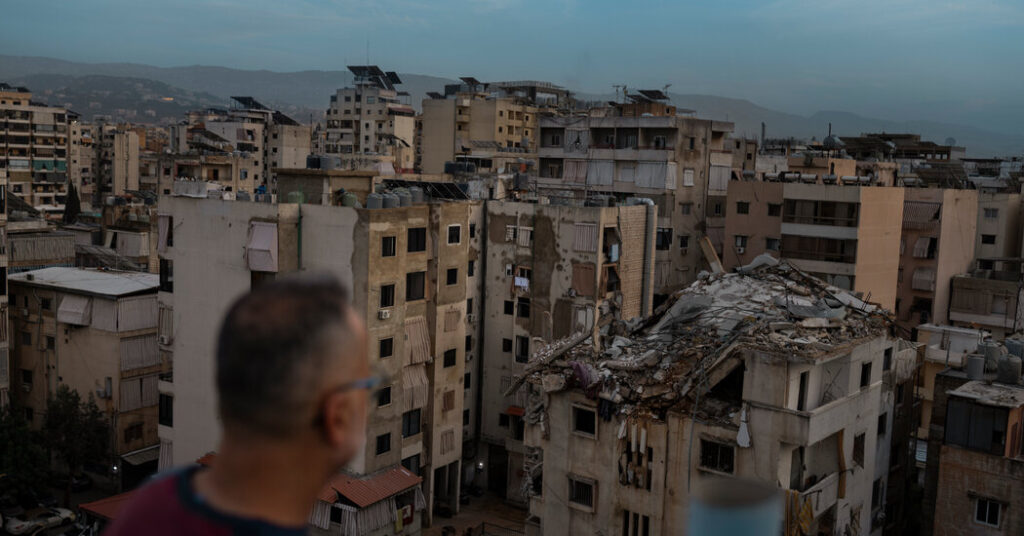
As the sun sank over the Mediterranean, Ibrahim Ammar snapped a sling and sent pieces of fruit ripping into the warm dusk light, coaxing his flock of pigeons higher and higher above Beirut’s jagged skyline.
“These are my children!” he yelled as the birds circled and fluttered overhead.
For generations, the ancient Levantine game of kash hamam, in which pigeon keepers lure and capture rivals’ birds from neighboring rooftops, has played out above Beirut, the Lebanese capital. Mr. Ammar’s father did the same before him, as did his grandfather and his great-grandfather before that.
Now, Mr. Ammar’s pigeons share the sky with a new kind of adversary: Israeli drones.
The drones above Beirut have become the most inescapable fixture of Israel’s continuing air campaign in Lebanon against the militant group Hezbollah, the mechanical whir an intermittent soundtrack to daily life. They punctuate phone calls, family dinners and first dates, as well as rooftop parties, classroom lessons and days at the beach.
The sound is steady and metallic, a mosquito-like whine hovering just at the edge of hearing and impossible to tune out.
More than a year after a cease-fire ended the deadliest war in decades between Israel and Hezbollah, residents still crane their necks skyward as the unrelenting buzz vibrates through the city — a reminder that, in many ways, the war never really ended.
Hundreds of people, many of them civilians, have been killed by Israeli airstrikes since the truce was signed, according to Lebanese officials and the United Nations. As those attacks have intensified in recent months, the drones’ whir has taken on a distinctly sharper edge amid fears of a renewed Israeli offensive.
“I’m always worried about the situation and thinking about whether the war will start again,” said Mr. Ammar, who fled his home during the war and left all 220 of his pigeons in the care of a shopkeeper across the city.
“I come up here to forget everything,” he said from his rooftop, gently stroking one of the birds as he peered down at a neighboring apartment building flattened by an Israeli airstrike. “But the pigeons can see and feel the drone, even if it is very far away,” he added.
U.N. peacekeeping forces say they have recorded more than 7,500 aerial violations — including drones and fighter jets — in the year since the cease-fire came into effect, and the drone incursions have increased in recent months. The drones over Beirut are primarily used for surveillance, but many are armed and capable of carrying out strikes, according to Lebanese security officials.
The Israeli military did not respond to requests for comment about why it continues to fly drones above the Lebanese capital, despite the truce. Hezbollah was required to disarm nationwide under the agreement, but Israel has accused the group of rebuilding its military capabilities. Israel says it is targeting Hezbollah operatives and weapons stockpiles, while taking steps to mitigate harm to civilians.
So infamous is the drone that it even has a nickname: Umm Kamel, or “Mother of Kamel,” a common name in Lebanon and a play on the Israeli drone model MK. It is a sound Lebanese have learned to recognize over years of recurring conflict, the aircraft often circling for hours on end before falling silent — watching, listening and, at times, raining missiles from the skies above.
It has also become a subject of dark humor online, reflecting a resigned familiarity with an unpredictable machine:
“Bro, doesn’t this MK have a family that checks on it?”
“Umm Kamel, go have lunch — we want to sleep.”
“It’s been two days since Umm Kamel showed up. I miss you.”
Along the devastated southern border with Israel, where Hezbollah has long held sway, the strikes are almost daily, and the drones broadcast warnings to residents through loudspeakers.
But in Beirut, life still goes on under watch.
Standing outside a neighborhood kebab joint, Maher Younes, a food-delivery rider, cut his moped’s engine and glanced up at the sky, phone still glowing in his hand. “When it’s overhead, my GPS can sometimes go crazy,” he said, shrugging. “You just stop looking at the map and start asking for directions.”
Ali Salman, 39, a convenience store owner, was less sanguine, barely able to concentrate at work as a drone spluttered above. “I keep thinking about my wife and my son at home,” he said.
“It’s one of the worst feelings,” he said. “To know someone is watching you in your own country, your own home — places where you’re supposed to feel safe.”
Others have found ways to answer back.
In his recording studio on Beirut’s outskirts, Mohamed Choucair, a Lebanese D.J. and founder of one of the city’s best-known underground nightclubs, sat hunched over synths and computer monitors as a drone circled outside.
During the height of the war, he affixed two shotgun microphones to the roof of his apartment building and recorded more than 200 hours of the drone’s monotonous hum.
The plan was simple: to turn it into an instrument of its own — a subtle act of defiance and a “small middle finger” to the Israeli military, he said. He created what he calls the Unmanned Aerial Instrument (a play on “Unmanned Aerial Vehicle,” the technical term for a drone), which allows producers to sample recordings of the drones and transform them into music.
“It is soothing to feel like I’m manipulating the sound that annoys me every day,” Mr. Choucair said.
“If you intend to make me scared, I’ll show you otherwise,” he said with a grin.
But not everyone can answer back.
Across town, crayon sketches line the waiting room of Noura Sahili’s community clinic, where she provides therapy to some of the city’s most vulnerable young people. The drone, she said, has a way of creeping into every part of a child’s day: the walk to school, playing in the street with friends, trying to concentrate on homework.
Even her sessions are sometimes interrupted, as children suddenly dart to the window to catch a glimpse of one overhead.
“Is this normal during a therapy session?” she said. “They know what the sound is. You can’t lie to them.”
The oft-repeated line that Lebanese are resilient, she added, only goes so far.
“They say we are resilient as a people, but are we?” she said. “Are we if our body is always in a constant state of alarm?”
Dayana Iwaza and Gabby Sobelman contributed reporting.
Euan Ward is a Times reporter covering Lebanon and Syria. He is based in Beirut.
The post Life in Beirut Beneath the Drones appeared first on New York Times.