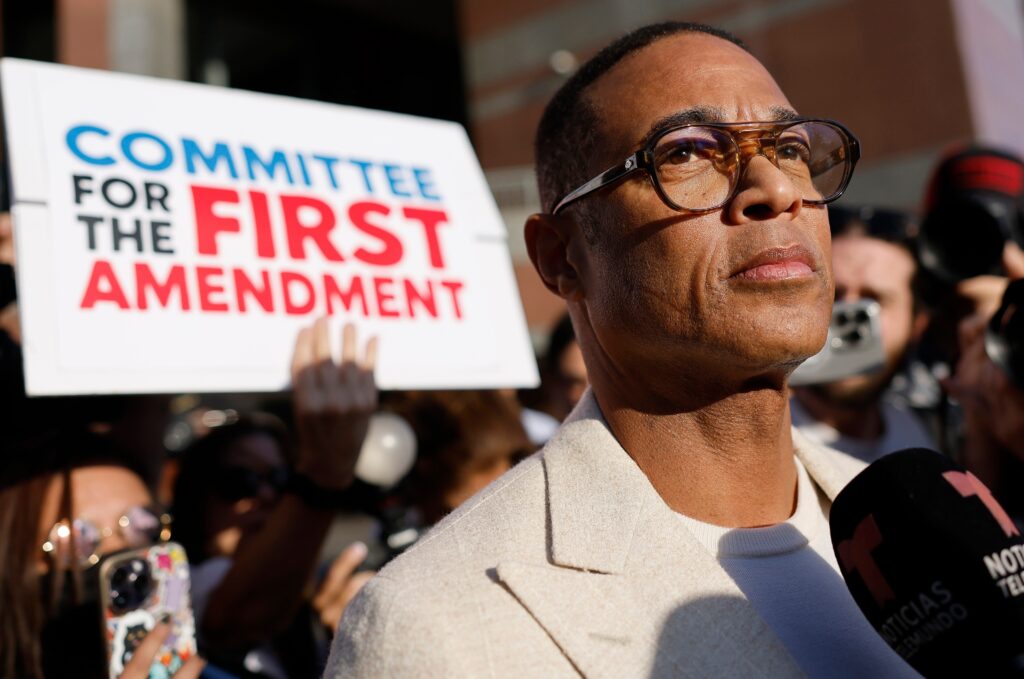
The White House took a victory lap late last month when federal authorities arrested journalist Don Lemon after he covered an immigration protest in a Minnesota church, tweeting his photo and the caption, “When life gives you lemons,” along with the emoji for chains.
But in the nearly two weeks since he was taken into custody, Lemon has enjoyed a triumph of his own. A new audience galvanized by the arrest has flooded his online-media empire, earning him more than 300,000 new followers on Instagram and 140,000 new subscribers on YouTube.
His Substack business has soared 73 percent to more than 140,000 subscribers, many of whom pay $8 a month to be a part of “Lemon Nation.” His online store has even started offering a new line of merchandise: tees, stickers and $55 sweatshirts labeled “We Will Not Be Silenced.”
“I think they did not expect public sentiment to go the way it’s going,” Lemon told The Washington Post in an interview. “They elevated me when they tried to demean me and demote me.”
Lemon’s arrest cast a spotlight on the increasingly aggressive ways the Trump administration has attacked the press, from filing billion-dollar lawsuits to lobbing insults and presenting an official White House “Hall of Shame” for what it says are the worst “media offenders.”
Federal investigators allege Lemon was not acting as a journalist but instead joined a mob that “oppressed, and terrorized” the church’s parishioners by interrupting a Sunday service last month. Media advocates, in turn, have warned that the criminal case against Lemon threatens to shatter a press-freedom precedent and erode Americans’ First Amendment rights.
But it also revealed a major unintended consequence for the administration’s push to condemn Lemon, which has sparked one of the biggest growth spurts of his online career. For journalists in the age of the news influencer, such moments can offer not just unparalleled publicity but a platform from which to reap a paying audience’s attention and support.
The White House referred comment to the Justice Department, which did not respond to requests for comment. But President Donald Trump himself has seemed to acknowledge the double-edged nature of the case, telling reporters in the hours after Lemon’s arrest that it was “probably, from his standpoint, the best thing that could happen to him.”
“He had no viewers. … And now he’s in the news,” Trump said.
Since CNN fired Lemon in 2023, following a controversy over what he later said were his “inartful” remarks about women “in their prime,” the former cable host has joined other once-traditional media players in pursuing a second life as a political-content creator, building a robust digital viewership for his twice-a-day live YouTube broadcasts and left-leaning commentary on the day’s headlines.
He was live-streaming protesters in a “Lemon Nation” beanie when the group entered the church’s Sunday service one morning last month. Trump officials said he was one of nine defendants — including seven activists, Lemon and another journalist, Georgia Fort — who conspired to violate congregants’ right to worship during “a coordinated takeover-style attack.”
Lemon has argued he was exercising his rights as a reporter in covering the scene. Mark Schoeff Jr., the president of the National Press Club, said the indictment crossed a dangerous line by “jailing a journalist for doing their job.”
Lemon told The Post he has focused more on his work than its online reception since the prosecution began, saying he’d “much rather not have been arrested” than reap the benefits of a growing follower count.
But he has also not shied away from covering the legal drama in which he has taken center stage. He discussed his case last week on a late-night show with Jimmy Kimmel and in a live interview on his own show with Rep. Alexandria Ocasio-Cortez (D-New York). “When you heard about what happened to me, what did you think, congresswoman?” he asked.
Lemon pleaded not guilty in federal court on Friday to two felony charges that he conspired to violate religious freedoms and interfered with religious activities at a house of worship. In a cinematic flourish, Lemon recently brought on as his attorney Joe Thompson, a former prosecutor who helped lead the office that charged Lemon until he quit last month.
“I don’t want it to seem that I’m capitalizing on this. And I’m not. Because I could’ve been on every single morning show, with all the people calling for me. … That’s just not why I’m doing this,” Lemon told The Post. But “am I grateful that it turned out the way it did, and that it’s actually been more help than hindrance, at least for my business? Yes.”
Even before the arrest, Lemon had become a profitable figure in the online creator economy. On YouTube, he earns a cut of the ad revenue for the freewheeling videos he delivers to his more than 1.2 million subscribers. Kyle Tharp, who has tracked Lemon’s online audience for his media newsletter Chaotic Era, estimated that Lemon is, based on viewership, making $1 million a year on the video platform.
Those videos are then cut into clips and interspersed with man-on-the-street interviews and slices of life on Lemon’s Facebook, Instagram and TikTok accounts, each of which was supercharged by the arrest. Lemon’s Instagram account went from gaining roughly 6,000 followers on the day before his arrest was publicized to 66,000 the day after, according to data from the analytics firm Social Blade.
Yesterday, I spoke outside the church with a member of the congregation at the site of a protest involving David Easterwood, a pastor at the church and the acting field office director for U.S. Immigration and Customs Enforcement in St. Paul according to Nekima Armstrong. After I shared the relevant facts, he declined to continue the conversation. Thoughts? #ice
Fort, the other journalist arrested after the church protest, has seen a similar surge. Her Instagram audience has roughly doubled since the arrest, to more than 120,000 followers. On the morning of her arrest, Fort live-streamed to Facebook as agents amassed at her door; that video has been viewed nearly 1 million times. Fort did not respond to requests for comment.
“When the Trump administration publicly targets an individual, whether they are a political opponent or a journalist, usually that results in an online, progressive, grassroots, rally-behind-the-flag effect that … grows the opponent’s audience,” Tharp said.
“The internet has a whole set of incentive structures for conflict and attention,” Tharp added. “The whole ordeal will help Don Lemon grow and monetize an audience, the administration will move on to another target, and the cycle will repeat again.”
Lemon is far from the first to be buoyed by support from viewers after being targeted by Trump officials. The former CNN White House correspondent Jim Acosta, a regular sparring partner of Trump’s during his first term, left the network last year and now has more than 300,000 subscribers on Substack.
Sen. Mark Kelly (D-Arizona) raised $13 million in the last three months of 2025 — despite not being up for reelection until 2028 — after federal prosecutors launched an investigation into his appearance in a video telling military service members to disobey “illegal orders.” A grand jury recently refused to indict Kelly, who now has half a million followers on X.
Trump’s DOJ tried to charge me with a crime simply for saying something they didn’t like. Think about that. This is after DOD already censured and threatened to demote me. He wants to make an example out of me and scare Americans from speaking out against him. Don’t let it work. pic.twitter.com/pfCVkPJ9WB
— Captain Mark Kelly (@CaptMarkKelly) February 11, 2026
Lemon declined to talk about his income or company’s revenue but said he’s “very happy” with its growth. In August, he told Variety he was on pace to surpass what he was making at CNN.
Besides YouTube revenue, Lemon said the Lemon Media Network has been able to monetize through his online store, where fans, known as “Lemonheads,” are told they can support independent journalism by buying merchandise like a “Turn the TV Off” T-shirt.
Lemon’s company also makes money through his speaking engagements, he said. A two-night show with the comedian D.L. Hughley next week in Atlanta is already sold out.
Lemon said in an interview he wishes he would have left cable five years earlier than he did, arguing that early adopters to the business of news influencing have flourished. But the work, he said, is also a lot harder than talking about the news on TV.
“It is relentless, and you can’t take your foot off the gas,” he said. “You have to be willing to work your ass off.”
Lemon is one of a growing number of high-profile TV news figures who have left their newsrooms and gone independent on platforms like Substack and YouTube, including Roland Martin, Joy Reid and Terry Moran. With a head start in name recognition over creators who started on the web, some of them have gained, or brought along, millions of followers by offering up the kinds of openly partisan views they never shared while in the legacy press.
His career as a content creator got off to a rocky start in 2023, when X owner Elon Musk canceled a streaming deal for Lemon’s new show hours after he’d sat for its first interview.
But in the months since, he has transitioned from what he said was his original idea of “doing cable lite,” with a couple high-profile interviews a week, to a more modern news-influencer playbook, centered on fiery direct-to-camera monologues and analysis of the day’s storylines.
The strategy, Tharp said, has become a kind of “algebraic formula” for left-wing media creators, with its own standardized format and style.
“The smart ones know not to reinvent the wheel, and that’s why they’re all doing the yellow-text titles in all [capital letters], with sensational, anti-Trump headlines,” he said.
But it works, Tharp added, because many viewers are eager to see media figures tussle with Trump and hold his administration to account. “We live in a choose-your-news environment,” he said, “where the creators are becoming more partisan, more values-driven, on both sides of the aisle.”
The post Trump officials condemned Don Lemon. He’s bigger than ever after arrest. appeared first on Washington Post.