On a subzero Tuesday last month, Daniel Woo, a 29-year-old sound designer incensed by the Trump administration’s immigration surge in Minnesota, drove to a St. Paul supermarket parking lot to monitor federal agents gathered there.
A gray SUV turned out of the lot. Mr. Woo checked in with his fellow monitors, a network of civilians tracking agents’ movements and alerting potential targets. The group confirmed the vehicle had been associated with Immigration and Customs Enforcement agents.
Mr. Woo followed as it traveled through the city. The SUV reached a freeway and headed west, and Mr. Woo became suspicious. He felt he knew where it was going. And sure enough, the SUV soon reached his neighborhood in Plymouth, Minn., about 40 minutes from where it had started, and pulled up in front of his house.
“They just came over to intimidate me,” Mr. Woo said in an interview this week. “To say, ‘We know where you live.’”
His was not an isolated experience. Among nearly 100 sworn statements filed in federal court on Friday are more than a dozen accounts like Mr. Woo’s, in which federal agents deployed to Minnesota singled out protesters, finding the addresses of their homes and showing up there.
It is not entirely clear how the agents determined the monitors’ home addresses; some assumed the agents had used their vehicles’ license plates. But whatever the case, the sworn statements describe a remarkable projection of police power.
The Trump administration began the immigration surge in December, ultimately deploying 3,000 agents to Minnesota in what it said was an effort to root out and deport criminal illegal immigrants. Minnesotans quickly responded, miring the federal agents in protests on the Twin Cities’ frozen streets and disrupting the city with chaotic clashes.
The statements described a fraught dynamic between protesters who often began the interactions by trailing agents, and were then threatened with dire consequences.
One Minnesota resident, Emily Beltz, 44, said in her statement that on Jan. 26, she drove to an apartment building in a suburb of Minneapolis where agents were said to be stationed.
An SUV left the scene and Ms. Beltz followed. Then, she said, the SUV suddenly turned and sped at her. “I thought the agents were going to deliberately T-bone my car,” she wrote. “Right before it hit me, the unmarked SUV braked hard.”
A masked woman leaned out the passenger window and yelled, “Emily, Emily, we’re going to take you home.” She shouted the address where Ms. Beltz lives with her husband and 5-year-old.
Asked for comment on the episodes described in this story, the Homeland Security Department did not immediately respond.
Mr. Woo’s and Ms. Beltz’s statements were filed by the American Civil Liberties Union, as well as its Minnesota affiliate and other lawyers, as part of a civil case they have brought against the Trump administration seeking to protect protesters’ rights.
Mr. Trump’s border czar, Tom Homan, said Thursday that the government was ending its deployment in Minnesota, which he called a success. But the case is continuing and on Friday, the A.C.L.U. filed an updated complaint that included the statements.
Administration officials have said that protesters are fundamentally misguided — some have said outright seditious — and are endangering the lives of law enforcement agents involved in important work.
Most of the declarations date from early January to early February, and paint a vivid picture of the otherworldly environment in the Twin Cities during the federal government’s surge. Many declarations come from residents who signed on to observe immigration operations and rapidly organized their own counteroperation.
Timothy Brandon, 70, wrote that he attended a protest at a federal building near Minneapolis, where he was struck in the hip by a projectile and fell while trying to run from tear gas, separating his shoulder.
Clayton Kelly, 25, a bus mechanic for Minneapolis Metro Transit, wrote that he heckled federal agents and was tackled by several of them, who hit him in the head and pepper sprayed him in his left eye at close range. Mr. Kelly said in his written statement that he is now often afraid to leave his own house.
And Mark Butcher, 55, a carpenter and freelance journalist, said he had been arrested on Jan. 20 after parking his truck on a residential street and recording video of federal agents. Mr. Butcher, who had open-heart surgery last year, said his cardiac tissue was damaged during his detention, and said in an interview that he had been feeling palpitations and heart rhythm problems since the encounter.
“They want to control what people are seeing and watching,” Mr. Butcher said.
The fatal shooting of two protesters by federal agents shaded many of the encounters. Sometimes, the declarations said, agents themselves would refer to the deaths of the protesters, Renee Good and Alex Pretti.
One woman, Patty O’Keefe, said in her sworn statement that after she followed an ICE vehicle, her car was pepper-sprayed and an agent smashed its windows open. Ms. O’Keefe was taken out of her car, cuffed and taken into the agents’ SUV where, she writes in her statement, the agents began to taunt and mock her.
“They mocked my appearance, saying I ‘had no good sides.’ The one who pepper sprayed my car referenced Renee Good, saying ‘You’ve got to stop obstructing us. That’s why that lesbian bitch is dead.’”
The Homeland Security Department also did not comment on that encounter.
There were times at which being followed home was only the beginning. Katie Henly, 40, works as a project manager in local government in Minneapolis. On Jan. 21, Ms. Henly went out in her car to monitor agents.
She came across two vehicles, an SUV and a truck, that she suspected were driven by federal agents. She texted their license plates to her monitoring group, confirmed her hunch and began following them.
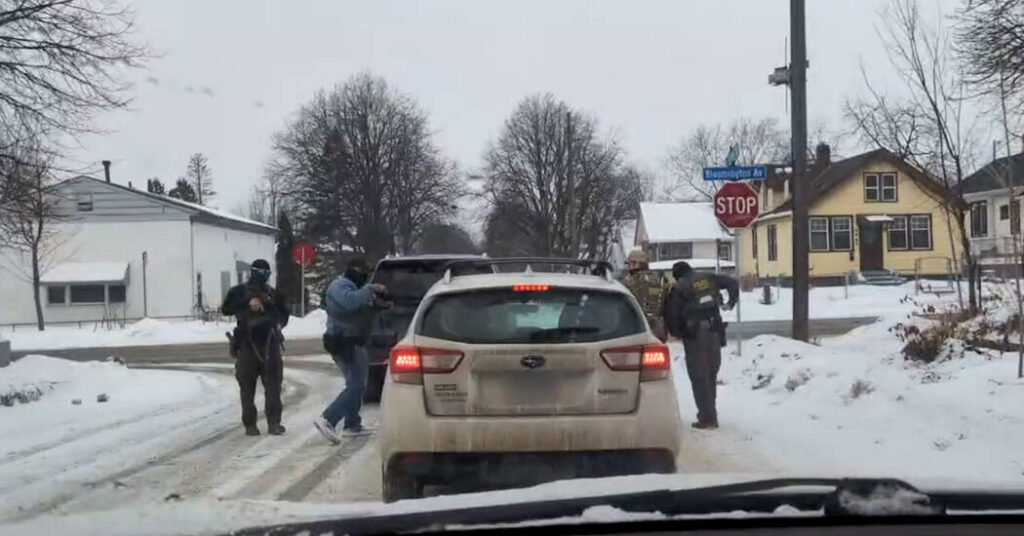
The two vehicles turned onto her street and pulled up to her house. One of the agents in the SUV poked a camera out the window and began taking pictures.
Ms. Henly continued to follow the SUV until it reached a stop sign and halted abruptly. Four immigration agents got out. One had the camera and snapped more pictures. Another was holding what Ms. Henly described in her sworn statement as a “large gun which he needed two hands to support.” She sent video to The New York Times; the gun was an AR-15-style rifle.
“I was more scared of that camera than I was of that gun,” Ms. Henly said. “The gun goes away. The camera is capturing me, and the unknown of what is happening with my image is scarier to me.”
ICE is using at least two facial recognition programs in Minnesota, as well as tools that allow agents to monitor people’s online activity. But Todd Lyons, the acting director of the agency, denied at a Congressional hearing on Thursday that his organization was contributing to any database.
Ms. Henly, when asked if she felt she had at any point overstepped, said no.
“I’m not trying to stop an investigation from happening. That is not my purpose,” she said. “My purpose when I went out there that day was to have eyes on the street in case something did happen. That I could be there immediately to document any sort of abduction of a neighbor, get their name, get their phone number, so that they don’t disappear.”
Asked the same question, Mr. Woo, the 29-year-old sound designer, also said no, explaining the feelings that had inspired him to join the monitoring network.
“They’re coming to our home, Minnesota,” he said, adding, “As someone who’s an immigrant, who comes from places and has stories from relatives about what can happen when accountability of the government is not there, you feel even more motivation to protect what America has promised in the Constitution.”
Kirsten Noyes contributed research. Mitch Smith and Thomas Gibbons-Neff contributed reporting.
Jonah E. Bromwich covers criminal justice in the New York region for The Times. He is focused on political influence and its effect on the rule of law in the area’s federal and state courts.
The post ICE Agents Menaced Minnesota Protesters at Their Homes, Filings Say appeared first on New York Times.