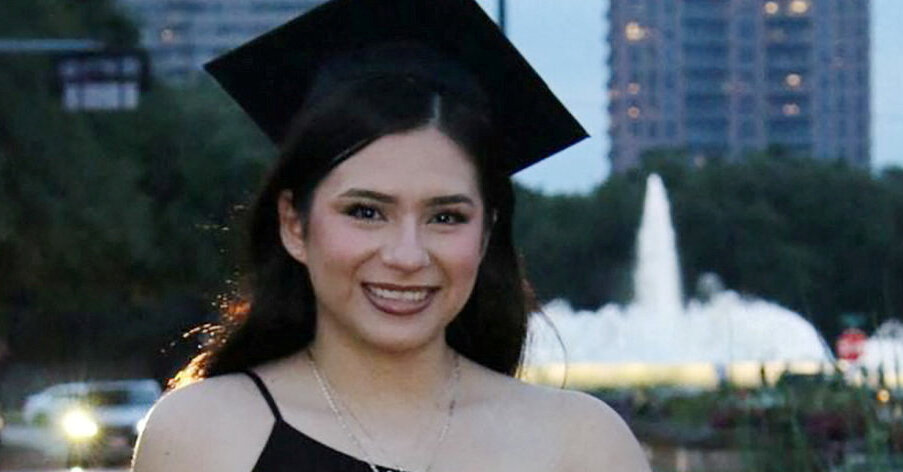
A federal judge on Friday ordered the Trump administration to return a college freshman to the United States within two weeks after she was mistakenly deported to Honduras in November.
The judge, Richard G. Stearns, had previously recommended that the administration issue a visa to the student, Any Lucia López Belloza, 19, that would allow her to continue studying at Babson College in Wellesley, Mass., while her immigration case was handled in court.
The immigration authorities detained Ms. López on Nov. 20 at Boston Logan International Airport, where she was awaiting a flight home to Houston to surprise her family for Thanksgiving.
She was flown to Honduras two days later, despite a court order signed on Nov. 21 barring her deportation while her case was pending.
The order on Friday by Judge Stearns in U.S. District Court in Massachusetts came after a federal prosecutor acknowledged in January that an Immigration and Customs Enforcement officer had made a mistake when the government deported Ms. López.
After Ms. López was moved out of Massachusetts, an ICE employee failed to activate a system that would have alerted officers in other jurisdictions that her case was subject to judicial review, according to the order.
“In this unfortunate case, the government commendably admits that it did wrong,” Judge Stearns wrote. “Now it is time for the government to make amends.”
The government has acknowledged its mistake but refused to voluntarily correct it, Judge Stearns wrote.
Secretary of State Marco Rubio declined to provide Ms. López an expedited student visa, which prompted further intervention from the court.
In a Feb. 6 court filing, Leah Foley, the U.S. attorney for Massachusetts, said that it was “unfeasible” to issue Ms. López a visa because the secretary of state lacked the authority to do so.
Ms. Foley added that the government would “respectfully decline” to return Ms. López to the United States.
The judge’s order requires the government to file status reports with the court on Feb. 18 and, if necessary, on Feb. 26 to share the “tangible steps” it has taken to facilitate Ms. López’s return to the United States.
Christina Sterling, a spokeswoman for the office of the U.S. attorney for the District of Massachusetts, said in a statement that it was “reviewing the order and will respond accordingly.”
Ms. López had a previous deportation order, and in 2018, her case was referred to ICE for potential arrest. She has previously said that she was unaware of the order and was able to live in the United States without issue.
Since arriving in Honduras, Ms. López has lived with her grandmother and attended Babson College remotely. She has struggled to keep up with her class work and exams, according to the order.
Ms. López’s lawyer, Todd Pomerleau, said that she “broke down in tears” when he informed her of the court order on Friday afternoon.
Judge Stearns has called Ms. López’s mistaken deportation a “bureaucratic fumble.” The government has spent the past month “punting” on its responsibility to bring her home, Mr. Pomerleau said.
The order was “a step in the right direction,” he said.
The Department of Homeland Security, which oversees ICE, has staunchly defended the government’s actions in deporting Ms. López.
Tricia McLaughlin, a spokeswoman for the department, has previously said that Ms. López received full due process before her deportation, including a final order of removal.
Ms. McLaughlin did not immediately respond to a request for comment on Friday.
Despite its spotty record of complying with court orders, the Trump administration has so far avoided being held in contempt of court by a federal judge.
Among the closest brushes has been a finding by Judge James E. Boasberg that there was “probable cause” that administration officials had committed criminal contempt by violating his order to turn around planes carrying migrants to El Salvador.
Judge Stearns’s eight-page ruling, titled “Order on Civil Contempt,” also comes close. It calls out the administration for “a violation” of a court order and declares that the government has “confused the prerogatives of the executive with those of the judiciary.”
While criminal contempt punishes the defiance of court orders, the goal of civil contempt is impose penalties to induce compliance.
Judge Stearns’s order does not punish or fine the government. Instead, it gives it until Feb. 27 to “facilitate” Ms. López’s return to the United States.
Should it fail to do so, said David Super, a law professor at Georgetown University, the ruling makes it clear that a contempt ruling would be the next step.
“The court found that the government has repeatedly disregarded its orders,” he said. “It discusses contempt of court extensively and provides the government with one final chance to avoid a formal contempt citation.”
Hannah Ziegler is a general assignment reporter for The Times, covering topics such as crime, business, weather, pop culture and online trends.
The post Judge Orders U.S. to Facilitate Return of College Student Who Was Deported in Error appeared first on New York Times.