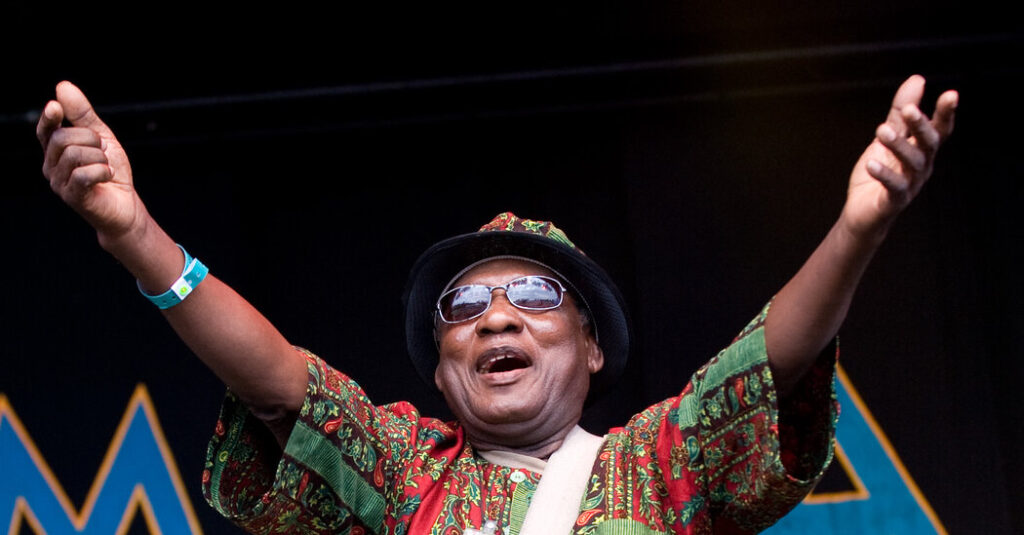
Ebo Taylor, who used the lilting rhythms of Ghana’s highlife music and the driving pulse of Afrobeat to forge a singular style that helped define West African music for a generation, died on Feb. 7 in Saltpond, a town on the coast of Ghana. He was 90.
His son Henry confirmed the death, in a hospital, a day after a festival honoring Mr. Taylor began in Accra, Ghana’s capital.
The elaborate guitar chords, two-fingered arpeggios, hypnotic rhythms and gruff, plangent vocal style that Mr. Taylor used in performing his own compositions, in Fante or English, overlaid an inherited tradition. That heritage, known as highlife, was the expression of coastal Ghana’s melting-pot culture, shaped by trans-Atlantic crosscurrents.
But highlife, the swaying, Caribbean-influenced dance music associated with Ghana’s independence in 1957 — the most famous anthem was “Ghana Freedom,” by E.T. Mensah — was only one tributary in the currents that shaped Mr. Taylor’s unusual style.
Inspired by Miles Davis, Charlie Parker and John Coltrane, Mr. Taylor “helped introduce advanced jazz chords” to Ghana’s highlife bands, John Collins, a musicologist at the University of Ghana, wrote in his 1994 book, “Highlife Time 3.”
The music that propelled Mr. Taylor to international recognition in his final years was also indebted to the traditional Akan rhythms of Ghana; the strident beat of the Nigerian Afrobeat pioneer Fela Kuti, a close friend; and even the Western classical tradition. Mr. Taylor recalled studying Dvorak’s “New World” Symphony “in detail” at the Eric Gilder School of Music in London in the early 1960s.
Highlife, which was added to UNESCO’s “intangible cultural heritage” list in December, has its roots in the music imported by West Indian soldiers stationed at the British colonial forts along Ghana’s coast in the late 19th century. The swing brought to Ghana by British and American soldiers during World War II was another influence.
Mr. Taylor took that heritage, combined it with elements like traditional Fante hand drums and created his own synthesis. “I experiment with the Fante tradition, and I fuse it with jazz,” he said in a 2011 video made by Strut Records. “When it come to highlife, I try to play it my way.”
Explaining the tension that distinguished his music from the more soothing dance-band style of traditional highlife, Mr. Taylor demonstrated on his guitar for Strut, in 2010.
“Here’s an imperfect cadence, and it’s traditional,” he said, playing an unresolved chord sequence that created a feeling of unease. “That’s what my uncles used.”
Improvising vocally in a kind of scat jazz style, he continued: “Then I create an introduction, and a development.”
As a young man in the 1950s, he had heard Mr. Mensah, the mellifluous highlife pioneer who died in 1996, perform at hotels in Accra. Mr. Taylor’s own vision of highlife, infused with subversive Afrobeat lyrics, was worlds away.
But he also hung out with Fela, the future bête noire of successive Nigerian military dictatorships, who created classic, funk-infused dissident anthems like “I.T.T.” (“International Thief Thief”) and “V.I.P.” (“Vagabonds in Power.”)
The two were close: Fela had taught him “harmonies,” Mr. Taylor said in an interview for the Vinyl Factory label in 2018. “Fela often came to my flat in Willesden,” he said, referring to his neighborhood in London, where he lived in the early 1960s. “And we would spend hours playing records by people like John Coltrane, Miles Davis and Charlie Parker, and analyzing them.”
He added: “Fela used to say to me, ‘Why are we Africans always playing jazz?’ He said jazz was for the Americans, and we should be doing our own thing.”
Deroy Ebow Taylor was born on Jan. 6, 1936, in Cape Coast, the capital of the British Gold Coast colony, the future Ghana. He was the son of Samuel Taylor, the choirmaster at St. Augustine’s College in Cape Coast, and Sarah Taylor. Ebo, as he was called, started playing the piano at 6 and the organ at 9.
While attending St. Augustine’s, he learned the guitar, joined several well-known local groups, and in 1957 moved upcountry to Kumasi to play with an established highlife ensemble, the Stargazers.
He moved back to the Ghana coast, to Takoradi, in 1961 to join the Broadway Dance Band, becoming the group’s arranger and composing highlife hits like “Wofa Nunu” (“There He Goes”), sometimes rendered as “Wofo Nono.” In 1962, he received a scholarship from Kwame Nkrumah, Ghana’s first post-colonial president, to study music in London.
After three years of listening to and playing jazz in London, Mr. Taylor returned to his homeland — and to composing, and highlife. His first albums, “My Love and Music” and “Ebo Taylor,” were released locally in the 1970s.
Decades later, in 2009, he made another album, celebrating the 100th anniversary of Mr. Nkrumah’s birth, “Abenkwan Puchaa,” which Mr. Collins described in his book as a fusion of “jazz, funk, Afrobeat and highlife with local asafo, agbadza, konkoma and adzewa drum rhythms.”
The next year, playing in festivals in Germany and the Netherlands, Mr. Taylor began to receive international recognition.
He released several more albums, including “Love and Death” (2010) and “Appia Kwa Bridge” (2012), both with the British label Strut Records, and “Ebo Taylor JID022” (2025) with the American label Jazz Is Dead.
“Taylor sings as if offering an ancient incantation,” the journalist David Peisner wrote last year in The New York Times.
In addition to his son Henry, Mr. Taylor, who had 14 children, is survived by another son, Kweku, and his wife, Elena. A complete list of survivors was not immediately available.
The intricate confluence of styles for which Mr. Taylor became known was at odds with his persona. In Saltpond, where he spent most of his life, he was known simply as Uncle Ebo.
Last year, he told Rob Shepherd of PostGenre, an online jazz magazine, that he wanted “others to appreciate my music.”
For that reason, he added, “I have not created music that is complex solely for the sake of complexity.”
Francis Kokutse contributed reporting from Accra.
Adam Nossiter has been bureau chief in Kabul, Paris, West Africa and New Orleans and is now a writer on the Obituaries desk.
The post Ebo Taylor, Musical Innovator of Highlife and Afrobeat, Dies at 90 appeared first on New York Times.