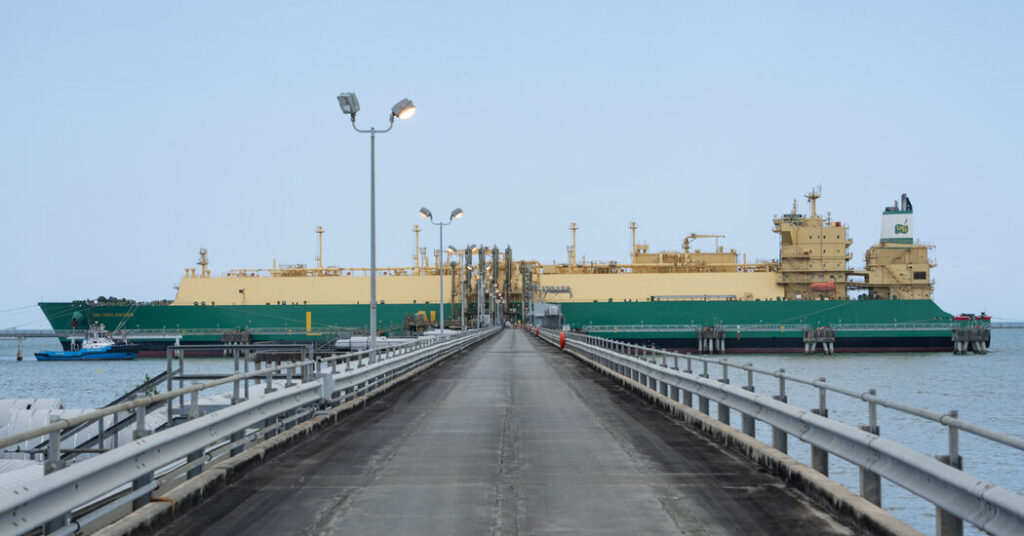
Venezuela’s oil reserves may be vast, but some of the best opportunities to quickly develop the country’s resources lie offshore, in the pockets of natural gas trapped deep beneath the seafloor.
Many of these gas fields were discovered decades ago off the country’s eastern coast, along the border with Trinidad and Tobago, a country made up of two main islands. But they went largely untouched as Venezuela focused on extracting and selling oil.
Companies like Shell, based in London, have wanted to produce this gas for many years, long before U.S. forces captured Venezuela’s president, Nicolás Maduro, in January. That contrasts with the appetite for diving into Venezuela’s oil fields, which many of the world’s biggest oil companies are reluctant to do. Part of the reason is that Venezuela, which closely guards its oil assets, has been more willing to give foreign companies access to its natural gas.
“This is like a new old toy,” said Antero Alvarado, an energy consultant based in Caracas, Venezuela’s capital. “You never opened the box.”
U.S. sanctions on Venezuela’s government and its state-owned oil company, Petróleos de Venezuela, have been some of the biggest obstacles to increasing gas production, though the Treasury Department has been gradually loosening restrictions including through new directives issued on Friday. Producing and selling a lot more of Venezuela’s natural gas would also require cooperation with Trinidad and Tobago.
Many of Venezuela’s gas fields lie along the maritime border with the island nation, which unlike its neighbor has the infrastructure to bring the fuel ashore and export it. But the relationship between the countries, which are separated by language and as little as seven miles of seawater, deteriorated over the past year. (Trinidad, a former British colony, uses English.)
Venezuelan leaders have chafed at Trinidad’s decision to align itself with the United States over Mr. Maduro’s government. Under Mr. Maduro, Venezuela had even more hostile relations with another neighbor with vast energy reserves, Guyana. It is unclear whether Delcy Rodríguez, Mr. Maduro’s vice president and successor, plans to repair those relationships.
Dragon, a giant gas field named after the choppy waters dividing Venezuela from Trinidad, is among the closest to being developed. Venezuela tried many years ago to retrieve the gas buried there before running out of money, an ill-fated effort that was punctuated by the sinking of an exploration rig in 2010.
Venezuela eventually agreed in 2023 to allow Shell to tap Dragon. The idea was that it would be much cheaper to build a short pipeline connecting Dragon to existing infrastructure in Trinidad than it would be to start fresh in Venezuela, which does not have a terminal to export gas.
That Venezuela needs its neighbor to get its gas to market is a big reason the project has a good chance of advancing, said Francisco J. Monaldi, who leads the Latin America energy program at Rice University in Houston.
“Venezuela cannot renege on the deal and monetize it elsewhere like it has done with oil, so Shell can be relatively safe in believing that Venezuela is not going to change the rules,” Dr. Monaldi said. Dragon and a different gas project along the maritime border with Trinidad are among the few new fields in Venezuela that have a good chance of being developed in the next five years, he said.
BP, another London energy company, told Reuters this week that it was seeking U.S. permission to pursue that second project, called Cocuina.
New licenses that the U.S. Treasury Department issued on Friday appeared to give oil and gas companies more leeway to negotiate with Venezuela and operate in the country. Shell and BP did not immediately respond to requests for comment on what those new permissions meant for these offshore gas projects.
“They are splicing together an environment that allows the existing players to operate,” said Rachel Ziemba, an adjunct senior fellow at the Center for a New American Security.
But many questions remain about access to electricity, security and banking in Venezuela, Ms. Ziemba added.
If Dragon gets off the ground, it could generate around $500 million a year in revenue, Luisa Palacios, a former chairwoman of U.S. refining company Citgo Petroleum, estimated based on recent natural gas prices. Government documents indicate that at least 45 percent of that would go to Venezuela in the form of taxes and royalties, she added.
But the project has advanced in fits and starts, caught between the two countries and U.S. policies, which continue to limit Shell’s activities.
“These are opportunities that could potentially be activated within months, with potentially a few billion dollars of investments and production in the next couple of years,” Wael Sawan, Shell’s chief executive, told CNBC last week.
His comments, delivered after Shell reported earnings, were a reminder that oil and gas timelines are long, and even advanced projects may not start producing before President Trump is out of office.
Taylor Rogers, a White House spokeswoman, said the Trump administration was “working with the interim authorities to make Venezuela prosperous again” and “ensure oil and gas companies are able to make unprecedented investments” in the country.
The energy secretary, Chris Wright, later expressed support for developing Venezuela’s gas.
“That’s a real potential win-win for Trinidad and Tobago, a win for the global L.N.G. market, a win for Venezuela,” Mr. Wright told reporters in Caracas, referring to the market for gas that has been cooled for export.
Details still need to be worked out with Venezuela, such as exactly how Shell would go about extracting the gas.
That would test the relationship between Venezuela and Trinidad, which reached a low point last year. Venezuela’s National Assembly declared Trinidad and Tobago’s prime minister “persona non grata” in October after she praised U.S. military activity in the region. Ms. Rodríguez later said Venezuela’s government was cutting off negotiations with Trinidad and Tobago and canceling gas contracts.
“All of our hopes and aspirations to get Venezuelan gas, Dragon gas, seemed to go up in smoke,” said Anthony Paul, who previously worked in Trinidad’s energy ministry.
The office of Trinidad and Tobago’s prime minister, Kamla Persad-Bissessar, did not respond to written questions. The energy minister, Roodal Moonilal, told reporters last month that Trinidad’s government had not received any cancellation notice from Venezuela. “We are optimistic,” Dr. Moonilal said.
The island nation has been keen to gain access to Venezuela’s gas fields because its own gas production has been declining, a serious blow to an economy that depends heavily on exporting fuel and related products.
Venezuela, on the other hand, wastes much of the gas it produces, contributing to climate change by letting it leak or burn in a process known as flaring. In 2024, Venezuela flared almost as much gas as the United States, the world’s largest oil and gas producer, despite producing much less energy, according to the World Bank.
“It is in the interest of all that we cooperate to jointly develop those natural gas resources,” said Kevin Ramnarine, a former energy minister for Trinidad and Tobago.
Farther west, near Colombia, Eni and Repsol, of Italy and Spain, are already producing natural gas that Venezuela uses to generate electricity. Venezuela used to pay for this gas with oil, which the companies were then able to sell. But the United States tightened sanctions after Mr. Trump returned to power, blocking such payments.
Eni did not immediately comment and Repsol declined to comment about whether the new exemptions that the U.S. Treasury Department granted on Friday would allow the companies to accept payment from Venezuela.
Eni, which also has interests in Venezuelan oil fields, previously said it would be open to producing more provided that it would get paid again.
That said, any increase in gas production on the western side of the country would be limited by what Venezuela was able to use domestically. A defunct pipeline connects Venezuela to Colombia, but it would have to be repaired.
“The question,” said Dr. Monaldi of Rice University, “is who is going to make that investment?”
Anatoly Kurmanaev , Simon Romero and Alan Rappeport contributed reporting.
Rebecca F. Elliott covers energy for The Times.
The post Venezuela’s Natural Gas, Not Oil, Might Be a Big Early Prize appeared first on New York Times.